
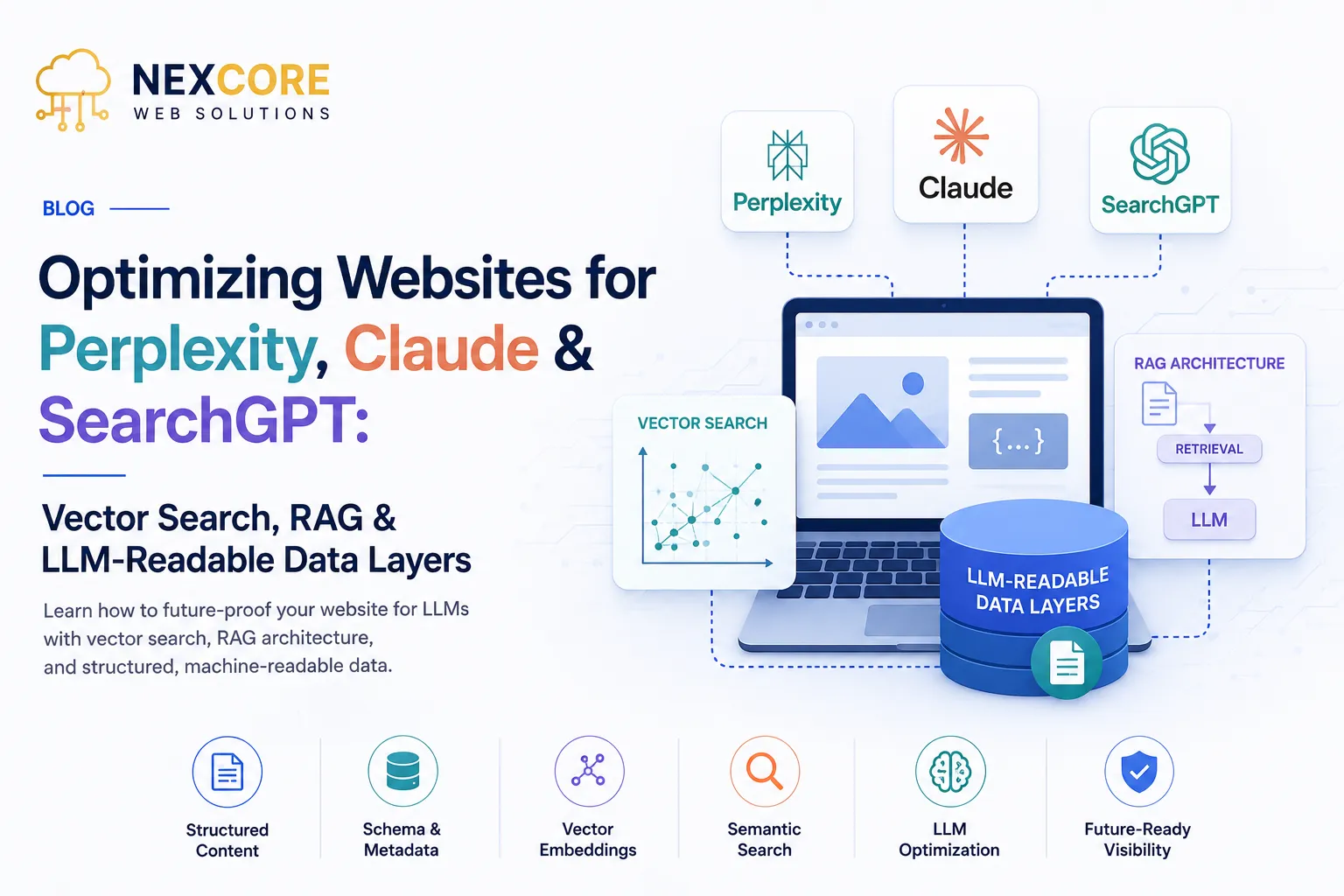
Search is changing rapidly as AI-powered assistants become a primary way people discover information online. Instead of scanning a list of blue links, users increasingly ask conversational questions and expect complete, trustworthy answers. Platforms such as Perplexity, Claude, and SearchGPT rely on large language models (LLMs) that understand context, retrieve relevant information, and generate natural responses. As a result, website optimization is evolving beyond traditional search engine optimization.
Modern websites must be structured not only for search engine crawlers but also for AI systems that interpret content differently. Concepts such as vector search, Retrieval-Augmented Generation (RAG), and LLM-readable data layers are becoming increasingly important. Businesses that adapt early will improve their chances of being referenced in AI-generated responses while maintaining strong visibility across traditional search engines.
Understanding AI-Powered Search
How AI Search Differs from Traditional Search
Traditional search engines primarily rank pages using keywords, backlinks, technical SEO, and user engagement signals. AI-powered search systems analyze meaning instead of simply matching keywords. They attempt to understand user intent, retrieve the most relevant information, and generate complete answers based on trusted sources. This shift rewards content that is clear, well-structured, and contextually rich rather than content created solely around keyword density.
Why Website Structure Matters More
Large language models process information differently from conventional crawlers. Instead of evaluating isolated keywords, they identify relationships between concepts, entities, and topics. Websites with logical heading structures, descriptive sections, and consistent terminology are easier for AI systems to interpret. A well-organized website also improves readability for human visitors, making structured content valuable for both audiences.
Understanding Vector Search
What Is Vector Search?
Vector search represents information as mathematical embeddings that capture semantic meaning instead of exact words. This allows AI systems to recognize that different phrases may express the same idea. For example, “improving website speed” and “optimizing page performance” can be understood as closely related concepts. This semantic understanding produces more accurate information retrieval than simple keyword matching.
Optimizing Content for Semantic Understanding
Content should naturally cover related topics instead of repeating identical keywords. Explaining concepts from multiple perspectives, using descriptive headings, and connecting related ideas helps AI models understand context more effectively. Comprehensive articles that answer common follow-up questions often perform better because they provide richer semantic relationships. Clear writing becomes increasingly valuable as AI search continues to evolve.
The Role of Retrieval-Augmented Generation
Understanding RAG
Retrieval-Augmented Generation, commonly called RAG, combines information retrieval with language generation. Rather than relying only on its existing knowledge, an AI system retrieves relevant information from trusted sources before generating a response. This approach improves factual accuracy and allows answers to reflect recent information. Websites containing authoritative, well-structured content have greater potential to become retrieval sources.
Creating RAG-Friendly Content
Content intended for AI retrieval should prioritize clarity and factual accuracy. Short explanatory sections, informative headings, concise definitions, and complete answers help retrieval systems identify relevant passages efficiently. Supporting claims with reliable evidence and maintaining consistent terminology also improve retrieval quality. Structured information reduces ambiguity and increases the likelihood that AI systems reference the correct content.
Building LLM-Readable Data Layers
Structured Data Beyond Traditional SEO
Schema markup remains valuable because it helps machines understand important information about articles, products, organizations, events, and FAQs. However, LLM-readable data extends beyond structured markup alone. Websites should maintain consistent entity relationships, descriptive metadata, clean HTML, and meaningful content hierarchies. Together, these elements help AI systems interpret information more accurately.
Content Organization
Large language models perform better when content follows predictable structures. Clear H1, H2, and H3 headings divide topics into logical sections while concise paragraphs improve readability. Tables, comparison sections, glossaries, and frequently asked questions provide additional context that retrieval systems can easily process. Organizing information consistently benefits both AI models and human readers.
Technical Foundations for AI Visibility
Crawlability and Accessibility
AI systems still depend on websites being accessible through standard web technologies. Important pages should remain crawlable, avoid unnecessary rendering barriers, and load efficiently across devices. XML sitemaps, internal linking, canonical tags, and proper indexing continue supporting discoverability. Strong technical foundations remain essential even as AI search evolves.
Entity-Based Optimization
Modern AI models increasingly recognize entities such as people, companies, products, technologies, and locations instead of isolated keywords. Clearly identifying these entities throughout content improves contextual understanding. Consistent naming, descriptive explanations, and relationships between related topics help establish topical authority. Entity optimization strengthens both traditional SEO and AI-driven discovery.
Keeping Content Current
AI systems increasingly favor accurate and up-to-date information when retrieving knowledge. Regularly reviewing articles, updating statistics, correcting outdated references, and expanding existing content helps maintain relevance. Fresh content also demonstrates ongoing expertise and increases confidence in the reliability of published information. Continuous maintenance supports long-term visibility.
Practical Best Practices
Write for Questions, Not Just Keywords
People naturally communicate with AI assistants using complete questions instead of fragmented search phrases. Creating content that answers these conversational queries improves usefulness while aligning with AI search behavior. Including clear explanations, examples, and practical guidance increases the likelihood that information will be selected during retrieval. Helpful content consistently outperforms keyword-focused writing.
Demonstrate Expertise and Trust
AI systems attempt to prioritize reliable information from trustworthy sources. Articles should clearly demonstrate expertise through accurate explanations, transparent authorship, supporting evidence, and consistent quality. Well-maintained author profiles, updated organizational information, and factual accuracy contribute to stronger credibility. Building trust remains one of the most effective long-term optimization strategies.
Conclusion
Optimizing websites for Perplexity, Claude, SearchGPT, and other AI-powered search platforms requires a broader perspective than traditional SEO alone. Semantic content, vector-friendly organization, Retrieval-Augmented Generation compatibility, and LLM-readable data layers all contribute to better discoverability within modern AI systems. At the same time, technical performance, structured data, accessibility, and authoritative content continue providing the foundation for long-term success. Businesses should focus on creating information that is easy for both humans and intelligent systems to understand rather than attempting to optimize for algorithms alone. As AI-powered search continues evolving, websites that prioritize clarity, expertise, and structured knowledge will remain well positioned for future visibility.
FAQs
1. What is vector search in website optimization?
Vector search is a semantic search technique that represents words and content as mathematical embeddings rather than exact keywords. This allows AI systems to understand meaning, context, and relationships between concepts. Optimizing content for vector search involves creating comprehensive, well-structured information that naturally covers related topics instead of repeating identical keywords.
2. What does Retrieval-Augmented Generation (RAG) mean?
Retrieval-Augmented Generation, or RAG, is an AI approach that retrieves relevant information from trusted sources before generating a response. Instead of relying entirely on previously learned knowledge, AI models combine retrieved information with language generation. Websites containing accurate, organized, and authoritative content have a greater chance of being selected during this retrieval process.
3. How can structured data help AI-powered search engines?
Structured data provides machine-readable information that helps AI systems understand page content more accurately. Schema markup identifies entities such as articles, products, organizations, FAQs, and authors, improving contextual understanding. Although structured data alone does not guarantee visibility, it strengthens the overall clarity and organization of website information.
4. Should I still focus on traditional SEO if AI search is growing?
Yes. Traditional SEO remains essential because technical performance, crawlability, mobile responsiveness, page speed, quality content, and internal linking continue supporting both conventional search engines and AI-powered platforms. Modern optimization should combine established SEO best practices with semantic organization and AI-friendly content structures rather than replacing one approach with another.
5. What is an LLM-readable data layer?
An LLM-readable data layer refers to website content and technical structures that large language models can easily interpret. This includes clean HTML, logical headings, structured metadata, schema markup, consistent entity relationships, and clearly organized information. These elements help AI systems retrieve accurate content while improving the overall user experience.




