
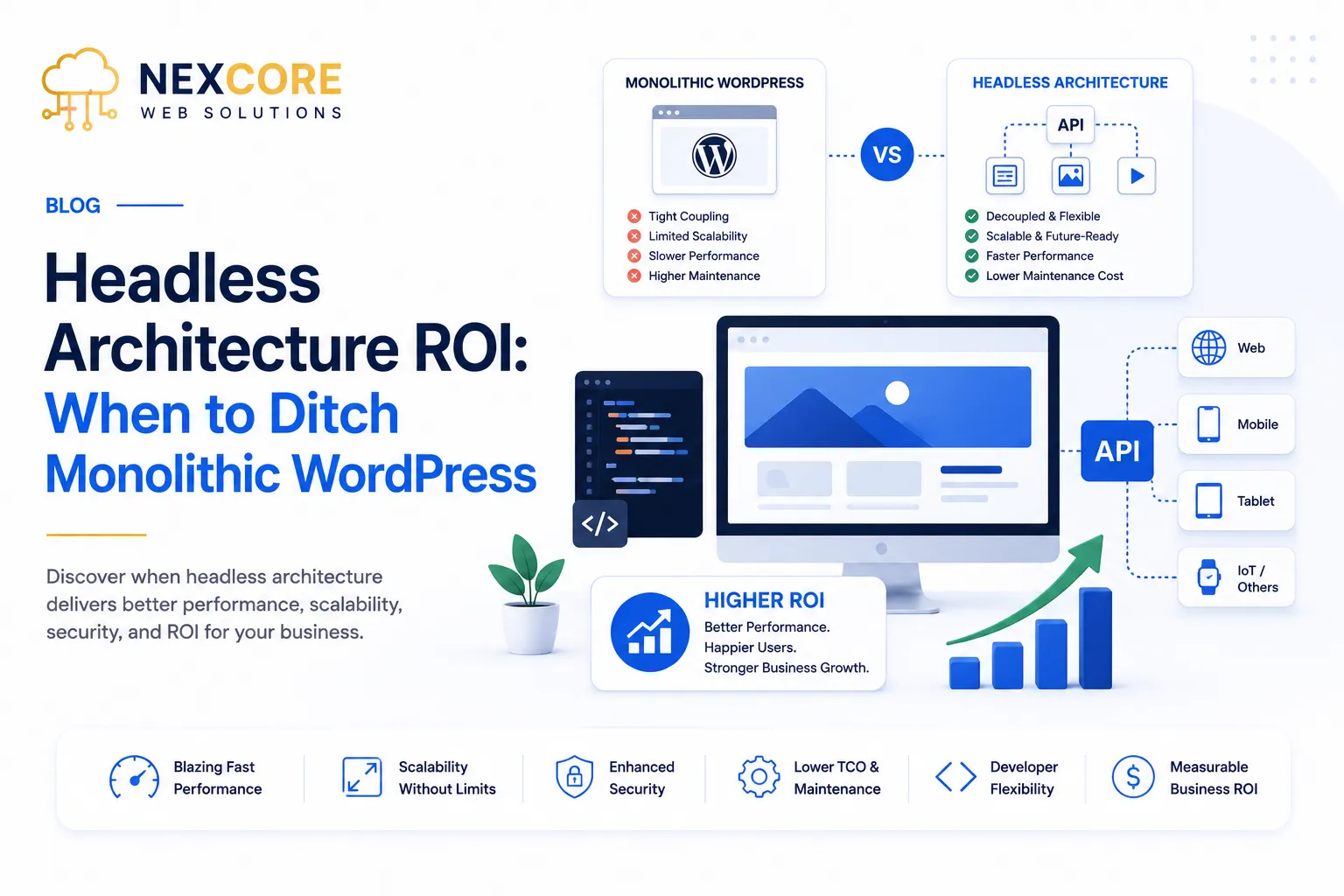
WordPress has powered millions of websites for nearly two decades, making it one of the most trusted content management systems available. For many businesses, its traditional monolithic architecture continues to provide everything needed to manage content and publish websites efficiently. However, modern digital experiences often require faster performance, omnichannel content delivery, greater scalability, and seamless integration with external platforms. These evolving requirements have encouraged many organizations to explore headless architecture as an alternative. While the concept promises flexibility and improved user experiences, migrating from a monolithic WordPress setup is not always the right business decision. Understanding the return on investment (ROI) of headless architecture helps organizations determine whether the benefits justify the additional complexity, development effort, and long-term maintenance costs.
Understanding Monolithic and Headless WordPress
What Is Monolithic WordPress?
Traditional WordPress follows a monolithic architecture where the content management system, database, backend, and frontend presentation layer operate together within a single application. Editors create content, and WordPress immediately renders it using themes and plugins. This approach simplifies website management because everything is available in one place. For most blogs, company websites, and small eCommerce stores, a monolithic setup remains reliable, affordable, and easy to maintain.
What Is Headless Architecture?
Headless WordPress separates the content management backend from the frontend user interface. WordPress continues managing content, while technologies such as React, Next.js, Vue, or mobile applications retrieve that content through APIs. This separation allows developers to create highly customized user experiences across websites, mobile apps, digital kiosks, and other connected platforms. The result is greater flexibility but also increased architectural complexity.
Evaluating the ROI of Headless Architecture
Performance Improvements
One of the strongest arguments for adopting headless architecture is improved website performance. Modern frontend frameworks generate optimized pages, reduce unnecessary server processing, and improve loading speeds. Faster websites contribute to better user experiences, higher conversion rates, and improved search visibility. Businesses with high traffic volumes often recover development costs through increased customer engagement and lower bounce rates.
Scalability for Growing Businesses
As businesses expand, digital platforms frequently require new features, integrations, and increased traffic capacity. Headless architecture allows frontend and backend systems to scale independently according to demand. Development teams can introduce new interfaces or services without rebuilding the content management system. This flexibility becomes particularly valuable for enterprises managing multiple digital channels simultaneously.
Better Omnichannel Content Delivery
Modern customers consume content through websites, mobile applications, smart devices, and other digital platforms. A headless content management system enables organizations to publish content once and distribute it across multiple channels using APIs. Marketing teams avoid duplicate content management while maintaining consistency across customer touchpoints. This efficiency improves operational productivity and simplifies future digital expansion.
When Monolithic WordPress Is Still the Better Choice
Small Business Websites
Not every website benefits from headless architecture. Small businesses with informational websites, local service pages, or basic online stores often gain little value from separating the frontend and backend. Traditional WordPress provides sufficient performance, extensive plugin support, and lower maintenance costs. Investing in better hosting and technical optimization usually delivers stronger returns than a complete architectural migration.
Limited Development Resources
Headless architecture requires experienced frontend developers, API specialists, and infrastructure management skills. Organizations without dedicated technical teams may struggle to maintain these environments efficiently. Even routine updates can become more complicated because multiple systems require ongoing monitoring. For businesses with limited budgets, monolithic WordPress often remains the more practical and cost-effective solution.
Signs It May Be Time to Switch
Complex Digital Ecosystems
Businesses operating multiple websites, mobile applications, customer portals, and digital products often reach a point where traditional WordPress becomes difficult to manage. A headless architecture simplifies content distribution while allowing each platform to deliver optimized user experiences. Organizations serving international audiences across multiple channels often achieve greater operational efficiency after adopting this approach.
High Performance Expectations
Industries where speed directly affects revenue should carefully evaluate headless solutions. Online retailers, SaaS providers, publishers, and media organizations frequently compete on user experience and website performance. Faster loading pages improve customer satisfaction while supporting higher conversion rates and stronger engagement. In these situations, the long-term ROI may justify the higher implementation costs.
Challenges That Affect ROI
Increased Development Costs
Although headless architecture offers flexibility, the initial investment is significantly higher than traditional WordPress development. Separate frontend applications, API integrations, deployment pipelines, and testing environments require additional expertise and longer development timelines. Organizations should calculate both implementation expenses and ongoing maintenance costs before making architectural decisions. A technically advanced solution does not automatically produce better financial returns.
Plugin Compatibility
Many WordPress plugins assume that WordPress controls the frontend presentation layer. In a headless environment, some plugins lose functionality or require custom API integrations to operate correctly. Businesses depending heavily on specialized plugins should evaluate compatibility before migrating. Unexpected redevelopment work can reduce the expected return on investment if not identified during planning.
Making the Right Decision
Choosing between monolithic WordPress and headless architecture should always begin with business objectives rather than technology trends. Organizations should evaluate expected traffic, digital channels, development resources, content workflows, and future growth plans. A clear understanding of measurable outcomes such as improved performance, operational efficiency, or increased conversions helps justify the investment. The most successful migrations occur when technical architecture directly supports long-term business strategy instead of following industry buzzwords.
Conclusion
Headless architecture offers significant advantages for organizations requiring exceptional performance, omnichannel content delivery, scalable infrastructure, and flexible frontend development. However, these benefits come with increased development complexity, higher implementation costs, and greater technical maintenance requirements. Monolithic WordPress continues to serve many businesses effectively, particularly those with straightforward content management needs and limited technical resources. Rather than assuming that newer architecture is automatically superior, businesses should carefully assess their goals, available expertise, and expected return on investment. A thoughtful evaluation ensures that technology decisions support measurable business outcomes instead of creating unnecessary complexity. Choosing the right architecture is ultimately about selecting the solution that delivers lasting value while supporting future growth.
FAQs
1. What is the main difference between headless and monolithic WordPress?
Monolithic WordPress combines content management and frontend presentation within a single application, while headless WordPress separates these components. Content is managed in WordPress but delivered through APIs to custom frontend applications built with modern frameworks. This separation increases flexibility but also introduces greater development complexity and maintenance requirements.
2. Is headless WordPress better for SEO?
Headless WordPress can support excellent SEO when implemented correctly. Modern frontend frameworks improve page speed, Core Web Vitals, and user experience, all of which contribute to search performance. However, developers must carefully manage metadata, structured data, server-side rendering, and crawlability to ensure search engines can efficiently index the website.
3. When should a business migrate to headless architecture?
A business should consider headless architecture when managing multiple digital platforms, requiring high website performance, delivering content across various channels, or needing advanced frontend customization. Organizations should evaluate expected business benefits, available technical expertise, and long-term maintenance costs before deciding to migrate from traditional WordPress.
4. Does headless WordPress cost more than traditional WordPress?
Yes. Headless WordPress generally requires higher upfront development costs because separate frontend applications, API integrations, testing environments, and deployment processes must be built and maintained. While larger organizations may recover these costs through improved performance and operational efficiency, smaller businesses may achieve better ROI with a traditional WordPress setup.
5. Can existing WordPress plugins work with a headless website?
Some WordPress plugins continue functioning normally because they operate within the backend, but many frontend-dependent plugins require custom development or API integrations. Before migrating to a headless architecture, businesses should carefully review plugin compatibility to identify features that may require redevelopment or alternative technical solutions.




