
Scalability is one of the most important design goals for any Software as a Service (SaaS) application. As the number of customers grows, the application must continue delivering reliable performance without compromising security, availability, or data integrity. One of the biggest architectural decisions that influences long-term scalability is the database isolation model used in a multi-tenant environment. Selecting the wrong approach can increase operational costs, complicate maintenance, and create performance bottlenecks as customer demand increases. On the other hand, a well-planned database strategy enables efficient resource utilization while supporting business growth. Understanding the strengths, limitations, and practical use cases of different multi-tenant database isolation models helps software architects and development teams build SaaS platforms that remain secure, scalable, and cost-effective throughout their lifecycle.
Understanding Multi-Tenant Architecture
What Is Multi-Tenancy?
Multi-tenancy is a software architecture in which multiple customers, known as tenants, share a single application while keeping their data isolated from one another. Every tenant interacts with the same software instance, but each organization only accesses its own information. This approach reduces infrastructure costs and simplifies software maintenance because updates are deployed centrally. Multi-tenancy has become the standard architecture for many modern SaaS products.
Why Database Isolation Matters
Although tenants share the same application, protecting customer data remains a top priority. Database isolation determines how information is stored and separated between organizations. A carefully designed isolation strategy improves security, simplifies compliance, and minimizes the impact of performance issues caused by high-traffic tenants. Choosing the right model depends on business requirements, expected growth, and operational complexity.
Common Database Isolation Models
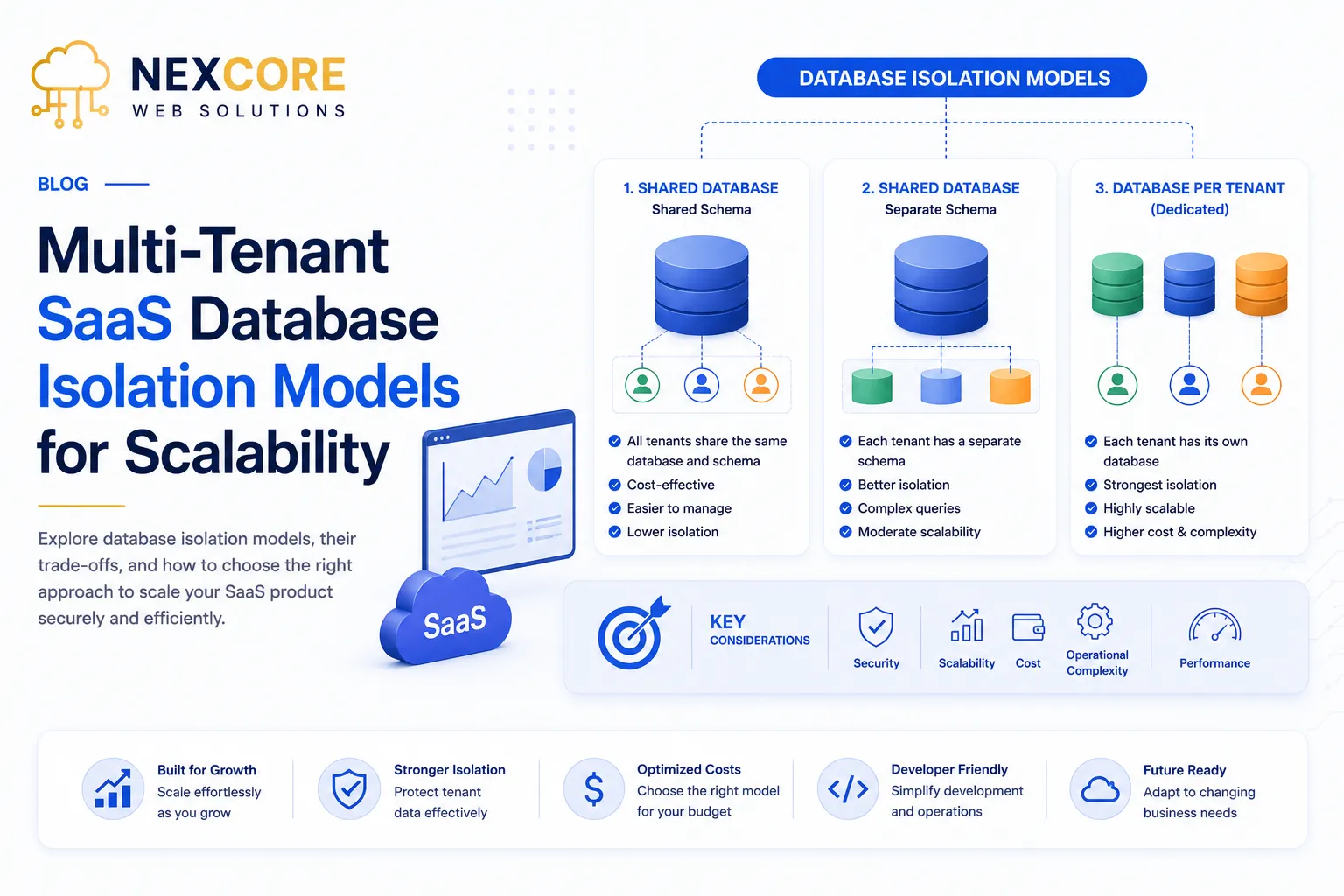
Shared Database, Shared Schema
In this model, every tenant stores data within the same database and shares the same tables. Tenant identification is managed through a unique tenant identifier in each record. This approach offers the lowest infrastructure cost because resources are shared efficiently across all customers. It is commonly used by SaaS startups that prioritize rapid growth and cost efficiency during the early stages of development.
However, maintaining strict data isolation becomes more challenging as the customer base expands. Queries must always filter data correctly to prevent accidental exposure between tenants. Performance optimization also becomes increasingly important because large tenants can influence overall database performance. Careful indexing and application-level security controls are essential for maintaining reliability.
Shared Database, Separate Schemas
This model uses a single database while assigning each tenant its own schema. Although database resources remain shared, tables and objects are logically separated. This approach provides stronger isolation than a shared schema while keeping infrastructure costs relatively manageable. Development teams also gain greater flexibility when applying tenant-specific customizations.
Managing numerous schemas introduces additional administrative responsibilities as the platform grows. Database migrations, backups, and monitoring become more complex when hundreds or thousands of schemas exist within a single database. Even so, this model often represents a balanced solution for medium-sized SaaS platforms that require improved isolation without maintaining separate databases.
Separate Database Per Tenant
Each customer receives an independent database dedicated exclusively to their organization. This model delivers the highest level of isolation because data, backups, permissions, and performance are completely separated. It also simplifies compliance with strict regulatory requirements where customers expect complete data segregation. Enterprise SaaS providers frequently adopt this approach for high-value clients.
The primary trade-off involves increased infrastructure costs and operational complexity. Provisioning, monitoring, upgrades, and backups must be managed individually for every tenant database. Automation becomes essential to prevent administrative workloads from growing alongside customer acquisition. Despite these challenges, many organizations consider the stronger security and flexibility worthwhile.
Comparing Scalability Considerations
Resource Utilization
Shared database models maximize hardware efficiency because computing resources are distributed among multiple tenants. This allows providers to serve large customer bases with lower infrastructure investments. Separate databases consume additional storage and computing resources, particularly when many tenants generate relatively small workloads. Businesses must carefully balance operational costs with customer expectations and security requirements.
Performance Isolation
Performance isolation becomes increasingly important as SaaS platforms expand. In shared environments, resource-intensive queries from one tenant may affect other customers if database optimization is insufficient. Separate databases significantly reduce this risk because workloads remain isolated. Organizations serving enterprise customers with demanding workloads often prioritize predictable performance over infrastructure savings.
Security and Compliance
Industries handling financial records, healthcare information, or sensitive enterprise data frequently require stronger isolation controls. Separate databases simplify compliance audits because customer data remains physically separated. Shared models can still achieve strong security through encryption, access controls, and application-level safeguards, but they require greater attention to implementation details. Regulatory obligations often influence architectural decisions more than technical preferences.
Choosing the Right Model
Startup and Small SaaS Platforms
Early-stage SaaS businesses generally prioritize speed, affordability, and efficient resource usage. Shared database models enable rapid product development while minimizing infrastructure expenses. As customer numbers remain relatively small, careful application design can provide sufficient isolation without introducing unnecessary complexity. This approach allows startups to validate products before investing in larger infrastructure.
Growing and Enterprise SaaS Applications
As customer demands become more diverse, scalability requirements evolve accordingly. Enterprise customers may request dedicated databases for compliance, performance guarantees, or contractual obligations. Many mature SaaS platforms adopt hybrid architectures that combine multiple isolation strategies based on customer needs. Smaller customers share infrastructure, while enterprise clients receive dedicated database resources for greater flexibility and security.
Best Practices for Long-Term Scalability
Regardless of the selected isolation model, automation plays a critical role in maintaining operational efficiency. Automated provisioning, database migrations, monitoring, backups, and disaster recovery processes reduce manual intervention while supporting rapid customer growth. Continuous performance monitoring helps identify bottlenecks before they affect users. Designing the architecture with future expansion in mind allows businesses to adapt without disruptive migrations later.
Conclusion
Selecting the appropriate multi-tenant SaaS database isolation model is a strategic decision that directly influences scalability, security, operational efficiency, and long-term costs. Shared database models offer excellent resource utilization and affordability, making them attractive for startups and rapidly growing businesses. Separate schemas provide stronger logical isolation while maintaining manageable infrastructure costs, whereas dedicated databases deliver maximum security and predictable performance for enterprise environments. No single model is universally superior because every SaaS application serves different business objectives and customer expectations. Organizations should evaluate compliance requirements, projected growth, operational capabilities, and performance goals before choosing an architecture. A carefully planned database isolation strategy creates a solid technical foundation that supports sustainable business growth while delivering reliable experiences for every customer.
FAQs
1. What is a multi-tenant SaaS database?
A multi-tenant SaaS database is a database architecture where multiple customers use the same application while keeping their data isolated from one another. Depending on the isolation model, tenants may share databases, schemas, or tables, or receive dedicated databases. The chosen architecture affects scalability, security, maintenance, and infrastructure costs.
2. Which database isolation model is best for startups?
Startups often benefit from a shared database with a shared schema because it minimizes infrastructure expenses and simplifies deployment. This model supports rapid growth while keeping operational costs low. As the business expands and customer requirements become more complex, the architecture can gradually evolve toward stronger isolation models if needed.
3. Why do enterprise SaaS companies use separate databases?
Enterprise customers frequently require dedicated databases to satisfy compliance regulations, security policies, and performance guarantees. Separate databases reduce the possibility of resource contention between tenants while simplifying backup management and regulatory audits. Although this approach increases operational costs, it provides greater flexibility and stronger customer confidence.
4. Can a SaaS application switch isolation models later?
Yes. Many SaaS platforms begin with shared database architectures and gradually migrate selected customers to dedicated schemas or databases as they grow. However, migration requires careful planning, automated data transfer, thorough testing, and minimal service disruption. Designing for future migration during the initial development phase significantly simplifies this process.
5. How does database isolation affect application scalability?
Database isolation directly influences resource utilization, maintenance complexity, performance consistency, and operational costs. Shared environments maximize efficiency but require careful optimization to prevent tenant interference. More isolated models improve security and predictable performance while increasing infrastructure requirements. Selecting the right balance helps SaaS applications scale efficiently as customer demand grows.




