
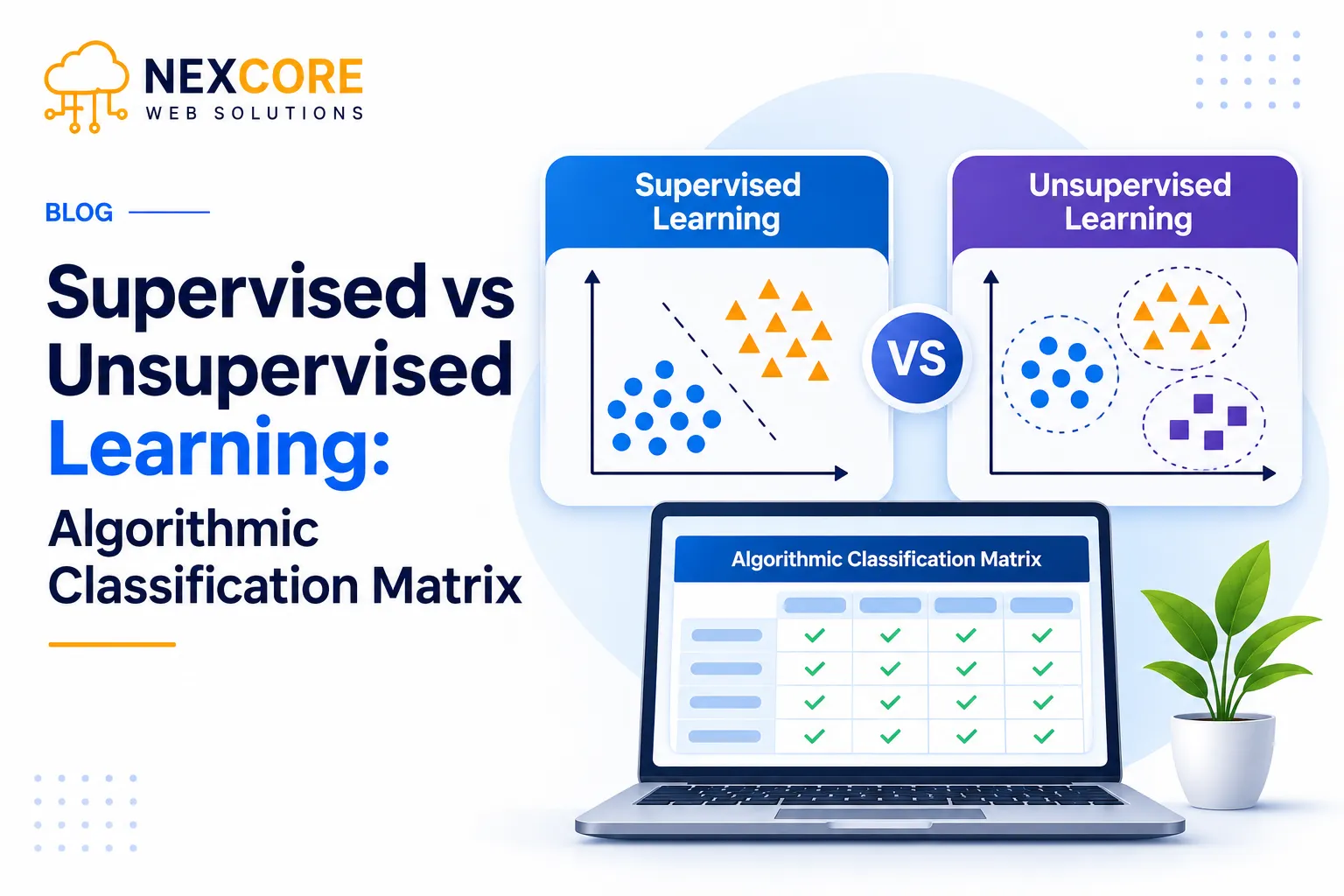
Machine learning helps computers identify patterns, make predictions, and support decisions using data. Two of its most important approaches are supervised learning and unsupervised learning. Although both rely on algorithms and data, they solve fundamentally different problems. Supervised learning works with labeled examples to predict known outcomes, while unsupervised learning explores unlabeled data to discover hidden structures. Understanding the difference is essential for developers, students, and businesses because selecting the wrong approach can lead to poor results and unnecessary complexity. This article explains how these learning methods work, compares their algorithms, and shows where each approach delivers the most value.
Understanding Supervised Learning
Supervised learning trains a model using data that already contains correct answers or labels. Each training example includes input features and a target output, allowing the algorithm to learn the relationship between them. For example, an email filtering system can learn from messages labeled as spam or legitimate. Once trained, the model can classify new emails based on patterns found in the historical data.
Supervised learning generally handles two major problem types: classification and regression. Classification predicts categories, such as whether a transaction is fraudulent or genuine. Regression predicts continuous numerical values, such as house prices or future sales. The quality of labeled data plays a major role because inaccurate labels can teach the model incorrect patterns.
Understanding Unsupervised Learning
Unsupervised learning works without predefined labels or target answers. Instead of being told what the correct output should be, the algorithm examines the data and searches for meaningful patterns, similarities, or unusual observations. A retailer, for example, may use customer purchase data to identify groups with similar buying behavior. These discovered groups can later support marketing or product decisions.
The most common unsupervised learning tasks are clustering, dimensionality reduction, and anomaly detection. Clustering separates similar records into groups without knowing those groups in advance. Dimensionality reduction simplifies complex datasets while preserving important information. Anomaly detection identifies observations that differ significantly from normal patterns, which can be useful in cybersecurity and operational monitoring.
Algorithmic Classification Matrix
The following comparison provides a practical view of how supervised and unsupervised learning approaches differ.
| Feature | Supervised Learning | Unsupervised Learning |
|---|---|---|
| Training data | Labeled data | Unlabeled data |
| Primary objective | Predict known outcomes | Discover hidden patterns |
| Common tasks | Classification and regression | Clustering and pattern discovery |
| Example algorithms | Decision trees, SVM, linear regression | K-means, DBSCAN, PCA |
| Evaluation | Accuracy, precision, recall, error | Cluster quality and business relevance |
| Data preparation | Requires reliable labels | Requires clean, meaningful features |
This matrix highlights that the choice is not simply about which method is more advanced. The correct approach depends on the available data and the problem being solved. A business with thousands of labeled customer support tickets may benefit from supervised classification. Another organization with large amounts of unexplored customer data may begin with unsupervised clustering to understand what patterns exist.
Common Supervised Learning Algorithms
Regression Algorithms
Linear regression is one of the simplest supervised algorithms and predicts a continuous value based on one or more input variables. It can be used to estimate property prices, energy consumption, or sales revenue. More complex regression methods can model non-linear relationships when simple straight-line predictions are insufficient. The main goal remains the same: learn from known input-output pairs and make reliable predictions for new data.
Classification Algorithms
Decision trees, logistic regression, support vector machines, and neural networks are widely used for classification. Each algorithm has different strengths regarding interpretability, speed, and ability to handle complex patterns. A decision tree can be easier to explain to business users, while a neural network may perform better on highly complex data. Developers should compare models using appropriate validation data rather than choosing an algorithm based only on popularity.
Common Unsupervised Learning Algorithms
Clustering Methods
K-means is a popular clustering algorithm that divides data into a predefined number of groups. It works well when clusters are reasonably separated and the approximate number of groups is already known. DBSCAN takes a different approach by identifying dense regions and can detect irregularly shaped clusters. This makes it useful when real-world data does not fit clean, circular patterns.
Dimensionality Reduction
High-dimensional datasets can be difficult to visualize, process, and understand. Principal Component Analysis, commonly called PCA, reduces the number of variables while retaining much of the dataset’s useful variation. This can improve computational efficiency and help analysts identify broad trends. Dimensionality reduction is often used before visualization or as part of a larger machine learning workflow.
Choosing the Right Learning Approach
The first question to ask is whether reliable labels are available. If a dataset contains verified outcomes and the goal is to predict those outcomes, supervised learning is usually the natural choice. For example, a bank with historical loan applications and repayment results can train a model to estimate future risk. However, labels alone are not enough; they must be accurate, representative, and relevant to the problem.
Unsupervised learning becomes valuable when the organization does not yet know what patterns exist in its data. A cybersecurity team may analyze network activity to identify unusual behavior without having labels for every possible attack. Similarly, a streaming platform may group users according to viewing habits before designing personalized recommendations. In these cases, the algorithm helps create understanding before a predictive model is built.
Evaluation and Real-World Challenges
Supervised models are generally easier to measure because their predictions can be compared with known answers. Metrics such as accuracy, precision, recall, F1-score, and mean squared error provide objective ways to evaluate performance. However, a high score does not always guarantee real-world success. Data drift, biased training samples, and changing user behavior can reduce performance after deployment.
Unsupervised learning presents a different evaluation challenge because there may be no single correct answer. Analysts often combine mathematical measures with domain knowledge to determine whether discovered clusters are meaningful. A technically strong cluster may still have little business value if its members do not share useful characteristics. Human interpretation therefore remains an important part of many unsupervised learning projects.
Can Supervised and Unsupervised Learning Work Together?
These approaches are often combined rather than treated as competitors. An organization might first use clustering to discover customer segments and then label those segments for future classification. Unsupervised methods can also help detect patterns, reduce dimensions, or identify unusual records before supervised training begins. This combination can improve data understanding and make complex machine learning workflows more efficient.
Modern machine learning systems increasingly use multiple techniques across different stages of a pipeline. The key is to understand what each algorithm contributes instead of forcing every problem into a single method. Data exploration can reveal issues that would otherwise damage a predictive model. Likewise, supervised validation can turn useful discoveries into repeatable automated decisions.
Conclusion
Supervised and unsupervised learning serve different but equally important roles in machine learning. Supervised learning is best suited to situations where reliable labeled data exists and a clear prediction is required. Unsupervised learning helps organizations explore unfamiliar data, identify hidden groups, and discover patterns without predefined answers. The most effective choice depends on the business objective, data quality, and available expertise. Rather than viewing the two approaches as alternatives, teams should consider how they can work together. A clear understanding of the algorithmic classification matrix makes it easier to build machine learning systems that are accurate, useful, and practical.
FAQs
What is the main difference between supervised and unsupervised learning?
The main difference is the type of training data used by each approach. Supervised learning requires labeled data containing known input-output relationships, allowing the model to make predictions. Unsupervised learning works with unlabeled data and searches for hidden patterns or groups. The right method depends on whether a known outcome exists and what the organization wants to discover.
Which algorithms are commonly used in supervised learning?
Common supervised learning algorithms include linear regression, logistic regression, decision trees, random forests, support vector machines, and neural networks. The best algorithm depends on the problem, dataset size, feature complexity, and need for interpretability. Classification algorithms predict categories, while regression algorithms predict numerical values. Testing multiple approaches with proper validation usually produces a more reliable selection.
What is clustering in unsupervised learning?
Clustering is the process of grouping similar data points without using predefined labels. Algorithms examine features and identify observations that share important characteristics or patterns. For example, a company can cluster customers according to purchasing behavior, spending patterns, or product preferences. The resulting groups can support marketing, product development, and deeper analysis of customer behavior.
Is supervised learning always more accurate than unsupervised learning?
The two approaches cannot be compared using accuracy alone because they solve different types of problems. Supervised learning can measure predictions against known answers, while unsupervised learning focuses on discovering meaningful structures. A supervised model may perform poorly if its labels or training data are unreliable. An unsupervised model can provide valuable insights even without a traditional accuracy score.
Can a machine learning project use both approaches?
Yes, many practical machine learning projects combine supervised and unsupervised techniques. A team may first use clustering to explore a large dataset and discover meaningful segments or unusual patterns. Those insights can later support feature engineering or supervised model development. Combining both approaches can improve data understanding and create more effective machine learning systems for complex real-world problems.




