
A Binary Search Tree (BST) is one of the most useful data structures for organizing and searching ordered data. It stores values in a hierarchical structure where each node can have a left and right child. The defining rule is simple: values smaller than a node are placed on its left, while larger values are placed on its right. This arrangement makes common operations such as searching, inserting, and deleting more efficient than working with an unsorted list. Understanding BST operations is important for students, programmers, and developers because tree-based structures appear in databases, file systems, indexing systems, and many software applications.
Understanding the Structure of a Binary Search Tree
A BST consists of nodes connected through parent-child relationships. Each node stores a value and references to its left and right children. The left subtree contains values smaller than the current node, while the right subtree contains values greater than it. This ordering rule applies recursively to every node in the tree.
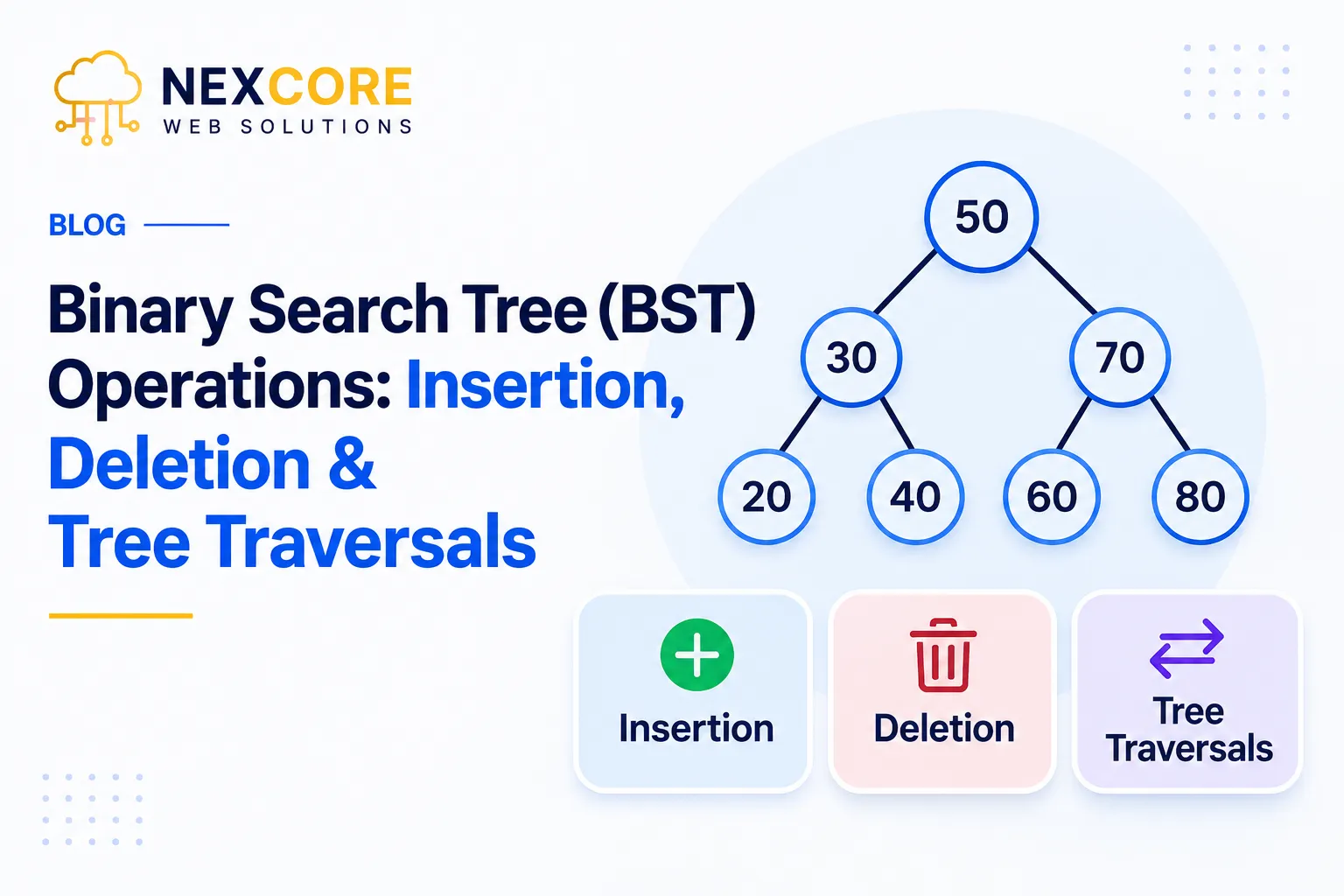
For example, consider a tree with 50 as its root. Values such as 30 and 20 belong somewhere in the left subtree, while values such as 70 and 80 belong in the right subtree. Because the data remains ordered, a program can eliminate large portions of the tree during a search. The efficiency of a BST depends heavily on how balanced its structure remains.
How BST Insertion Works
Insertion begins by comparing a new value with the root node. If the new value is smaller, the algorithm moves to the left child; if it is larger, it moves to the right child. This comparison process continues until the algorithm finds an empty position. The new value is then added as a leaf node.
Suppose a BST already contains 50, 30, and 70, and you want to insert 40. The algorithm first compares 40 with 50 and moves left because 40 is smaller. It then compares 40 with 30 and moves right because 40 is larger. If that position is empty, 40 becomes the right child of 30.
Handling Duplicate Values
A standard BST usually assumes that each value is unique. However, real applications may need to store duplicate values, so developers must define a consistent rule. One approach places duplicate values in the right subtree, while another stores a count inside the existing node. The chosen strategy should remain consistent throughout insertion, searching, and deletion operations.
Duplicate handling becomes especially important when a BST represents real-world records rather than simple numbers. For example, multiple products might share the same price, or several records may have an identical priority level. In such cases, storing additional information within nodes can be more practical than creating multiple identical nodes. The design should reflect how the application plans to search and manage repeated data.
Deleting Nodes from a Binary Search Tree
Deletion is more complex than insertion because removing a node can disrupt the tree’s ordering. The deletion process depends on whether the target node has no children, one child, or two children. Each situation requires a different approach to preserve the BST property. Understanding these three cases is essential when implementing a reliable tree.
Deleting a Leaf Node
A leaf node has no children, making it the simplest node to remove. The program can disconnect the node directly from its parent without changing any other part of the tree. For example, if 20 is a leaf node, deleting it simply removes that reference. The remaining nodes continue to satisfy the BST ordering rules.
This case is straightforward because no subtree needs to be moved or reorganized. However, the program must still correctly update the parent’s left or right reference. If the deleted node is the root and the tree contains only one node, the tree becomes empty. Proper handling of these edge cases prevents broken references and unexpected behavior.
Deleting a Node with One or Two Children
When a node has one child, its child can take its place. The parent of the deleted node connects directly to that child, preserving the structure and ordering. For example, if a node has only a right child, removing the node means linking its parent to that right child. This operation avoids losing the entire subtree.
A node with two children requires a replacement value, usually the inorder successor or inorder predecessor. The successor is the smallest value in the right subtree, while the predecessor is the largest value in the left subtree. After copying the replacement value, the algorithm removes the original successor or predecessor node. This method maintains the BST property without rebuilding the complete tree.
Understanding Tree Traversals
Tree traversal means visiting every node in a specific order. Different traversal methods serve different purposes, including sorting, copying tree structures, and processing hierarchical information. The three most common depth-first traversal methods are inorder, preorder, and postorder. Each method follows a different sequence when visiting the root and its subtrees.
Inorder, Preorder, and Postorder Traversal
Inorder traversal visits the left subtree, then the root, and finally the right subtree. In a valid BST, this process produces values in ascending order, making it useful for retrieving sorted data. Preorder traversal visits the root before its left and right subtrees. It can help recreate a tree structure or process parent nodes before their children.
Postorder traversal visits both subtrees before processing the root. This approach is useful when child nodes must be handled before their parent, such as deleting an entire tree safely. Another important method is level-order traversal, which visits nodes level by level. It is commonly implemented using a queue and provides a clear view of the tree’s hierarchical structure.
Performance and the Importance of Tree Balance
The performance of BST operations depends on the height of the tree. In a balanced tree, searching, insertion, and deletion generally take approximately O(log n) time because each comparison eliminates a large portion of the remaining nodes. This makes a BST efficient for managing large collections of ordered data. However, the best performance depends on maintaining a reasonably balanced structure.
A poorly balanced BST can resemble a linked list, especially when values are inserted in sorted order. In that situation, operations may degrade to O(n) time because the algorithm must examine nodes one by one. Self-balancing trees such as AVL trees and Red-Black trees address this problem by automatically controlling tree height. Choosing the right tree structure depends on the application’s data patterns and performance requirements.
Conclusion
Binary Search Trees provide a practical foundation for understanding hierarchical data and efficient searching. Their ordering rule makes insertion and search operations straightforward, while deletion demonstrates the importance of maintaining structural relationships. Tree traversals offer several ways to process stored data, with inorder traversal being particularly useful for producing sorted results. Although a basic BST can become inefficient when unbalanced, balanced tree implementations solve many of these performance concerns.
For developers, the key is to understand both the algorithm and the data being stored. A BST works best when fast ordered access is required and the tree can remain reasonably balanced. Practicing insertion, deletion, and traversal with sample trees builds a strong understanding of pointers and recursive algorithms. These fundamentals also make advanced data structures easier to learn and implement.
Frequently Asked Questions
What is the main rule of a Binary Search Tree?
The main rule of a Binary Search Tree is that values smaller than a node are stored in its left subtree, while larger values are stored in its right subtree. This rule applies to every node in the tree, creating an ordered structure. The arrangement allows search operations to eliminate unnecessary branches and locate values more efficiently than an unsorted collection.
What are the three cases for deleting a BST node?
The three deletion cases depend on the number of children the target node has. A leaf node can be removed directly, while a node with one child is replaced by that child. When a node has two children, developers typically replace its value with its inorder successor or predecessor before removing the replacement node from its original position.
Why does inorder traversal return sorted values?
Inorder traversal processes the left subtree first, then the current node, followed by the right subtree. Because a Binary Search Tree stores smaller values on the left and larger values on the right, this sequence naturally visits values from smallest to largest. This makes inorder traversal particularly useful when an application needs to retrieve data in sorted order.
What is the time complexity of BST operations?
In a balanced Binary Search Tree, searching, inserting, and deleting values typically take O(log n) time. Each comparison allows the algorithm to move toward one branch and ignore much of the remaining tree. However, if the tree becomes heavily unbalanced, its height can approach the number of nodes, causing these operations to degrade to O(n) time.
How can a BST avoid becoming unbalanced?
A standard BST does not automatically prevent an uneven structure, particularly when data arrives in sorted order. Self-balancing trees, such as AVL trees and Red-Black trees, use rotation and balancing rules to control tree height. These structures add implementation complexity but help maintain predictable O(log n) performance for common operations as the amount of stored data grows.




