
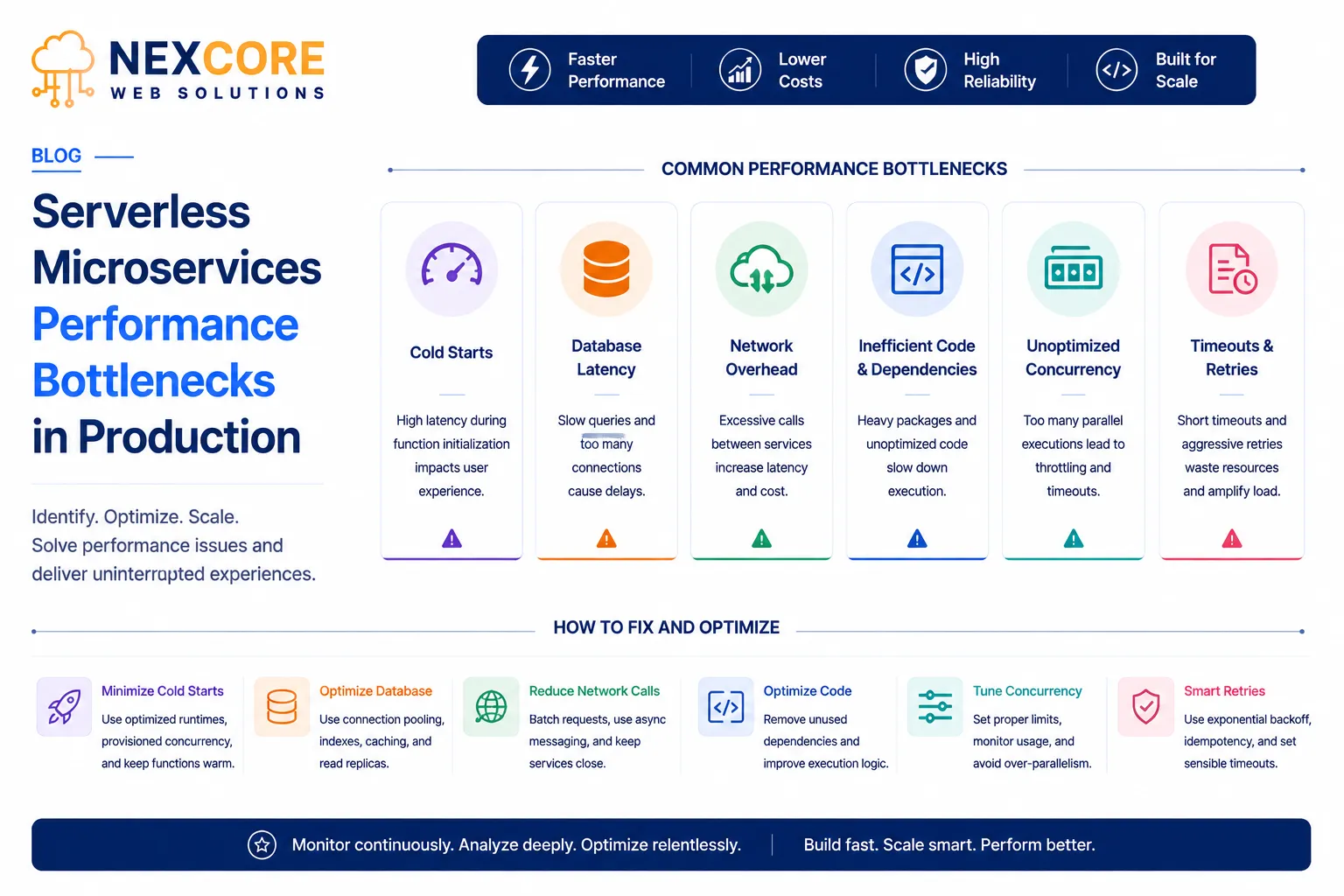
Serverless microservices can help organizations build applications that scale automatically without requiring teams to manage traditional server infrastructure. Functions can respond to events, APIs, queues, and scheduled tasks while cloud platforms handle much of the underlying infrastructure. However, production workloads often expose performance problems that are difficult to notice during development. Cold starts, excessive network calls, inefficient database access, concurrency limits, and poorly designed service dependencies can introduce unexpected latency. These bottlenecks become particularly important for applications serving large numbers of users or processing business-critical transactions. Understanding where serverless microservices lose performance allows engineering teams to design more efficient architectures, improve response times, control cloud costs, and deliver reliable experiences under real-world traffic conditions.
Understanding Serverless Performance
Why Production Behaves Differently
Development environments rarely reproduce the traffic patterns, concurrency, payload sizes, and service dependencies found in production. A function that responds quickly during testing may behave differently when thousands of requests arrive simultaneously. Production workloads also introduce network variability, database contention, retries, and resource limits. Performance testing must therefore reflect realistic operating conditions.
Measuring the Right Metrics
Effective optimization begins with observability. Teams should monitor function duration, cold-start frequency, invocation rates, memory usage, error rates, queue delays, database latency, and downstream service response times. Looking only at average response time can hide serious problems because slow requests may affect a smaller but important percentage of users. Percentile metrics such as p95 and p99 provide a clearer picture of real production behavior.
Cold Starts and Execution Latency
Understanding Cold Starts
A cold start occurs when a serverless platform creates a new execution environment before running a function. Runtime initialization, dependency loading, configuration processing, and application startup can add noticeable latency to requests. The impact is particularly significant for user-facing APIs where every additional millisecond affects perceived responsiveness. Lightweight functions and optimized dependencies can reduce initialization overhead.
Reducing Initialization Work
Developers should keep deployment packages small and avoid loading unnecessary libraries during startup. Heavy frameworks, large dependency trees, and expensive initialization routines increase cold-start duration. Moving nonessential work outside the critical request path can also improve responsiveness. Keeping functions focused makes performance easier to predict and optimize.
Network and Service-to-Service Latency
Distributed Communication Costs
Microservices frequently communicate through APIs, message brokers, and managed cloud services. Although each individual request may be fast, a chain of several synchronous calls can create substantial cumulative latency. A user request that triggers five or six dependent services may become slow even when every component performs efficiently in isolation. Architecture should minimize unnecessary synchronous dependencies.
Reduce Chatty Services
Excessive communication between microservices is a common production bottleneck. Instead of making many small network calls, applications can aggregate related operations or process independent tasks asynchronously. API gateways and backend-for-frontend patterns can also reduce unnecessary client-to-service communication. Fewer network round trips generally produce more predictable performance.
Database Bottlenecks
Connection Management
Serverless functions can scale rapidly, creating large numbers of simultaneous database connections. Traditional databases may struggle when connection demand increases suddenly, resulting in connection exhaustion and increased latency. Connection pooling, managed database proxies, and serverless-compatible database services can help control this problem. Database capacity should always be considered alongside function concurrency.
Query Optimization
A fast function cannot compensate for an inefficient database query. Missing indexes, large scans, unnecessary joins, and excessive data retrieval can dominate total request time. Production workloads should be analyzed using query execution plans and database performance metrics. Optimizing the most expensive queries often delivers greater benefits than optimizing application code.
Concurrency and Throttling
Managing Bursts
Serverless platforms can automatically scale functions, but scaling is not unlimited. Account quotas, regional concurrency limits, downstream capacity, and service-specific restrictions can create bottlenecks during sudden traffic spikes. When incoming demand exceeds available capacity, requests may be throttled or delayed. Capacity planning should account for both serverless limits and dependent systems.
Protecting Downstream Services
Unlimited function concurrency can overwhelm databases, payment services, or external APIs. Concurrency controls, rate limits, queues, and backpressure mechanisms prevent serverless components from generating unsustainable downstream traffic. Controlled scaling protects the entire application rather than optimizing a single service in isolation. This is essential for resilient production systems.
Memory, CPU, and Resource Configuration
Finding the Right Allocation
Serverless platforms commonly associate CPU capacity with configured memory. Increasing memory can therefore reduce execution time for CPU-intensive workloads, although it may increase per-invocation costs. The optimal configuration depends on the function’s workload rather than a universal setting. Benchmarking multiple resource levels helps teams identify the best performance-to-cost balance.
Avoiding Resource Waste
Allocating excessive resources to lightweight functions increases costs without necessarily improving response times. Conversely, underpowered functions may run longer and consume more resources overall. Teams should evaluate duration, memory utilization, throughput, and cost together. Continuous measurement helps maintain efficient resource configurations as workloads change.
Observability and Troubleshooting
Trace Distributed Requests
Distributed tracing helps engineers follow a request across multiple functions, APIs, databases, and external services. Trace data can reveal exactly where latency accumulates within a complex workflow. Without tracing, teams may spend time optimizing components that are not actually responsible for performance problems. End-to-end visibility makes troubleshooting significantly more efficient.
Use Structured Logging
Structured logs provide searchable information about request identifiers, execution duration, errors, dependency calls, and business events. Consistent logging makes it easier to correlate failures across distributed services. However, excessive logging can increase storage and processing costs, so teams should record information that supports meaningful diagnosis. Good observability balances detail with operational efficiency.
Conclusion
Serverless microservices can deliver excellent scalability, but production performance depends on more than automatic infrastructure scaling. Cold starts, distributed network calls, database connections, concurrency limits, resource configuration, and downstream dependencies can all become significant bottlenecks as workloads increase. Effective optimization requires realistic load testing, detailed observability, careful service boundaries, efficient database design, and controlled concurrency. Teams should focus on end-to-end performance rather than optimizing individual functions in isolation. By measuring real production behavior and addressing the bottlenecks with the greatest user and business impact, organizations can build serverless microservice architectures that remain responsive, reliable, scalable, and cost-efficient as traffic and application complexity continue to grow.
FAQs
1. What are the most common serverless microservices bottlenecks?
Common bottlenecks include cold starts, slow database queries, excessive service-to-service communication, concurrency limits, downstream API restrictions, inefficient resource allocation, and poor observability. These problems can become more visible in production because real workloads introduce higher traffic, greater concurrency, larger payloads, and more complex dependency chains than typical development environments.
2. How can cold starts be reduced?
Cold starts can be reduced by minimizing deployment package sizes, removing unnecessary dependencies, simplifying initialization code, and avoiding expensive startup operations. Keeping functions focused and lightweight also helps. For latency-sensitive workloads, organizations may additionally use platform-specific features designed to maintain initialized execution environments when consistent response times are required.
3. Why can databases become a bottleneck in serverless applications?
Serverless functions can scale quickly and create many simultaneous database requests or connections. Traditional databases may not handle sudden connection spikes efficiently, resulting in throttling or increased latency. Connection pooling, database proxies, appropriate indexing, query optimization, and controlled concurrency can help ensure database capacity remains aligned with serverless application demand.
4. Does increasing serverless function memory improve performance?
Increasing memory can improve performance because many serverless platforms allocate additional CPU resources alongside higher memory configurations. CPU-intensive functions may therefore complete significantly faster. However, higher memory can also increase invocation costs. Teams should benchmark different configurations and evaluate execution time, throughput, resource usage, and total cost before selecting a production setting.
5. How should serverless microservices performance be monitored?
Teams should monitor execution duration, p95 and p99 latency, cold starts, invocation volume, errors, concurrency, throttling, database performance, queue delays, and downstream service latency. Distributed tracing and structured logging provide additional context by showing where individual requests spend time. Continuous monitoring helps identify bottlenecks before they become major production incidents.




