
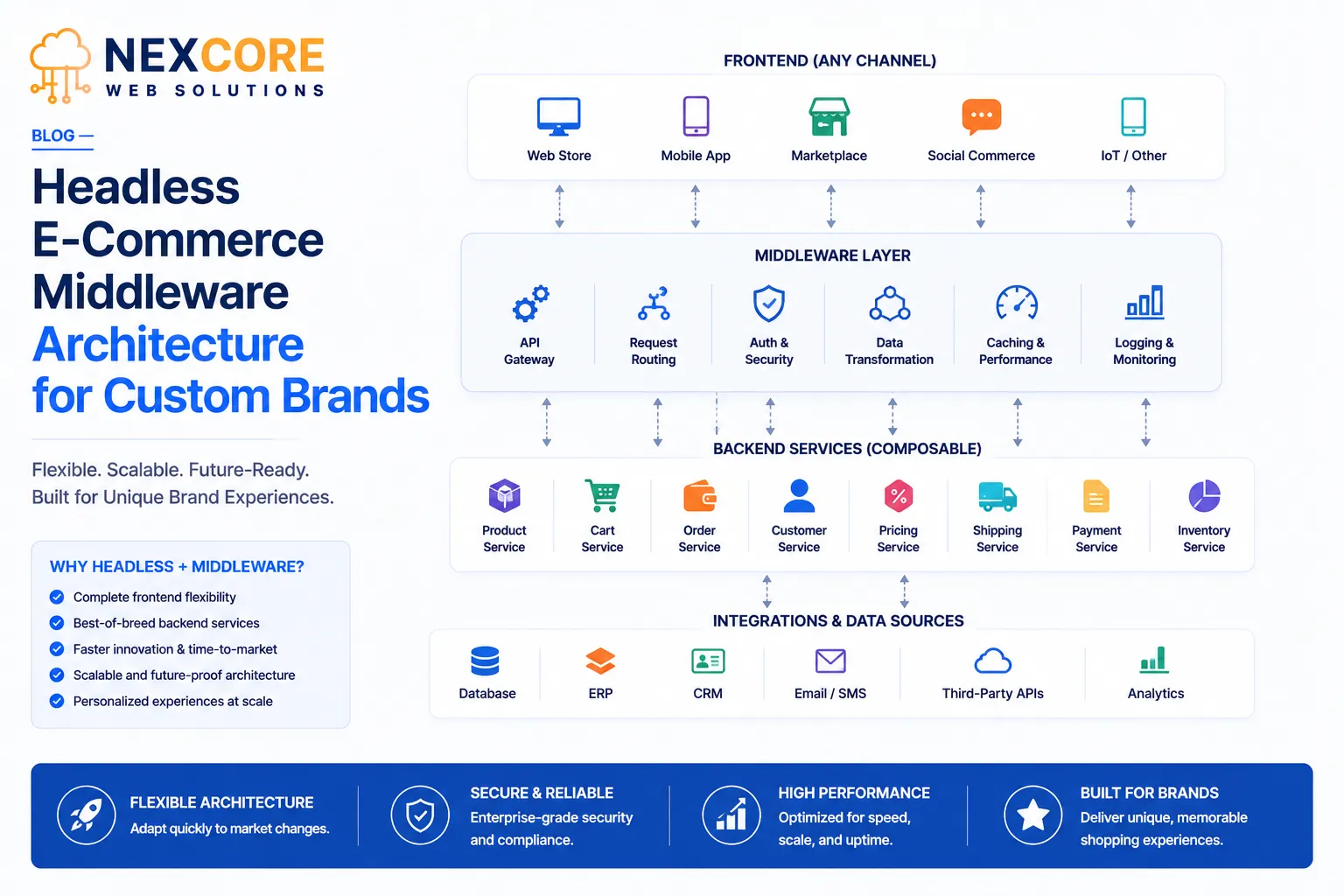
Custom e-commerce brands increasingly need digital experiences that move beyond the limitations of traditional storefront platforms. Customers may interact with a brand through websites, mobile applications, marketplaces, social commerce channels, kiosks, or connected devices, while business teams continue managing products, orders, customers, inventory, and payments through different systems. Headless commerce separates the customer-facing presentation layer from the underlying commerce engine, but this flexibility introduces another challenge: connecting all systems reliably. Middleware provides the integration layer that coordinates these services and keeps business operations synchronized. A well-designed headless e-commerce middleware architecture can improve scalability, simplify integrations, support personalized experiences, and give custom brands greater control over their digital ecosystem without forcing every channel to depend directly on every backend system.
Understanding Headless E-Commerce
What Makes Commerce Headless?
A headless e-commerce architecture separates the storefront interface from commerce functionality such as product management, carts, checkout, payments, pricing, and order processing. The frontend communicates with backend services through APIs rather than relying on tightly coupled templates. This approach allows brands to create highly customized shopping experiences across different devices and channels. Development teams can also update the presentation layer without rebuilding the entire commerce platform.
Why Middleware Is Necessary
Headless systems often involve several independent platforms, including commerce engines, ERP software, CRM systems, payment providers, search services, inventory platforms, and marketing tools. Connecting every application directly creates complex dependencies that become difficult to maintain as the ecosystem grows. Middleware provides a central integration layer that manages communication, data transformation, authentication, and business workflows. This creates a more manageable architecture.
Core Components of Middleware Architecture
API Gateway
An API gateway provides a controlled entry point between frontend applications and backend services. It can manage authentication, request routing, rate limiting, caching, and API security before forwarding requests to appropriate systems. Centralizing these responsibilities reduces duplicated logic across individual applications. It also gives engineering teams greater visibility into traffic and service performance.
Integration and Orchestration Layer
The orchestration layer coordinates workflows that require multiple backend systems to work together. For example, placing an order may require inventory verification, payment authorization, customer validation, order creation, and fulfillment notification. Middleware can coordinate these steps while handling failures and retries. This keeps complex business processes away from frontend applications.
Data Synchronization
Real-Time Data
Custom brands often need product prices, inventory levels, order status, and customer information to remain synchronized across multiple systems. Middleware can use APIs, webhooks, and event-driven messaging to distribute changes as they occur. Real-time synchronization reduces inconsistencies between storefronts and internal systems. Accurate data also improves customer trust during purchasing.
Data Transformation
Different systems rarely use identical data formats or naming conventions. An ERP might structure product information differently from an e-commerce platform or marketplace. Middleware transforms and maps these formats so applications can communicate consistently without requiring major changes to existing systems. This reduces integration friction and supports future platform changes.
Performance and Scalability
Caching Frequently Requested Data
Headless storefronts can generate large numbers of API requests, particularly when customers browse product catalogs or search for inventory. Middleware can cache frequently requested information such as product details, categories, and pricing where appropriate. Caching reduces repeated backend requests while improving response times. Cache policies should account for data freshness requirements.
Asynchronous Processing
Not every operation needs to happen during the customer’s request. Tasks such as analytics updates, email notifications, fulfillment messages, and some synchronization processes can run asynchronously through queues or event streams. This reduces the amount of work performed during critical customer interactions. Faster checkout and browsing experiences can result from moving nonessential work into background processes.
Security and Reliability
Protecting APIs
Middleware should enforce authentication, authorization, request validation, encryption, and rate limiting across connected services. Centralized security controls make it easier to apply consistent policies throughout the commerce ecosystem. Sensitive customer and payment information should only be exposed to services that genuinely require access. Strong API security reduces the risk of unauthorized activity.
Handling Integration Failures
Distributed commerce systems must assume that individual services can become temporarily unavailable. Middleware should support retries, timeouts, circuit breakers, dead-letter queues, and clear error handling for failed operations. These mechanisms prevent one failing integration from bringing down the entire shopping experience. Resilient workflows are particularly important for high-volume brands.
Supporting Multiple Channels
Omnichannel Experiences
Headless architecture enables brands to deliver consistent commerce functionality across websites, mobile applications, marketplaces, and other digital channels. Middleware ensures these channels can access common product, customer, inventory, and order services without duplicating business logic. This makes omnichannel expansion easier to manage. New interfaces can be added without rebuilding the entire backend.
Personalization
Middleware can combine customer, product, behavioral, and transactional data from multiple systems to support personalized experiences. For example, a storefront could use customer segments and purchase history to influence recommendations or promotions. Data orchestration enables personalization while keeping the frontend focused on presentation. Appropriate privacy and access controls remain essential.
Monitoring and Observability
Track Integration Health
Middleware environments require continuous monitoring because failures may occur between systems rather than inside a single application. Teams should track API latency, error rates, queue depth, synchronization delays, failed transactions, and service availability. Centralized logs and distributed tracing help identify where problems occur. Strong observability reduces troubleshooting time.
Measure Business Impact
Technical metrics alone do not reveal whether the architecture supports business goals. Brands should also monitor checkout completion, failed orders, inventory discrepancies, API-related abandonment, and order processing times. Connecting technical performance with commercial outcomes helps prioritize the most valuable improvements. Architecture decisions should ultimately support customer and business needs.
Conclusion
Headless e-commerce middleware architecture provides custom brands with a flexible foundation for connecting storefronts, commerce platforms, ERP systems, payment providers, inventory services, and customer applications. By introducing API gateways, orchestration, data transformation, caching, asynchronous processing, security controls, and observability, middleware reduces the complexity created by distributed commerce ecosystems. The goal is not simply to add another technical layer but to create reliable communication between systems while keeping customer experiences fast and consistent. Brands that design middleware around scalability, resilience, data accuracy, and measurable business requirements can expand into new channels more efficiently while maintaining control over their digital commerce infrastructure as the organization grows.
FAQs
1. What is headless e-commerce middleware?
Headless e-commerce middleware is an integration layer that connects a headless storefront with commerce platforms and other business systems such as ERP, CRM, inventory, payment, and fulfillment services. It manages APIs, data transformation, orchestration, security, and synchronization so different systems can communicate reliably.
2. Why do custom brands need middleware?
Custom brands often use multiple specialized platforms that must exchange product, customer, inventory, payment, and order information. Middleware reduces direct dependencies between these systems and centralizes integration logic. This makes the architecture easier to maintain, scale, secure, and adapt when new technologies or sales channels are introduced.
3. How does middleware improve headless commerce performance?
Middleware improves performance through techniques such as API caching, request routing, asynchronous processing, connection optimization, and efficient data synchronization. By reducing unnecessary backend calls and moving noncritical tasks into background workflows, middleware can help deliver faster storefront responses while protecting core commerce services from excessive traffic.
4. Is middleware secure for e-commerce applications?
Middleware can provide strong security when implemented with authentication, authorization, encryption, request validation, rate limiting, secure secrets management, and detailed monitoring. Centralized controls make it easier to apply consistent security policies across connected services. Sensitive customer and payment data should always be limited to authorized systems.
5. Can middleware support omnichannel commerce?
Yes. Middleware can provide consistent access to shared commerce data across websites, mobile applications, marketplaces, kiosks, and other channels. It coordinates product, customer, inventory, pricing, and order information so each channel can deliver a consistent experience without duplicating core business logic.




