
Enterprise employees often spend significant time searching for information scattered across documents, knowledge bases, emails, project systems, policies, and internal applications. Traditional portal search can locate matching keywords, but it may struggle when employees ask complex questions or need information from several sources at once. Retrieval-Augmented Generation (RAG) improves this experience by combining search and language models to retrieve relevant enterprise information before generating an answer. Instead of relying only on a model’s stored knowledge, a RAG-powered search system grounds responses in approved internal content. This makes enterprise search more useful for practical tasks such as finding policies, understanding procedures, locating technical documentation, or summarizing project information. When designed carefully, RAG can transform an internal portal into a faster, more context-aware knowledge access system.
Understanding RAG-Powered Enterprise Search
How RAG Works
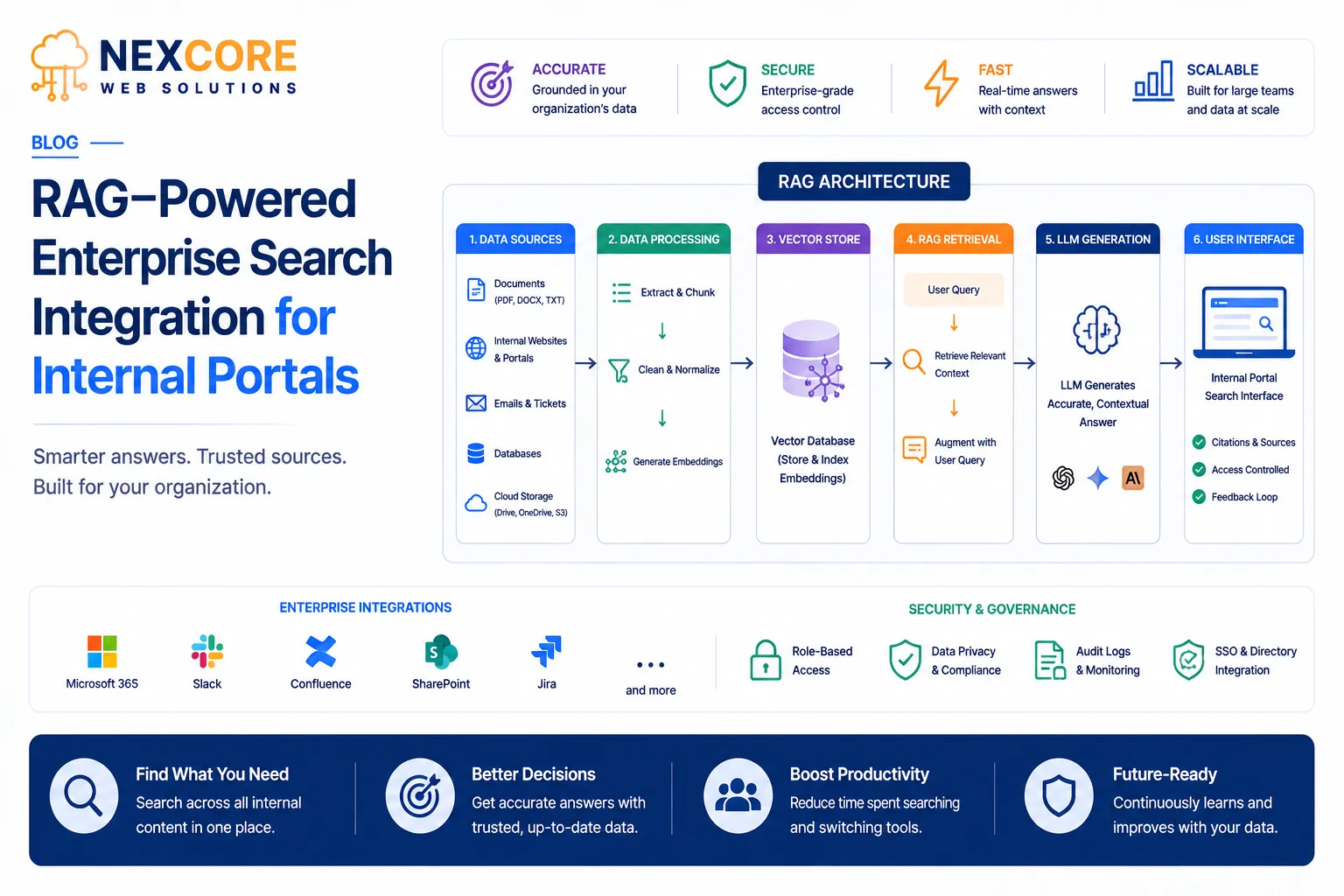
RAG combines information retrieval with generative AI. When an employee submits a question, the system converts the query into a searchable representation and retrieves relevant content from connected enterprise data sources. Selected documents or passages are then provided to a language model, which generates a response based on that retrieved context. This process helps connect natural-language questions with current organizational information.
Why Traditional Search Falls Short
Keyword-based search works well when employees already know the exact terminology used in a document. However, users may phrase questions differently from the language used by internal policies or technical documentation. Semantic retrieval can identify content based on meaning rather than exact word matches. This makes search more useful for natural questions and unfamiliar terminology.
Building the Data Retrieval Layer
Connecting Enterprise Sources
A RAG-powered portal can connect to document repositories, intranets, knowledge bases, ticketing systems, CRM platforms, project management tools, and other authorized sources. Connectors extract relevant content while preserving metadata such as document ownership, timestamps, categories, and access permissions. Centralizing these sources improves discoverability without requiring employees to search multiple systems manually.
Chunking and Metadata
Large documents should be divided into meaningful sections before being indexed. Effective chunking preserves enough context for accurate retrieval while preventing irrelevant information from overwhelming the language model. Metadata such as department, document type, author, date, and access level can further improve filtering. Well-structured indexing directly influences retrieval quality.
Semantic Search and Vector Databases
Using Embeddings
Embeddings convert text into numerical representations that capture semantic relationships between concepts. Similar ideas can therefore be retrieved even when they use different words. For example, an employee asking about parental leave may retrieve a human resources policy even if the document uses formal legal terminology. Semantic retrieval improves search relevance for conversational queries.
Hybrid Search
Vector search should not always replace traditional keyword search. Hybrid retrieval combines semantic similarity with keyword matching to handle both conceptual questions and exact terms such as product codes, employee IDs, policy numbers, or technical error messages. Combining retrieval methods generally provides broader coverage. Ranking mechanisms can then prioritize the most useful results.
Security and Access Control
Respecting Existing Permissions
Enterprise search systems must never expose information that a user could not access through the original source. Retrieval pipelines should enforce existing permissions before content reaches the language model. Identity-aware filtering ensures employees only receive information authorized for their role, department, or security group. Access control should be treated as a core architectural requirement.
Protecting Sensitive Information
Internal portals may contain confidential financial data, customer information, legal documents, intellectual property, and employee records. Data encryption, secure authentication, audit logging, and controlled model access help reduce exposure risks. Organizations should also define retention and data-handling policies for retrieved content. Security cannot be added as an afterthought.
Improving Answer Quality
Grounded Responses
A reliable RAG system should generate responses based on retrieved enterprise sources rather than unsupported assumptions. Providing citations, document names, timestamps, or links allows employees to verify important information. This is particularly valuable for policies, compliance requirements, technical procedures, and operational decisions. Source transparency increases user confidence.
Handling Missing Information
The system should recognize when available sources do not contain enough information to answer a question confidently. Instead of inventing an answer, it can explain that relevant information was not found and suggest appropriate sources or departments. This behavior reduces hallucination risk. Clear uncertainty handling is essential for enterprise environments.
Performance and Scalability
Optimize Retrieval Speed
Employees expect internal search to respond quickly, even when enterprise datasets contain millions of documents. Index optimization, efficient vector databases, caching, query filtering, and retrieval limits can reduce response times. Systems should retrieve only the most relevant content instead of sending large document collections to the language model. Efficient retrieval also reduces model processing costs.
Monitor Search Quality
Performance should be evaluated using metrics such as retrieval relevance, response latency, citation accuracy, unanswered queries, and user feedback. Regular evaluation identifies weak data sources, poorly structured documents, and retrieval problems. Search quality should be treated as an ongoing engineering process rather than a one-time deployment task.
Practical Enterprise Use Cases
RAG-powered search can support many internal workflows. Employees can ask questions about HR policies, technical troubleshooting, product documentation, procurement procedures, compliance requirements, project records, or customer service processes. Support teams can retrieve relevant solutions from previous tickets while engineers can search technical documentation using natural language. These applications reduce information discovery time and help organizations make better use of existing knowledge.
Conclusion
RAG-powered enterprise search can turn fragmented internal information into a more accessible and intelligent knowledge system. By combining semantic retrieval, vector databases, hybrid search, permission-aware indexing, and grounded language model responses, organizations can help employees find useful information without navigating multiple disconnected systems. However, successful implementation depends on more than selecting an AI model. Data quality, access control, retrieval accuracy, source transparency, monitoring, and scalable infrastructure all influence the final experience. Organizations that approach RAG as an integrated search architecture rather than simply an AI chatbot can create internal portals that deliver faster knowledge discovery while maintaining security, accuracy, and operational trust.
FAQs
1. What is RAG-powered enterprise search?
RAG-powered enterprise search combines information retrieval with generative AI to answer employee questions using current internal business information. The system retrieves relevant documents or passages from authorized enterprise sources and provides that context to a language model, which then generates a grounded response based on the retrieved information.
2. How does RAG improve internal portal search?
RAG improves internal search by allowing employees to ask questions using natural language rather than relying on exact keywords. Semantic retrieval can identify relevant information across documents with different terminology, while generated responses can summarize multiple sources. This makes enterprise knowledge easier to discover and understand.
3. Can RAG search respect enterprise permissions?
Yes. A properly designed RAG architecture can enforce existing access permissions during retrieval. User identity and authorization information should be applied before documents are provided to the language model. This prevents employees from receiving confidential information that they are not authorized to access.
4. What data sources can RAG enterprise search connect to?
RAG systems can connect to many authorized enterprise sources, including document repositories, internal websites, knowledge bases, technical documentation, ticketing platforms, CRM systems, project management tools, and policy libraries. Connectors and indexing pipelines allow information from these systems to become searchable while preserving important metadata and permissions.
5. How can organizations reduce hallucinations in RAG systems?
Organizations can reduce hallucinations by improving retrieval quality, limiting model context to trusted sources, using permission-aware indexing, requiring citations, and instructing systems to acknowledge when information is unavailable. Continuous evaluation of retrieval accuracy and generated responses also helps identify and correct weaknesses before they affect employees.




