
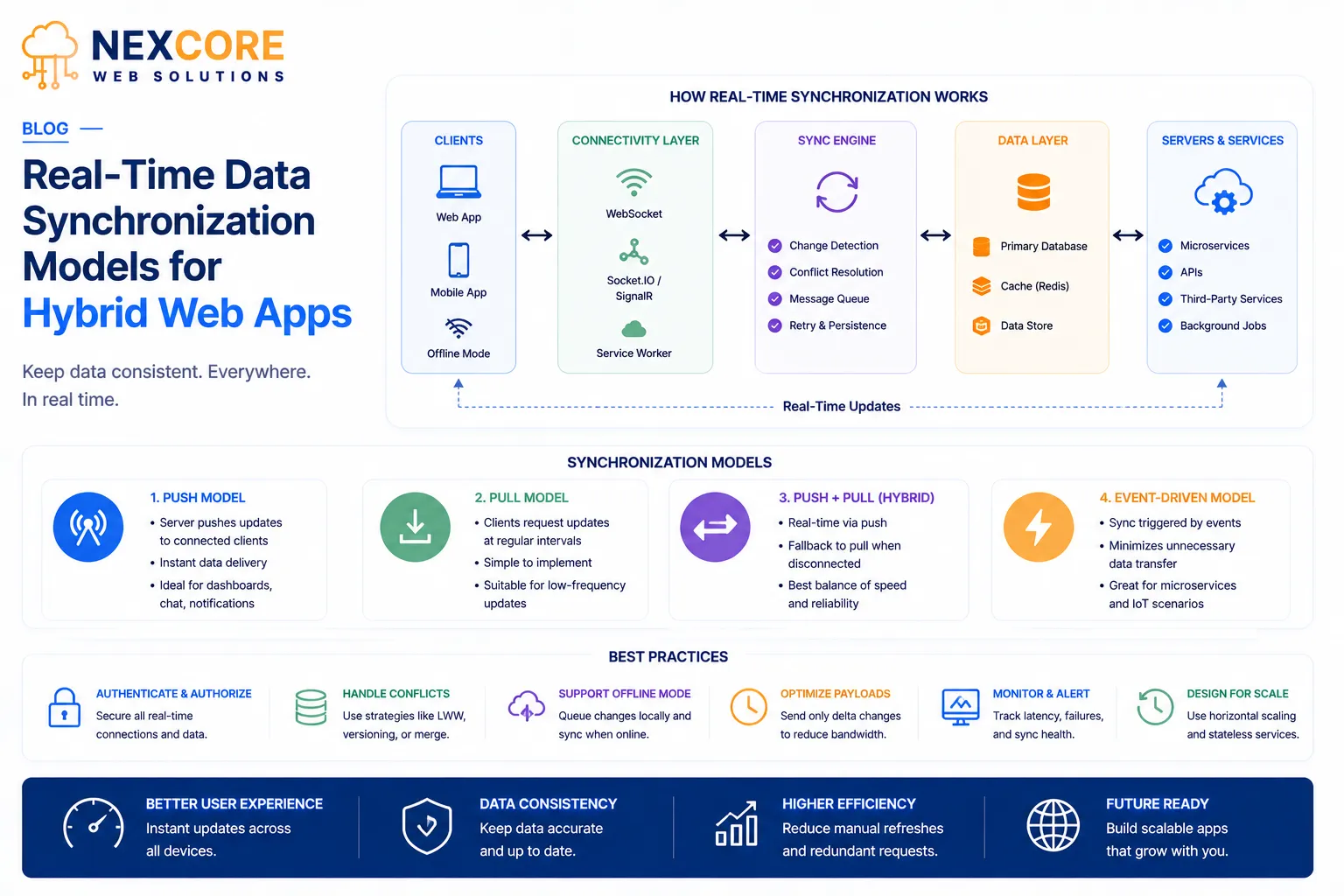
Modern web applications increasingly operate across multiple environments, including cloud platforms, on-premises systems, mobile devices, edge infrastructure, and third-party services. Keeping information consistent across these environments becomes difficult when users expect changes to appear almost immediately. A sales representative updating a customer record, for example, may need that change to reach a CRM, analytics dashboard, and mobile application without manual refreshes. Real-time data synchronization models address this challenge by continuously moving changes between connected systems. The right architecture depends on data volume, consistency requirements, network reliability, application complexity, and business priorities. For hybrid web applications, selecting an appropriate synchronization model can improve responsiveness, reduce duplicate data entry, prevent conflicts, and create a more consistent experience across different platforms and devices.
Understanding Real-Time Synchronization
What Real-Time Data Synchronization Means
Real-time synchronization ensures that changes made in one system are propagated to other connected systems with minimal delay. Instead of waiting for scheduled imports or manual updates, applications exchange changes through events, APIs, messaging systems, or persistent connections. This approach is particularly valuable when multiple applications depend on the same business information. The objective is not always instantaneous consistency, but reliable and predictable propagation.
Why Hybrid Apps Need Synchronization
Hybrid web applications often combine cloud services with existing enterprise infrastructure. A business may have an on-premises ERP, cloud-based CRM, web portal, mobile application, and analytics platform operating simultaneously. Each system may maintain different parts of the same business data. Synchronization creates a communication layer that keeps these environments aligned without forcing the organization to replace every legacy system.
Common Synchronization Models
API-Based Synchronization
API-based synchronization allows applications to exchange data through predefined endpoints. When a record changes, one application can notify another through an API request or retrieve updated information when required. This model is relatively straightforward and works well for systems with clear integration boundaries. However, frequent polling can increase network traffic and introduce delays.
Event-Driven Synchronization
Event-driven architecture publishes an event whenever an important business change occurs. Other systems subscribe to relevant events and process them independently. For example, an order-created event could trigger inventory updates, customer notifications, analytics processing, and fulfillment workflows. This model reduces direct dependencies and scales effectively across distributed applications.
Persistent Real-Time Connections
WebSockets
WebSockets maintain an open communication channel between browsers and servers, allowing data to move in both directions without repeated HTTP requests. They are useful for dashboards, collaborative applications, monitoring interfaces, and systems where users need immediate updates. Persistent connections can reduce perceived latency significantly. Infrastructure must nevertheless handle connection scaling and reconnection behavior carefully.
Server-Sent Events
Server-Sent Events provide a simpler mechanism for continuously sending updates from a server to a browser. They are useful when communication primarily flows from the server to connected clients. Applications such as live notifications, status dashboards, and activity feeds can benefit from this model. SSE can be easier to implement than full two-way communication when client-to-server messaging is limited.
Handling Data Conflicts
Why Conflicts Occur
Conflicts happen when multiple systems modify the same record before changes are synchronized. A customer might update contact information through a portal while an employee changes the same field through an internal CRM. Without conflict management, one update may unintentionally overwrite another. Hybrid applications therefore need clear rules for resolving competing changes.
Conflict Resolution Strategies
Common approaches include last-write-wins, version numbers, timestamps, field-level merging, and manual review. The appropriate method depends on the importance and structure of the data. Critical financial or operational records may require stronger consistency and explicit conflict handling. Less sensitive information may tolerate eventual consistency.
Eventual vs Strong Consistency
Eventual Consistency
Eventual consistency allows systems to temporarily contain different versions of information while changes propagate through the architecture. This model offers greater scalability and resilience because services do not need to wait for every dependent system before completing an operation. It works well for analytics, notifications, and many content-driven workflows. Clear synchronization indicators can help users understand temporary delays.
Strong Consistency
Strong consistency ensures that related systems observe updates in a tightly controlled manner. It is appropriate for operations where stale information could create serious business consequences, such as financial transactions or inventory allocation. However, stronger consistency can increase latency and infrastructure complexity. Organizations should apply it selectively rather than treating every dataset identically.
Reliability and Offline Support
Retry and Message Queues
Network failures are inevitable in hybrid environments. Message queues allow synchronization events to remain available until receiving systems successfully process them. Retry mechanisms can automatically attempt failed operations while dead-letter queues isolate messages that repeatedly fail. These techniques prevent temporary outages from causing permanent data loss.
Offline Synchronization
Some hybrid web applications must continue operating when users lose connectivity. Offline-first designs store local changes and synchronize them once connectivity returns. Applications need mechanisms for identifying pending changes, resolving conflicts, and confirming successful synchronization. This approach is especially useful for field operations and mobile business workflows.
Security and Monitoring
Protecting Synchronized Data
Synchronization systems frequently transport sensitive customer, financial, operational, or employee information. Secure authentication, encrypted communication, authorization checks, and careful event validation help prevent unauthorized access. Data should only be synchronized with systems that genuinely require it. Strong access controls should remain consistent across every connected environment.
Monitoring Synchronization Health
Teams should monitor event delivery delays, failed messages, synchronization queues, connection counts, API errors, and data discrepancies. Centralized logging and distributed tracing make it easier to identify where synchronization problems originate. Automated alerts can notify engineers before small delays become significant business issues. Observability is essential for maintaining trust in distributed data.
Choosing the Right Model
No single synchronization model works for every hybrid web application. Teams should evaluate data criticality, update frequency, network reliability, scale, latency requirements, offline needs, and integration capabilities before selecting an architecture. Many production systems combine several models, using events for business changes, APIs for controlled queries, queues for reliability, and WebSockets for user-facing updates. A hybrid synchronization strategy often provides the best balance between performance, reliability, and complexity.
Conclusion
Real-time data synchronization is a fundamental requirement for hybrid web applications that depend on consistent information across cloud, on-premises, mobile, and third-party environments. API-based integration, event-driven messaging, WebSockets, server-sent events, queues, and offline synchronization each address different operational requirements. Successful architectures also account for conflicts, consistency levels, security, retries, and observability rather than focusing only on data transfer speed. Organizations should design synchronization around business-critical workflows and avoid applying unnecessarily complex techniques to simple data. With the right combination of models, hybrid applications can deliver responsive experiences while maintaining reliable data flow across increasingly distributed technology environments.
FAQs
1. What is real-time data synchronization?
Real-time data synchronization is the process of propagating data changes between connected applications or systems with minimal delay. It can use APIs, event streams, message queues, WebSockets, or other communication mechanisms. The goal is to keep distributed systems aligned while allowing users and applications to access current information.
2. Which synchronization model is best for hybrid web applications?
There is no universal model because requirements differ between applications. Event-driven synchronization works well for distributed business workflows, APIs are useful for controlled integrations, and WebSockets support immediate user-facing updates. Many hybrid applications combine multiple approaches based on data criticality, latency requirements, reliability, and system architecture.
3. How are synchronization conflicts handled?
Synchronization conflicts can be handled using timestamps, version numbers, last-write-wins rules, field-level merging, or manual review. The appropriate strategy depends on how important the data is and how frequently multiple systems modify it. Critical records generally require stronger conflict controls than low-risk content or analytics information.
4. What is the difference between eventual and strong consistency?
Eventual consistency allows systems to temporarily contain different versions of data while updates propagate, improving scalability and resilience. Strong consistency ensures systems observe changes in a tightly controlled manner, which is useful for critical transactions. Strong consistency can introduce additional latency and complexity, so it should be applied where business requirements justify it.
5. How can real-time synchronization remain reliable during network failures?
Reliable synchronization uses durable message queues, retries, acknowledgments, dead-letter queues, and monitoring to prevent temporary failures from causing permanent data loss. Offline-capable applications can also store changes locally and synchronize them after connectivity returns. These mechanisms make distributed synchronization more resilient to unstable networks and temporary service outages.




