
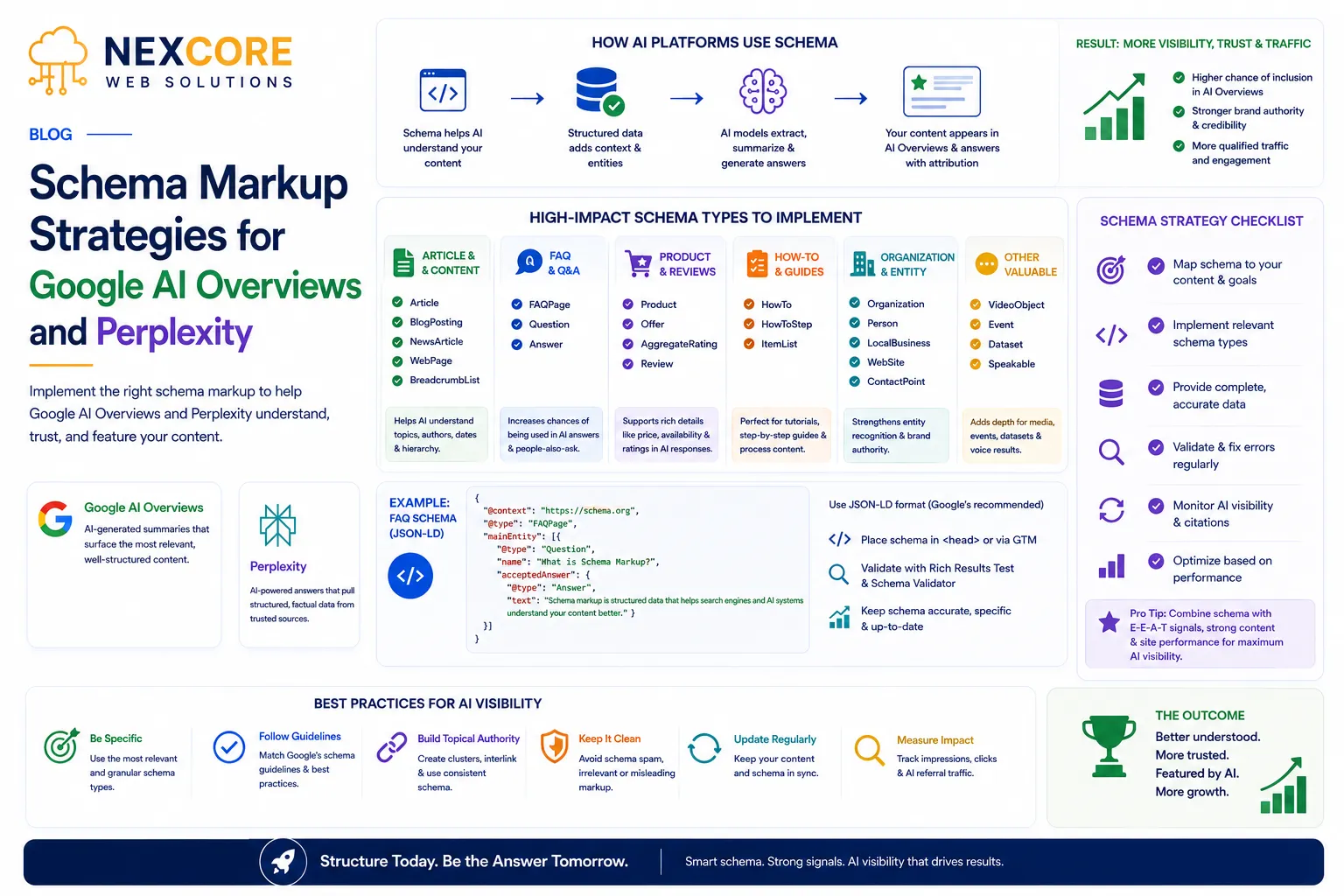
Search is evolving beyond traditional blue links. AI-powered search experiences such as Google AI Overviews and Perplexity analyze web content, identify reliable sources, and generate detailed answers for users within seconds. While high-quality content remains the foundation of visibility, structured data has become increasingly valuable for helping search engines understand the meaning, relationships, and context behind web pages. Schema markup provides this structured information by organizing content into standardized formats that machines can interpret efficiently. Although schema markup does not guarantee inclusion in AI-generated responses, it improves content clarity and supports better semantic understanding. Businesses and publishers that combine authoritative content with accurate structured data create stronger signals for modern search systems, improving discoverability while preparing their websites for the future of AI-assisted search.
Understanding Schema Markup
What Is Schema Markup?
Schema markup is structured data that helps search engines understand the content and purpose of a webpage. Instead of relying only on visible text, search engines can interpret details such as authors, organizations, products, articles, FAQs, reviews, events, and business information through standardized vocabulary. Most websites implement schema using JSON-LD because it is easier to maintain and recommended by major search engines. Well-structured data improves content interpretation without changing the visible appearance of a webpage.
Why Structured Data Matters
Modern AI-powered search systems evaluate context rather than simply matching keywords. Structured data helps clarify relationships between topics, organizations, authors, and content types, making information easier to interpret accurately. This additional context supports search engines when generating summaries, answering complex questions, and identifying trustworthy sources. Although schema alone does not improve rankings, it contributes to stronger semantic understanding.
Schema Types That Support AI Search
Article and NewsArticle Schema
Editorial content benefits from Article and NewsArticle schema because these formats identify publication dates, authors, headlines, images, and publishers in a structured format. AI systems can better understand who created the content, when it was published, and whether it represents original reporting or educational material. Accurate publication details also improve content freshness signals for time-sensitive topics.
FAQPage and HowTo Schema
Frequently asked questions and instructional content naturally align with conversational search queries. FAQPage schema organizes questions and answers into structured data, helping search systems recognize concise explanations for common user concerns. HowTo schema clearly defines step-by-step processes, making instructional content easier for AI platforms to interpret. Both formats improve content organization while supporting better information retrieval.
Organization and Person Schema
Credibility plays a significant role in AI-generated search experiences. Organization schema identifies business details such as name, website, logo, contact information, and social profiles, while Person schema connects authors with their expertise and published work. These schemas strengthen entity recognition and support EEAT principles by providing transparent authorship and organizational information.
Building High-Quality Structured Data
Maintain Accuracy
Structured data should always match the visible content displayed on the webpage. Inconsistent publication dates, incorrect author information, or misleading product details reduce trust and may invalidate schema implementation. Regular reviews help ensure structured data remains synchronized with website updates. Accuracy improves search engine confidence while reducing the possibility of indexing issues.
Use Appropriate Schema Types
Adding unnecessary schema simply because it exists does not improve website performance. Every structured data implementation should accurately represent the content available on the page. Product pages should use Product schema, articles should use Article schema, and business pages should use Organization schema where appropriate. Relevant implementation creates clearer semantic signals than excessive markup.
Supporting Google AI Overviews
Create Well-Structured Content
Google AI Overviews prioritize content that clearly answers user questions while demonstrating expertise and trustworthiness. Structured headings, descriptive paragraphs, logical organization, and relevant schema improve content interpretation. Pages that combine comprehensive explanations with accurate structured data provide stronger contextual signals for Google’s understanding systems. Readability remains equally important alongside technical optimization.
Strengthen Entity Relationships
Google increasingly evaluates relationships between people, organizations, products, and topics. Consistent schema implementation across an entire website helps establish these connections more effectively. Linking authors to organizations, articles to publishers, and products to businesses improves semantic consistency throughout the website. Strong entity relationships support broader knowledge graph recognition over time.
Optimizing for Perplexity
Focus on Information Quality
Perplexity emphasizes factual, well-sourced, and clearly organized information when generating AI responses. Schema markup supports content interpretation, but authoritative writing remains the primary factor. Comprehensive explanations, reliable references, transparent authorship, and logical page structures improve the likelihood that AI systems recognize valuable information. Technical optimization works best when paired with genuinely useful content.
Maintain Technical Consistency
Perplexity and other AI-powered platforms benefit from websites that present structured information consistently across multiple pages. Standardized schema implementation, accurate metadata, logical internal linking, and crawlable page architecture help AI systems understand website relationships efficiently. Consistency reduces ambiguity while improving overall content discoverability.
Common Implementation Mistakes
Some websites misuse schema by adding markup that does not reflect visible content or by combining unrelated schema types unnecessarily. Others neglect to update structured data after modifying webpage content, resulting in outdated information. Missing required properties or incorrect formatting may also prevent search engines from interpreting schema successfully. Regular validation and maintenance are essential for preserving structured data quality over time.
Conclusion
Schema markup has become an important component of modern technical SEO because it helps AI-powered search systems understand website content more accurately. While structured data alone cannot guarantee visibility within Google AI Overviews or Perplexity responses, it strengthens semantic clarity, improves entity recognition, and supports trustworthy content presentation. Organizations should focus on implementing accurate, relevant schema that aligns with visible webpage content while maintaining high editorial standards and technical consistency. Combined with authoritative writing, strong internal linking, and excellent user experience, structured data creates a solid foundation for future search visibility. As AI-assisted search continues evolving, websites with clear semantic structure will be better positioned to remain discoverable, credible, and valuable to both users and intelligent search platforms.
FAQs
1. What is schema markup in SEO?
Schema markup is structured data added to webpages to help search engines understand content more accurately. It provides standardized information about articles, organizations, products, FAQs, events, authors, and other entities. This additional context improves semantic understanding and supports enhanced search features without changing the visible content of the webpage.
2. Does schema markup help with Google AI Overviews?
Schema markup does not guarantee inclusion in Google AI Overviews, but it helps search engines interpret webpage content more effectively. Accurate structured data improves semantic clarity, identifies entities, and provides important contextual information. Combined with high-quality content and strong EEAT signals, schema contributes to better content understanding by AI-powered search systems.
3. Which schema types are most useful for AI search?
Commonly recommended schema types include Article, NewsArticle, FAQPage, HowTo, Organization, Person, Product, and BreadcrumbList. The appropriate choice depends on the webpage’s purpose and content. Using relevant schema that accurately reflects visible information provides stronger semantic signals than applying unnecessary or unrelated structured data.
4. Can incorrect schema negatively affect SEO?
Yes. Structured data that contains inaccurate information, missing required properties, misleading content, or formatting errors may prevent search engines from interpreting it correctly. Although minor mistakes may not directly reduce rankings, incorrect schema weakens content clarity and can affect eligibility for enhanced search features or rich results.
5. How should websites maintain schema markup over time?
Websites should review structured data regularly whenever content changes, ensuring publication dates, authors, business information, products, and other details remain accurate. Schema validation tools help identify formatting issues and missing properties. Consistent maintenance ensures structured data continues supporting search engine understanding as websites grow and evolve.




