
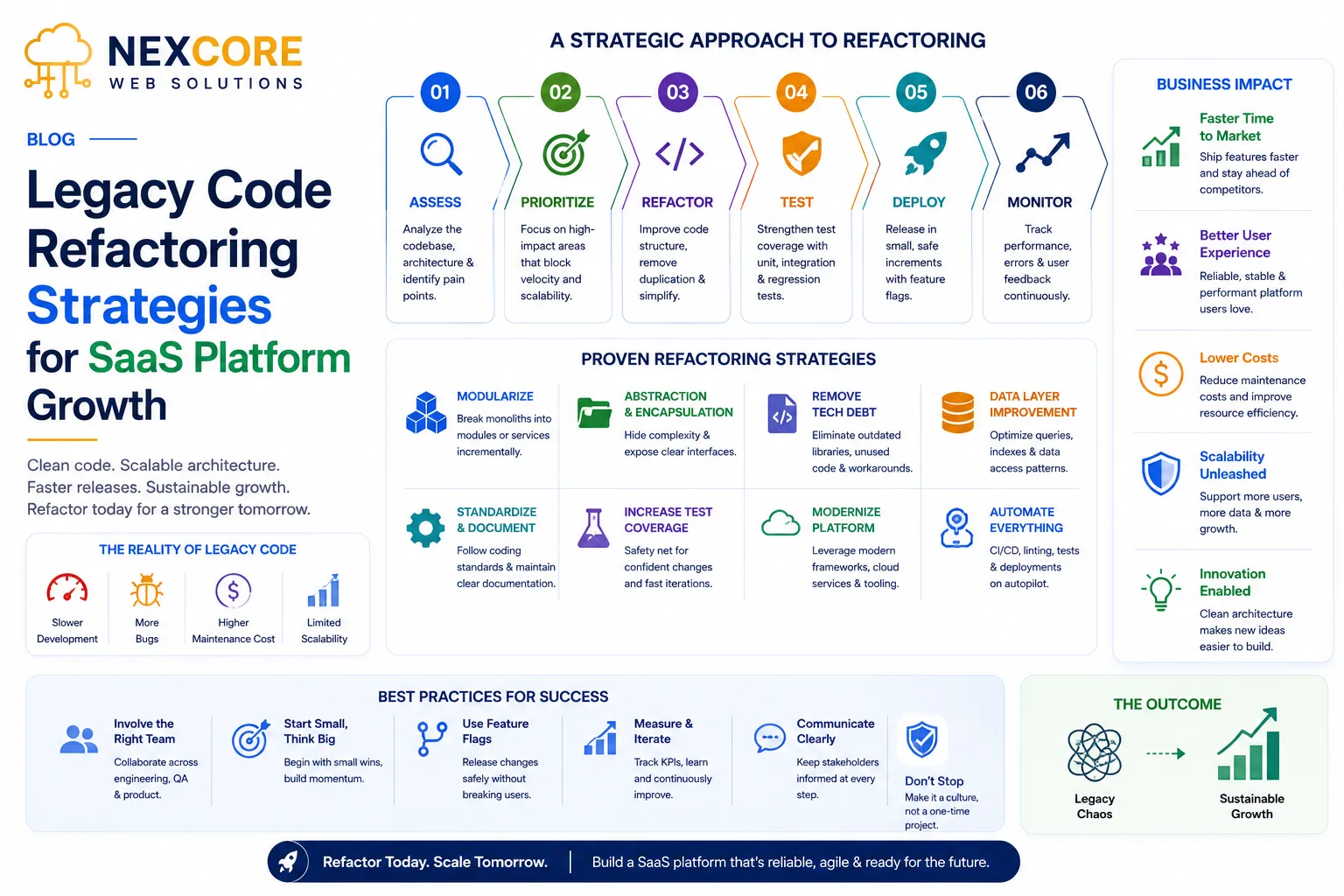
As Software-as-a-Service (SaaS) platforms mature, their codebases naturally become larger and more complex. Features added over several years, changing business requirements, quick bug fixes, and multiple development teams often result in legacy code that is difficult to maintain and scale. While legacy code may continue supporting existing functionality, it frequently slows development, increases technical debt, and introduces operational risks. Refactoring this code is not about rewriting everything from scratch. Instead, it focuses on improving the internal structure while preserving existing functionality. A well-planned refactoring strategy enables SaaS companies to enhance performance, simplify maintenance, accelerate feature delivery, and prepare their platforms for future growth. Understanding practical refactoring approaches helps organizations modernize their applications without disrupting daily business operations or customer experiences.
Understanding Legacy Code
What Is Legacy Code?
Legacy code refers to software that continues to perform valuable business functions but has become difficult to maintain or extend. It may rely on outdated programming practices, limited documentation, obsolete frameworks, or tightly coupled components. In many SaaS platforms, legacy code develops gradually as new features are added under tight deadlines. Although the software still works, making changes often introduces unexpected bugs or requires excessive development effort.
Why Legacy Code Becomes a Problem
Growing SaaS businesses need to release updates quickly while maintaining platform stability. Legacy code slows this process because developers spend more time understanding existing implementations before making modifications. Complex dependencies increase testing requirements, while outdated architectures make integrating modern technologies more challenging. Over time, technical debt reduces development productivity and increases operational costs.
Assessing the Existing Codebase
Identify High-Risk Areas
Before starting any refactoring initiative, development teams should evaluate the current codebase to identify modules with frequent defects, poor performance, or repeated maintenance requirements. Customer-facing features such as authentication, billing, reporting, and subscription management often deserve special attention because they directly influence user experience. Prioritizing high-impact areas delivers measurable improvements without requiring a complete system overhaul.
Measure Technical Debt
Technical debt represents the accumulated cost of choosing quick development solutions over sustainable software design. Static code analysis tools, architecture reviews, and code quality metrics help identify duplicated logic, excessive complexity, outdated dependencies, and insufficient test coverage. Quantifying technical debt enables organizations to create realistic refactoring roadmaps based on measurable priorities rather than assumptions.
Refactoring Without Disrupting Users
Adopt an Incremental Approach
Large-scale rewrites often introduce unnecessary risk because they require replacing substantial portions of the application simultaneously. Incremental refactoring allows development teams to improve individual modules while keeping the platform fully operational. Smaller improvements are easier to test, deploy, and monitor, reducing the likelihood of unexpected production issues. Continuous progress also delivers business value much sooner than lengthy redevelopment projects.
Build Comprehensive Test Coverage
Reliable testing provides confidence that refactoring has not altered existing business functionality. Automated unit tests, integration tests, and end-to-end testing verify application behavior throughout the modernization process. Expanding test coverage before modifying complex modules reduces deployment risks while enabling developers to refactor more aggressively. Strong testing practices become increasingly valuable as applications continue growing.
Modernizing Architecture
Improve Code Modularity
Monolithic applications often contain tightly connected components that make changes difficult and time-consuming. Separating business logic into smaller, reusable modules simplifies maintenance while improving scalability. Modular architecture allows different development teams to work independently on specific features without introducing unnecessary dependencies. This flexibility accelerates feature development while improving overall code quality.
Upgrade Frameworks Carefully
Many legacy SaaS platforms continue using outdated frameworks because upgrades appear risky or resource-intensive. However, unsupported technologies may create compatibility issues, security vulnerabilities, and performance limitations over time. Incrementally upgrading frameworks, libraries, and dependencies reduces long-term maintenance costs while improving access to modern development capabilities. Careful planning ensures compatibility throughout the migration process.
Improving Performance and Scalability
Optimize Database Interactions
Database inefficiencies frequently become major performance bottlenecks in mature SaaS applications. Refactoring slow queries, reducing unnecessary database calls, implementing indexing strategies, and optimizing caching significantly improve application responsiveness. Performance improvements not only enhance customer satisfaction but also reduce infrastructure costs as user traffic continues increasing. Database optimization often provides immediate and measurable business benefits.
Reduce Infrastructure Complexity
Legacy applications sometimes contain redundant services, outdated integrations, or unnecessary processing layers accumulated over years of development. Simplifying infrastructure reduces operational overhead while improving system reliability. Removing obsolete components also minimizes maintenance responsibilities and decreases potential security vulnerabilities. A streamlined technology stack supports more efficient long-term platform growth.
Strengthening Collaboration
Improve Documentation
Poor documentation is one of the most common challenges associated with legacy software. Developers often spend valuable time understanding existing code before implementing changes. Updating architectural diagrams, documenting business rules, and maintaining technical references improve knowledge sharing across engineering teams. Well-documented systems reduce onboarding time for new developers while supporting more consistent development practices.
Establish Coding Standards
Refactoring efforts should include standardized coding guidelines that promote readability, maintainability, and consistency across the codebase. Common naming conventions, formatting rules, architectural principles, and review processes help prevent new technical debt from accumulating. Consistent development practices enable teams to collaborate more effectively while maintaining higher software quality over time.
Planning for Continuous Improvement
Legacy code refactoring should become an ongoing engineering practice rather than a one-time modernization project. Development teams should allocate regular time for improving code quality alongside delivering new features. Monitoring technical debt, reviewing architecture decisions, and continuously optimizing performance ensure the platform remains adaptable as business requirements evolve. Sustainable improvement creates a healthier software ecosystem that supports long-term innovation without sacrificing operational stability.
Conclusion
Refactoring legacy code is an essential investment for SaaS platforms seeking sustainable growth, improved performance, and faster feature delivery. Rather than replacing an entire application, organizations achieve better results through incremental improvements supported by comprehensive testing, modular architecture, updated technologies, and consistent development standards. Addressing technical debt early prevents small maintenance challenges from becoming significant operational risks as the platform expands. Successful refactoring balances business continuity with long-term modernization by focusing on high-impact improvements that deliver measurable value. As SaaS products continue evolving, organizations that treat code quality as an ongoing priority will be better positioned to scale efficiently, respond to changing customer expectations, and maintain reliable software that supports continued business success.
FAQs
1. What is legacy code in a SaaS platform?
Legacy code refers to existing application code that continues supporting business operations but has become difficult to maintain, understand, or extend. It often results from years of feature additions, outdated technologies, limited documentation, and accumulated technical debt. Although functional, legacy code can significantly slow future development and increase maintenance costs.
2. Why is refactoring better than rewriting an application?
Refactoring improves the internal structure of existing code without changing its external functionality, allowing businesses to modernize gradually while maintaining platform availability. Complete rewrites typically require greater time, cost, and risk because they replace large portions of the application simultaneously. Incremental refactoring delivers faster business value with fewer operational disruptions.
3. How can SaaS companies reduce technical debt?
Technical debt can be reduced by regularly reviewing code quality, eliminating duplicate logic, improving documentation, increasing automated test coverage, updating outdated dependencies, and following consistent coding standards. Incorporating refactoring into normal development cycles prevents technical debt from growing while improving long-term software maintainability and scalability.
4. What role does automated testing play during refactoring?
Automated testing verifies that application functionality remains unchanged while developers improve internal code structure. Unit tests, integration tests, and end-to-end testing help identify regressions before deployment, reducing operational risk. Strong test coverage enables engineering teams to refactor confidently while maintaining platform reliability and customer satisfaction.
5. When should a SaaS business start refactoring legacy code?
Organizations should begin refactoring when maintenance becomes increasingly difficult, development slows significantly, technical debt affects productivity, or outdated technologies create security and compatibility concerns. Starting early with incremental improvements prevents larger modernization challenges later while supporting continuous platform growth and long-term operational efficiency.




