
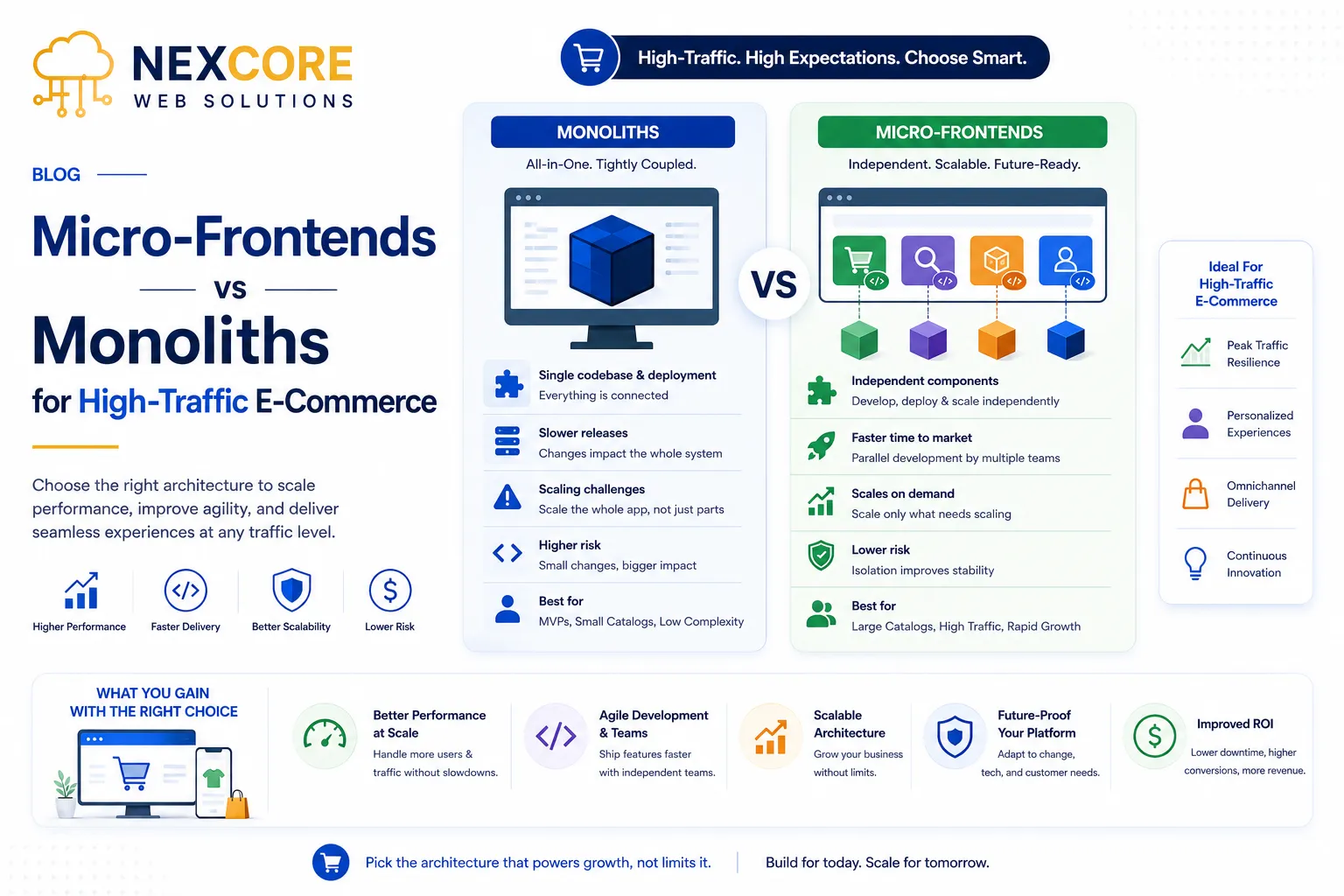
As eCommerce businesses grow, their websites become more complex. New features, expanding product catalogs, personalized shopping experiences, and increasing traffic place significant demands on the frontend architecture. One of the most important architectural decisions for high-traffic eCommerce platforms is choosing between a traditional monolithic frontend and a micro-frontend architecture. While monoliths offer simplicity and centralized development, micro-frontends provide flexibility, independent deployments, and better scalability for large development teams. Selecting the right approach directly affects website performance, maintenance costs, deployment speed, and the ability to deliver new features without disrupting existing functionality. Understanding the strengths, limitations, and practical use cases of both architectures helps organizations make informed decisions that support long-term growth while maintaining a fast and reliable shopping experience for customers.
Understanding Frontend Architectures
What Is a Monolithic Frontend?
A monolithic frontend is a single application where all user interface components, pages, and business logic are developed, tested, and deployed together. Product pages, checkout, customer accounts, search functionality, and promotional content all exist within one unified codebase. This approach simplifies project management because every feature follows the same framework and deployment process. Smaller teams often find monolithic applications easier to develop and maintain during the early stages of business growth.
What Are Micro-Frontends?
Micro-frontends extend the principles of microservices to the frontend by dividing the user interface into smaller, independently managed applications. Each section of the website, such as product listings, shopping cart, checkout, or customer dashboard, can be developed and deployed by separate teams. These independent modules work together to create a seamless customer experience while allowing faster feature delivery and isolated updates. Large enterprises frequently adopt this architecture to improve development agility.
Performance Considerations
Website Speed and User Experience
Website performance directly influences customer satisfaction, conversion rates, and search visibility. Monolithic applications may initially load larger bundles because the browser downloads a significant portion of the application at once. Micro-frontends can reduce unnecessary downloads by loading only the components required for a specific page. However, poor implementation may introduce additional network requests that offset these advantages, making performance optimization essential regardless of architecture.
Handling High Traffic
High-traffic eCommerce stores experience fluctuating demand during seasonal sales, product launches, and promotional campaigns. Monolithic applications rely on scaling the entire frontend even if only one feature receives increased traffic. Micro-frontends allow individual sections to scale independently based on demand. For example, checkout services can receive additional resources during flash sales without increasing infrastructure for unrelated components such as blog pages or customer profiles.
Development and Maintenance
Team Collaboration
Development efficiency becomes increasingly important as organizations expand. In monolithic projects, multiple teams often work within the same codebase, increasing the possibility of merge conflicts and deployment coordination challenges. Micro-frontends enable independent teams to manage separate features without affecting unrelated parts of the application. This separation improves productivity while allowing specialized teams to focus on their own business domains.
Deployment Flexibility
Deploying a monolithic application typically requires releasing the entire frontend even when only one feature has changed. This increases testing requirements and deployment risks because unrelated functionality may be affected. Micro-frontends support independent deployments, allowing organizations to release updates for specific modules without impacting the rest of the website. Faster release cycles help businesses respond quickly to customer feedback and market demands.
Scalability and Business Growth
Supporting Enterprise Expansion
As eCommerce businesses expand internationally, they often introduce new payment methods, regional storefronts, language support, and customer experiences. Monolithic applications become increasingly difficult to modify because every enhancement affects the central codebase. Micro-frontends allow teams to develop region-specific functionality independently while maintaining consistent branding across the platform. This flexibility supports continuous business expansion with reduced operational complexity.
Technology Flexibility
A monolithic frontend usually relies on a single framework and technology stack for the entire application. Upgrading the framework or introducing new technologies may require significant redevelopment. Micro-frontends provide greater flexibility by allowing different teams to adopt technologies that best suit their individual modules. Organizations can modernize specific areas without rebuilding the entire frontend simultaneously.
Security and Operational Challenges
Managing Security Consistently
Regardless of architecture, maintaining consistent security practices remains essential. Monolithic applications simplify security management because all authentication, authorization, and session handling exist within a centralized environment. Micro-frontends require coordinated security policies across multiple independent modules to prevent inconsistencies. Shared authentication systems, secure API communication, and standardized access controls help maintain enterprise-grade protection.
Monitoring and Troubleshooting
Operational visibility becomes more complex as frontend architecture evolves. Monolithic applications generally provide centralized logging and simpler debugging because every feature belongs to the same application. Micro-frontends require distributed monitoring that collects logs, performance metrics, and error reports from multiple independent services. Comprehensive observability tools are therefore essential for identifying issues quickly in large-scale deployments.
Choosing the Right Architecture
The best architectural choice depends on organizational size, development resources, business goals, and expected traffic growth. Smaller companies with limited engineering teams often benefit from the simplicity of monolithic applications because they reduce operational overhead and accelerate initial development. Large enterprises with multiple product teams, continuous feature releases, and complex customer experiences frequently gain greater value from micro-frontends. Careful evaluation of current requirements and future scalability should guide every architectural decision rather than simply following industry trends.
Conclusion
Both monolithic frontends and micro-frontends offer valuable advantages for high-traffic eCommerce platforms, but neither represents a universal solution. Monoliths provide simplicity, centralized management, and easier maintenance for smaller teams, while micro-frontends deliver scalability, deployment independence, and improved collaboration for growing enterprises. Success depends on aligning architecture with business objectives, technical capabilities, and long-term growth plans. Organizations should evaluate performance requirements, development workflows, operational complexity, and customer expectations before selecting an approach. A well-designed frontend architecture supports faster innovation, reliable performance, and exceptional shopping experiences while providing the flexibility needed to adapt to evolving market demands. Choosing the right foundation today creates opportunities for sustainable growth and continuous improvement in the competitive eCommerce landscape.
FAQs
1. What is the difference between micro-frontends and monolithic frontends?
A monolithic frontend combines all website functionality into a single application with one codebase and deployment process. Micro-frontends divide the user interface into smaller, independently managed modules that different teams can develop, test, and deploy separately. This architectural difference significantly affects scalability, maintenance, and development flexibility.
2. Are micro-frontends better for high-traffic eCommerce websites?
Micro-frontends are often better suited for large, high-traffic eCommerce platforms because they allow independent scaling, faster deployments, and parallel development across multiple teams. However, they also introduce additional architectural complexity. Businesses should evaluate team size, operational requirements, and long-term growth before choosing this approach.
3. When should a business choose a monolithic frontend?
A monolithic frontend is ideal for startups and small to medium-sized businesses with limited development teams and relatively simple applications. It reduces infrastructure complexity, simplifies deployment, and lowers maintenance overhead while enabling faster initial development before significant scaling becomes necessary.
4. Do micro-frontends improve website performance?
Micro-frontends can improve performance by loading only the required application modules instead of an entire frontend bundle. However, benefits depend on proper implementation, efficient asset loading, optimized network requests, and effective caching strategies. Poor architectural decisions may reduce or even eliminate expected performance improvements.
5. What are the biggest challenges of adopting micro-frontends?
The primary challenges include increased architectural complexity, consistent security management, shared authentication, cross-team coordination, distributed monitoring, and maintaining a unified user experience. Organizations should establish clear development standards and governance processes before adopting micro-frontends to ensure long-term maintainability and operational efficiency.




