
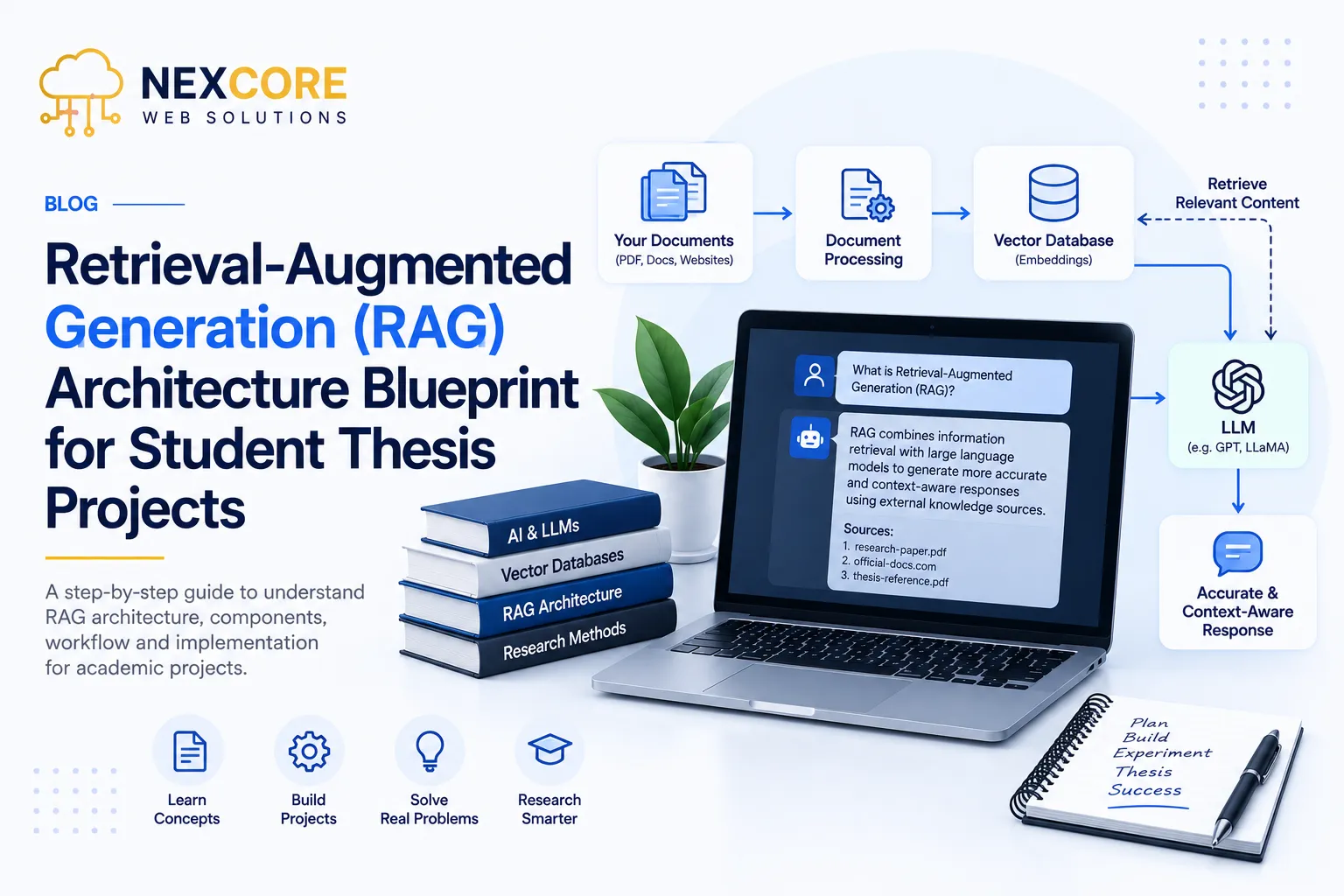
Retrieval-Augmented Generation (RAG) is a practical architecture for applications that combine information retrieval with large language models. For student thesis projects, it turns a broad AI idea into a system that can be designed, tested, and evaluated through measurable components. Instead of relying only on a model’s trained knowledge, RAG retrieves relevant information from a selected knowledge base and provides that context to the model. This makes it useful for university document assistants, research portals, technical support tools, and academic question-answering systems. A well-planned architecture gives students clear opportunities to study retrieval quality, response accuracy, latency, and citation behavior.
What Is a RAG Architecture?
A RAG system contains two connected stages: retrieval and generation. Retrieval searches a document collection for passages relevant to a question, while generation uses those passages as context for an answer. The knowledge base may contain PDFs, lecture notes, research papers, or manuals. Instead of sending the entire collection to the model, the system selects useful passages. This separation also lets students evaluate retrieval and generation as distinct parts of a thesis.
Core Components
A typical architecture includes document ingestion, chunking, embeddings, vector storage, retrieval, prompt construction, a language model, and an interface. Documents are chunked, embedded, and stored with metadata. During a query, the system embeds the question and searches for similar chunks. Selected context is passed to the language model.
Designing the Document Pipeline
RAG quality depends heavily on source preparation. A pipeline can extract text from PDFs, remove unnecessary formatting, and split content while preserving context. Very small chunks may lose meaning, while large chunks can contain irrelevant information. Students should test chunk sizes and document the chosen strategy. Storing source metadata with every chunk also supports reliable evaluation and citations.
Embeddings and Vector Storage
An embedding model converts text into numerical vectors representing semantic relationships. Similar questions and passages can therefore be close in vector space even when they use different words. A vector database stores these representations for similarity searches. Students can compare embedding models using the same test questions to measure retrieval differences.
Retrieval and Ranking
Retrieval determines what evidence reaches the language model. A basic system can use vector similarity to select top-k passages, while advanced designs can combine keyword and semantic search. Reranking can prioritize relevant candidates, although it may increase latency. Students should measure relevance and response time when comparing approaches.
Context Construction
Retrieved passages must be assembled into a clear prompt. The prompt should separate source context from the user’s question and explain how evidence should be used. Limiting context can prevent irrelevant information from overwhelming the model. If sources conflict, the model can be instructed to identify the conflict.
Generation and Grounded Responses
The generation stage uses retrieved context to formulate a response. Prompts should discourage unsupported claims and encourage the model to state when evidence is insufficient. If source transparency matters, the interface can display document references alongside answers. Generation quality should be assessed separately because strong retrieval does not guarantee correctness.
Evaluating a Student RAG Project
A thesis should evaluate the pipeline rather than rely only on subjective impressions. Students can create factual, ambiguous, multi-step, and unanswerable questions from their documents. Retrieval can use recall@k and precision@k, while responses can be assessed for correctness, relevance, groundedness, and citation accuracy. Comparing RAG with a baseline can show measurable benefits.
Common RAG Challenges
RAG systems can fail when documents are poorly extracted, chunks lack context, or retrieval returns irrelevant passages. A model may produce a confident answer when evidence does not support it. Students should include negative tests where the answer is absent from the knowledge base. Logging retrieved chunks and responses helps identify whether failures begin during retrieval or generation.
Conclusion
A RAG architecture gives students a structured framework for an applied AI thesis with measurable technical components. The workflow can include document ingestion, chunking, embeddings, vector storage, retrieval, reranking, context construction, and grounded generation. Each stage creates opportunities to investigate design choices instead of treating the language model as a black box. A strong thesis should define a focused knowledge domain, establish an evaluation dataset, compare meaningful baselines, and report quality and performance results. Students should document limitations, particularly retrieval failures and unsupported answers. With careful evaluation, a RAG project can demonstrate practical AI system design while maintaining a clear research methodology.
FAQs
What is RAG in a student thesis project?
RAG retrieves relevant information from a knowledge base and supplies it to a language model before an answer is generated. For a thesis, it can support university documents, research papers, manuals, or specialized datasets. Students can measure retrieval accuracy, response quality, latency, and citation correctness. This makes RAG suitable for practical thesis experiments.
What components should a basic RAG system contain?
A basic RAG system typically includes document ingestion, text chunking, embeddings, vector storage, a retriever, prompt construction, a language model, and an interface. Metadata should remain attached to stored chunks for source tracking. Students can add reranking, hybrid search, or automated evaluation when required. The architecture should remain focused on the thesis objective.
How should students evaluate a RAG system?
Students should create a test set containing normal questions, difficult queries, ambiguous requests, and questions that cannot be answered from the knowledge base. Retrieval can use recall@k and precision@k. Generated answers can be assessed for correctness, relevance, groundedness, and citation accuracy. Comparing RAG with a baseline makes results more informative.
Why is chunking important in RAG?
Chunking determines how documents are divided before they are embedded and retrieved. Very small chunks can remove important context, while large chunks can introduce irrelevant material into the prompt. Students should test reasonable chunk sizes and overlap settings using consistent evaluation questions. Recording these choices improves reproducibility.
Can RAG prevent AI hallucinations completely?
RAG can provide external evidence that helps reduce unsupported responses, but it cannot guarantee that every answer will be correct. Problems can occur when retrieval misses relevant information, documents conflict, or the model misinterprets context. A good thesis should test questions that cannot be answered from the knowledge base. Reporting failures provides a more accurate reliability assessment.




