
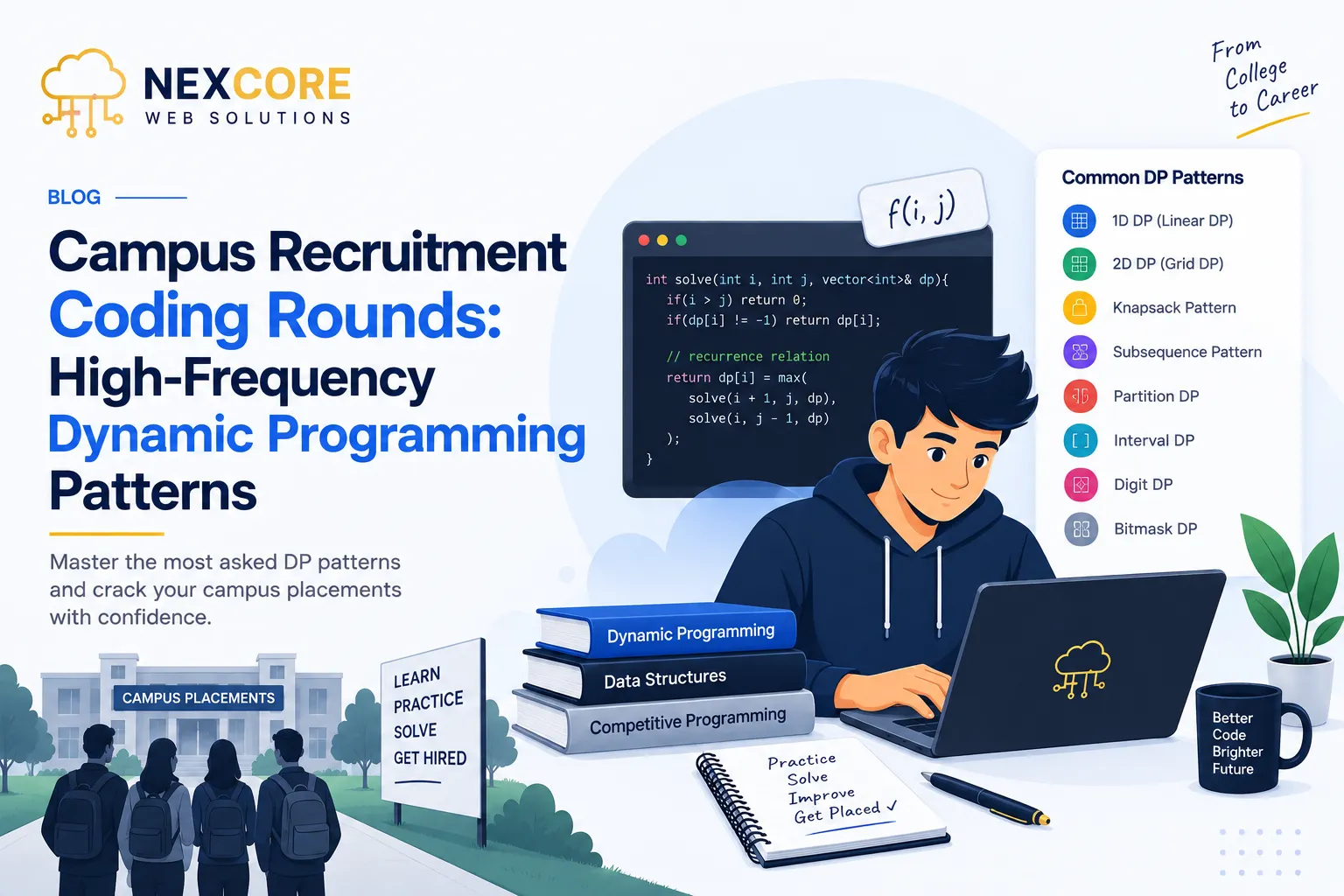
Dynamic programming (DP) is widely tested in campus recruitment coding rounds because it measures how candidates break complex problems into smaller, reusable decisions. DP questions can look difficult because they combine recursion, optimization, and careful state management. However, many problems follow recognizable patterns. Learning these patterns is more useful than memorizing solutions. Common themes include one-dimensional DP, grids, subsequences, knapsack choices, and interval problems. Once students identify the state, transition, base case, and iteration order, unfamiliar questions become easier to approach. This foundation is useful for online assessments and technical interviews.
Understanding the DP Mindset
Dynamic programming works when a problem contains overlapping subproblems and an optimal substructure. Instead of solving the same smaller problem repeatedly, DP stores previous results and reuses them. Two common approaches are top-down recursion with memoization and bottom-up tabulation. Candidates should first determine what describes a subproblem before choosing an approach. A clear state definition makes implementation easier and keeps the logic testable.
State, Transition, and Base Case
A useful analysis asks three questions: what does dp[i] or dp[i][j] represent, how can the current answer be calculated from earlier states, and what are the smallest valid cases? In a climbing-stairs problem, dp[i] can represent the number of ways to reach step i, based on earlier positions. Writing these definitions before coding reduces mistakes and prevents random trial-and-error implementation.
One-Dimensional DP Patterns
One-dimensional DP is a practical starting point because it introduces core mechanics without excessive state complexity. Problems involving climbing stairs, house robber variations, and minimum costs often use a one-dimensional state. The main challenge is identifying which earlier states affect the current result. Space can sometimes be reduced to a few variables when only recent states are required.
Climbing Stairs and Fibonacci Variations
In climbing-stairs problems, each position can usually be reached from one or two earlier positions. This creates a recurrence similar to Fibonacci and provides a simple introduction to state transitions. Candidates should write the recurrence and initial values before coding.
Knapsack and Choice-Based DP
Knapsack problems teach a pattern in which every item creates a decision: include it or exclude it. A typical state uses the current item and remaining capacity, while the transition compares both choices. Variations include 0/1 knapsack, subset sum, partition, and target-sum problems. Recognizing this structure can save time because many questions share the same decision model.
Subset Sum and Partition
Subset problems often ask whether values can produce a target sum or satisfy a partition condition. A boolean DP table can represent whether a sum is achievable. The transition checks whether the element creates a reachable sum. Candidates should pay attention to iteration direction because the wrong direction can accidentally reuse an item multiple times.
Grid-Based Dynamic Programming
Grid DP is common when a problem describes movement through a matrix. Typical examples ask for the number of paths, minimum travel cost, or maximum collected value under movement rules. A state such as dp[i][j] generally represents the best or total result for reaching a particular cell. The transition combines valid neighboring states, with special handling for blocked cells.
How to Practice DP for Campus Rounds
Effective DP preparation requires pattern recognition rather than solving random questions endlessly. Students should maintain a focused practice set covering major patterns. For every problem, write the state and transition in plain language before coding. Then test small examples and edge cases before optimizing memory or runtime.
Conclusion
Dynamic programming becomes far less intimidating when preparation is organized around recurring patterns. One-dimensional recurrences build the foundation, while knapsack and grid problems introduce more complex states and transitions. The key skill is recognizing what a state represents and how decisions lead to later results. Candidates should practice writing recurrences, validating base cases, and testing edge cases before optimizing. Regular practice across focused patterns improves speed and confidence during timed coding rounds. Reviewing failed attempts also reveals gaps in state design and boundary handling. Students should keep notes on recurring mistakes and revisit them before assessments. This turns practice into measurable improvement and builds confidence under pressure during recruitment.
FAQs
What dynamic programming patterns are most important for campus recruitment?
Candidates should prioritize one-dimensional DP, knapsack and subset-sum problems, grid DP, longest subsequence problems, and interval-based DP. These patterns cover common state-transition structures. Students should learn how to identify the state and recurrence for each pattern instead of memorizing individual solutions. This makes preparation more transferable in practice.
Should I learn recursion before dynamic programming?
Yes, basic recursion is helpful because many DP solutions begin by expressing a problem as recursive choices. However, recursion alone can repeat the same subproblems and become inefficient. DP improves that approach through memoization or tabulation. Students should understand the recursive relationship first, then learn how stored results improve performance.
How do I identify whether a coding problem requires DP?
Look for problems involving repeated subproblems, optimization, counting, or decisions that build on earlier results. Words such as maximum, minimum, number of ways, longest, shortest, or possible can be useful clues, although they do not automatically indicate DP. Define a smaller version and check whether its result can be reused to solve larger instances.
Is memoization or tabulation better for coding rounds?
Neither approach is universally better because the choice depends on the problem and implementation requirements. Memoization can be easier to derive from a recursive solution and may avoid computing unnecessary states. Tabulation usually provides predictable iteration and avoids recursion-depth concerns. Candidates should know both methods and choose the one easiest to verify.
How many DP problems should students practice before placements?
There is no fixed number that guarantees readiness because quality and variety matter more than raw count. A focused collection covering major patterns is more useful than repeatedly solving similar questions. Students should revisit incorrect solutions, explain each state and transition without looking at code, and practice under time limits. This develops understanding and implementation speed.




