
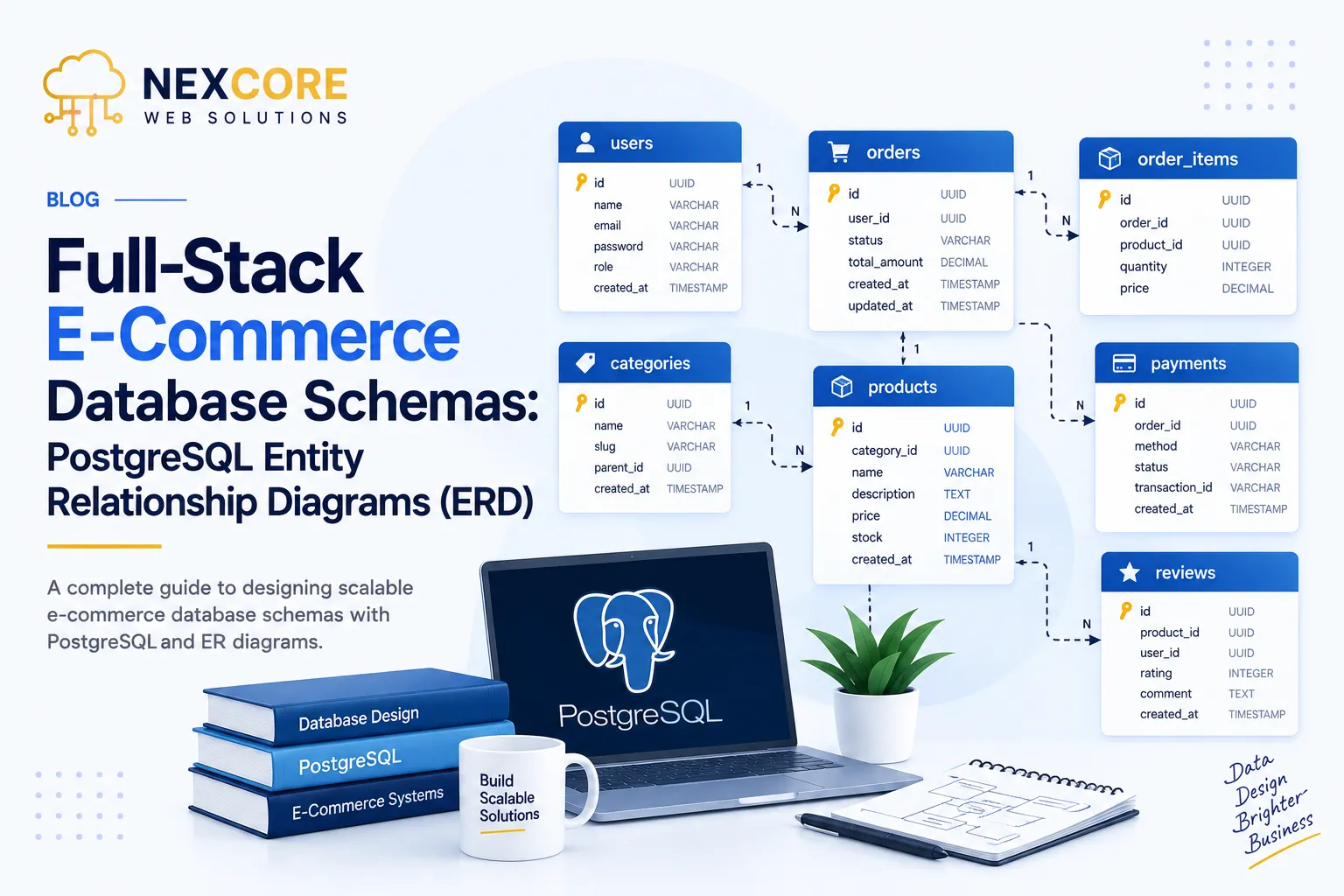
A successful e-commerce application needs a database that can reliably manage customers, products, orders, payments, and inventory. PostgreSQL is a strong choice because it supports relational structures, foreign keys, transactions, constraints, and efficient querying. Before creating tables, developers can use an Entity Relationship Diagram (ERD) to visualize how different parts of the system connect. A well-designed ERD reduces duplicate data, prevents unclear relationships, and makes future development easier. For full-stack projects, database planning is especially important because the schema becomes the foundation for backend APIs, frontend features, checkout workflows, and reporting. Understanding these relationships helps developers build e-commerce systems that remain organized as their data grows.
Core E-Commerce Database Entities
An e-commerce database usually begins with several essential entities representing major business objects. Common tables include users, addresses, products, categories, orders, order_items, payments, and inventory. Each table should have a clear responsibility instead of storing unrelated information in one large structure. For example, customer details belong in users, while product information belongs in products. This separation makes the database easier to maintain and allows different application features to access only the information they need.
Users, Addresses, and Orders
A customer can have multiple addresses, so users and addresses normally have a one-to-many relationship. An order belongs to one customer, while a customer can have many orders over time. Orders should preserve the billing and shipping information associated with the transaction because a customer may change their address later. Foreign keys can connect these tables and prevent an order from referencing a nonexistent customer. This relationship forms one of the central structures in most e-commerce ERDs.
Products and Categories
Products need a flexible structure because online stores often contain hundreds or thousands of catalog records. A simple database can place a category_id foreign key inside the products table when every product belongs to one category. If products can appear in multiple categories, a junction table such as product_categories can create a many-to-many relationship. This approach avoids storing repeated category values inside individual product records. The selected design should reflect the actual catalog rules rather than adding complexity without a business reason.
Product Variants and Inventory
Many products have variations such as size, color, storage capacity, or material. In these situations, inventory should normally be connected to a specific product variant rather than only to the general product. A product_variants table can contain SKU, variation details, and pricing information, while an inventory table can track available and reserved quantities. This structure allows the checkout process to identify the exact item being purchased. It also makes stock management more accurate when several versions of the same product exist.
Orders and Order Items
An order should not connect directly to products through a simple many-to-many relationship. Instead, an order_items table works as the bridge between orders and products or product variants. It can store quantity, unit price, discount, and product references for each purchased item. Recording the purchase price is important because the product’s current price may change after the transaction. The orders table can then store totals, tax, shipping charges, currency, status, and timestamps.
Payments and Shipments
Payment and shipping information should be separated from the main order record because they represent different operational processes. A payments table can store payment method, provider reference, amount, transaction status, and timestamps. A shipments table can track carrier details, tracking numbers, shipping status, and delivery information. Separating these entities allows the system to handle failed payment attempts, refunds, partial shipments, or multiple deliveries more effectively. These relationships can be represented clearly in the PostgreSQL ERD through foreign keys connected to the order.
PostgreSQL Constraints and Relationships
An ERD shows the intended structure, but PostgreSQL constraints enforce important rules inside the database. Primary keys uniquely identify records, while foreign keys maintain valid relationships between related tables. NOT NULL, UNIQUE, and CHECK constraints can prevent invalid data such as missing required fields, duplicate SKUs, or negative product prices. Transactions are also important during checkout because creating an order, inserting order items, and updating inventory may need to succeed together. If one operation fails, a transaction can roll back the related changes and help preserve database consistency.
Indexing for E-Commerce Performance
A good schema must consider how the application will retrieve information, not just how tables are connected. Columns frequently used in searches, joins, filtering, or sorting can benefit from appropriate indexes. Product SKUs, customer IDs, order numbers, foreign keys, and order timestamps are common examples. However, adding indexes to every column is not a good strategy because indexes consume storage and can increase write overhead. Developers should examine actual PostgreSQL query patterns and use query plans to identify performance problems before adding or changing indexes.
Designing the ERD for Full-Stack Development
The database design should match real workflows performed by the application. Developers can map actions such as registration, product browsing, cart updates, checkout, payment confirmation, and order tracking before finalizing the schema. Each workflow should have clear relationships and appropriate transaction boundaries. The ERD should document primary keys, foreign keys, cardinality, optional relationships, and important constraints. This shared diagram helps backend developers create APIs and migrations while frontend developers understand what data each feature can expect.
Conclusion
A PostgreSQL ERD provides a practical blueprint for the data layer of a full-stack e-commerce application. Separating customers, addresses, products, categories, variants, inventory, orders, payments, and shipments creates clearer responsibilities and stronger relationships. Foreign keys and constraints protect data integrity, while carefully selected indexes help applications retrieve information efficiently. The best schema should reflect real business workflows rather than attempting to support every possible feature from the beginning. Developers should start with essential entities, test the design against realistic checkout and catalog scenarios, and evolve the database through controlled migrations. A clear ERD makes full-stack development easier to understand, maintain, and extend.
FAQs
What tables are essential in an e-commerce PostgreSQL database?
Common tables include users, addresses, products, categories, product variants, inventory, orders, order items, payments, and shipments. The exact structure depends on the application’s requirements. Smaller stores may need fewer entities, while larger platforms can add reviews, coupons, returns, warehouses, or vendors. The main goal is to give each important business responsibility a clear and manageable place in the database.
Why is an ERD important for an e-commerce application?
An ERD helps developers understand relationships before writing extensive application code. It can reveal duplicate information, missing foreign keys, unclear ownership, and unsuitable table structures early in development. Because e-commerce checkout involves several connected records, planning these relationships is particularly useful. The diagram also provides a common reference for frontend developers, backend developers, database engineers, and project stakeholders.
Should products and categories have a many-to-many relationship?
A many-to-many relationship is useful when one product can legitimately belong to several categories. PostgreSQL can implement this relationship through a junction table such as product_categories, containing foreign keys for both entities. If each product belongs to exactly one category, a simpler one-to-many relationship is usually enough. The database design should follow the store’s actual catalog requirements and business rules.
Why should order items store the purchase price?
Order items should record the price charged during the transaction because product prices can change later. If an order only references the current product price, historical invoices could display incorrect amounts after a price update. Storing the transaction price preserves the financial state of the original purchase. It also makes refunds, reports, invoices, and customer-service investigations more reliable.
How does PostgreSQL maintain e-commerce data integrity?
PostgreSQL provides primary keys, foreign keys, unique constraints, check constraints, and not-null requirements to enforce important database rules. These mechanisms help prevent invalid relationships and unsuitable values from being stored. Transactions are especially valuable during checkout because multiple operations can be committed together or rolled back if something fails. Combining database-level protection with application validation creates a more dependable e-commerce system.




