
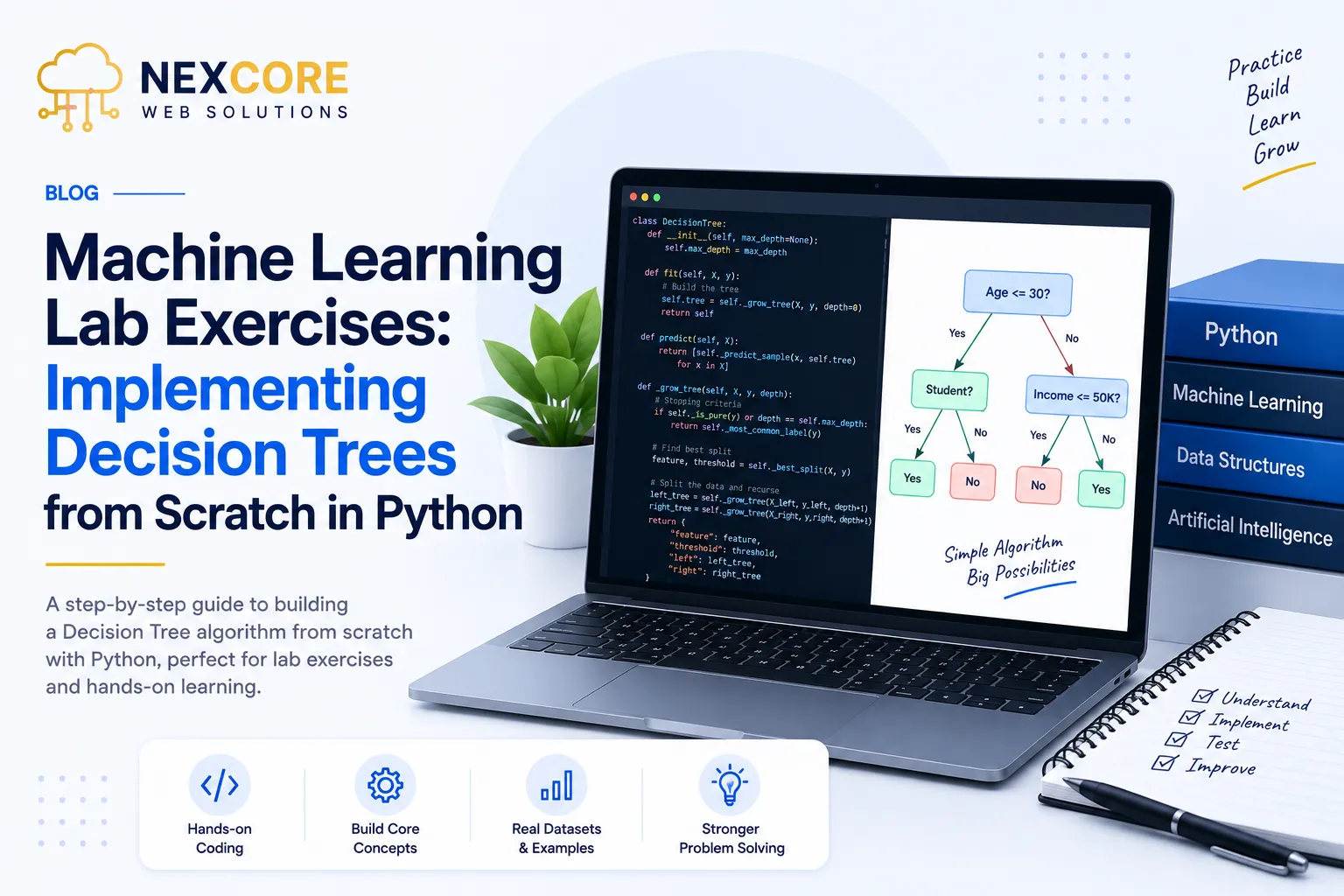
Decision trees are among the most useful machine learning algorithms for understanding how classification and regression models make decisions. They are also excellent for laboratory exercises because the underlying logic can be implemented in Python without depending entirely on machine learning libraries. Building a decision tree from scratch helps students understand concepts such as feature selection, entropy, information gain, recursion, and stopping conditions. Instead of calling a ready-made classifier, students can see how a model evaluates data and creates decision rules step by step. This practical approach strengthens programming and machine learning fundamentals at the same time. By completing this exercise, learners can understand what happens inside a decision tree before using production libraries such as Scikit-Learn.
Understanding the Decision Tree Algorithm
A decision tree represents a series of questions that divide a dataset into smaller groups. Each internal node represents a decision based on a feature, while each branch represents an outcome of that decision. The final nodes, called leaves, contain the predicted class or value. For example, a model predicting whether a student will pass could ask whether attendance is above a certain level before considering assignment scores. The tree continues splitting the data until it reaches a suitable stopping condition.
Entropy and Information Gain
A common method for selecting decision-tree splits uses entropy and information gain. Entropy measures how mixed the target classes are within a dataset, with higher entropy indicating greater uncertainty. A split is useful when it reduces this uncertainty and produces cleaner groups. Information gain measures the reduction in entropy produced by a particular split. When implementing the algorithm from scratch, calculating these values manually helps students understand why one feature threshold is selected instead of another.
Preparing the Python Dataset
Start with a small dataset so the algorithm’s behavior can be inspected easily. A CSV file containing features such as study hours, attendance, and assignment completion can be used to predict a binary outcome. Python lists, dictionaries, or NumPy arrays can store the feature values and target labels. Before training, check for missing values, inconsistent data types, and unsuitable target labels. A small dataset is particularly useful during laboratory work because students can manually verify individual splits and predictions.
Finding the Best Split
The core of a decision tree is finding the split that produces the greatest improvement in data purity. For each candidate feature, the algorithm can examine possible thresholds and divide the dataset into left and right groups. It then calculates the weighted entropy of those groups and compares the result with other candidate splits. The split producing the highest information gain becomes the next decision node. This process is repeated recursively for the resulting subsets.
Example Split Logic
Suppose a dataset contains an attendance feature with values ranging from 50 to 100 percent. The algorithm might test thresholds such as 60, 70, 80, and 90 percent. For every threshold, it separates records into two groups and calculates the resulting impurity. If 80 percent produces the highest information gain, the tree can create a rule such as attendance <= 80. The same process can then continue independently on each resulting branch.
Implementing the Tree Recursively
Recursion makes the implementation easier because every branch of the tree represents the same basic problem on a smaller dataset. A recursive function can receive the current data, available features, tree depth, and stopping parameters. It first checks whether the data should become a leaf; otherwise, it finds the best split and recursively builds both child branches. A simple node representation can store the selected feature, threshold, left child, right child, and prediction information. This structure mirrors the actual tree and makes the implementation easier to inspect.
Important Stopping Conditions
A tree should not continue splitting indefinitely because that can produce an unnecessarily complex model that memorizes the training data. Useful stopping conditions include reaching a maximum depth, having too few samples, or finding that all remaining examples belong to the same class. Another practical condition is stopping when no split produces meaningful information gain. These controls reduce overfitting and keep the resulting tree easier to understand. Students should experiment with different depth limits and observe how training and testing performance change.
Making Predictions
Once the tree has been trained, prediction means following its branches from the root to a leaf. For each input record, the algorithm compares the relevant feature value with the node’s threshold. If the condition is satisfied, it moves to one child; otherwise, it moves to the other child. This continues until a leaf is reached, where the stored class becomes the prediction. Testing several individual records manually is a useful laboratory exercise because it shows exactly how the model reaches each result.
Evaluating the Model
A decision tree should be evaluated on data that was not used to build the tree. Accuracy can provide a simple starting point for classification, but students should also consider precision, recall, F1-score, and a confusion matrix when appropriate. Comparing training and testing performance can reveal signs of overfitting. A tree that achieves nearly perfect training accuracy but performs poorly on unseen examples may be too complex. Evaluation therefore helps students connect algorithm design decisions with real predictive performance.
Comparing With Scikit-Learn
After completing the manual implementation, students can compare their results with Scikit-Learn’s decision-tree classifier. The library implementation is optimized and provides features that would require considerably more work to reproduce manually. Comparing predictions and evaluation metrics can help identify differences caused by split criteria, handling of ties, stopping rules, or parameter settings. The purpose of the exercise is not necessarily to outperform a mature library. Instead, it is to understand the algorithm deeply enough to use professional implementations correctly.
Common Laboratory Mistakes
Students often focus on writing the recursive function but overlook data preparation and evaluation. Incorrect entropy calculations, inconsistent class labels, missing stopping conditions, and accidentally training on test data can all produce misleading results. Another common mistake is assuming that a deeper tree is automatically better because it fits the training dataset more closely. Keep the implementation modular so functions for entropy, information gain, splitting, tree construction, and prediction can be tested independently. Small test cases make debugging considerably easier.
Conclusion
Implementing a decision tree from scratch in Python is a valuable machine learning laboratory exercise because it connects mathematical concepts with practical programming. Students learn how entropy measures uncertainty, how information gain guides feature selection, and how recursion creates the tree structure. They also discover why stopping conditions and separate testing data are important for controlling overfitting. After building the basic algorithm manually, comparing it with Scikit-Learn provides a useful bridge between academic understanding and professional machine learning practice. The strongest learning comes from experimenting with different datasets, thresholds, tree depths, and evaluation metrics. By understanding the internal mechanics first, students can use decision-tree libraries with much greater confidence.
FAQs
Why should students implement a decision tree from scratch?
Implementing a decision tree manually exposes the logic that a machine learning library normally hides. Students can understand how entropy, information gain, feature thresholds, recursion, and stopping conditions work together. This knowledge makes it easier to debug models and interpret library parameters later. A from-scratch implementation is particularly useful in laboratory assignments because each algorithmic step can be demonstrated and tested independently.
What is entropy in a decision tree?
Entropy measures the level of uncertainty or impurity in the target labels within a dataset. If all records belong to one class, entropy is low because there is little uncertainty. When classes are evenly mixed, entropy is higher. Decision trees use entropy-based calculations to evaluate possible splits and identify divisions that make the resulting groups more consistent in their target labels.
What is information gain?
Information gain measures how much a potential split reduces uncertainty in a dataset. The algorithm compares the entropy before the split with the weighted entropy of the resulting groups. A split that produces purer groups generally provides greater information gain. During a from-scratch implementation, calculating information gain for multiple thresholds demonstrates how the tree chooses its decision rules.
Why does a decision tree need stopping conditions?
Without stopping conditions, a decision tree can continue splitting until it closely memorizes the training examples. This creates a complex tree that may perform well on training data but poorly on unseen data, which is a common form of overfitting. Conditions such as maximum depth, minimum samples, and insufficient information gain help control tree complexity and improve generalization.
Should a from-scratch decision tree replace Scikit-Learn?
A manual implementation is mainly valuable for learning and understanding the algorithm rather than replacing optimized machine learning libraries. Scikit-Learn provides tested implementations, useful configuration options, evaluation support, and better integration with production workflows. After understanding the algorithm manually, students should use library implementations for practical projects while retaining their knowledge of how the underlying decision process works.




