
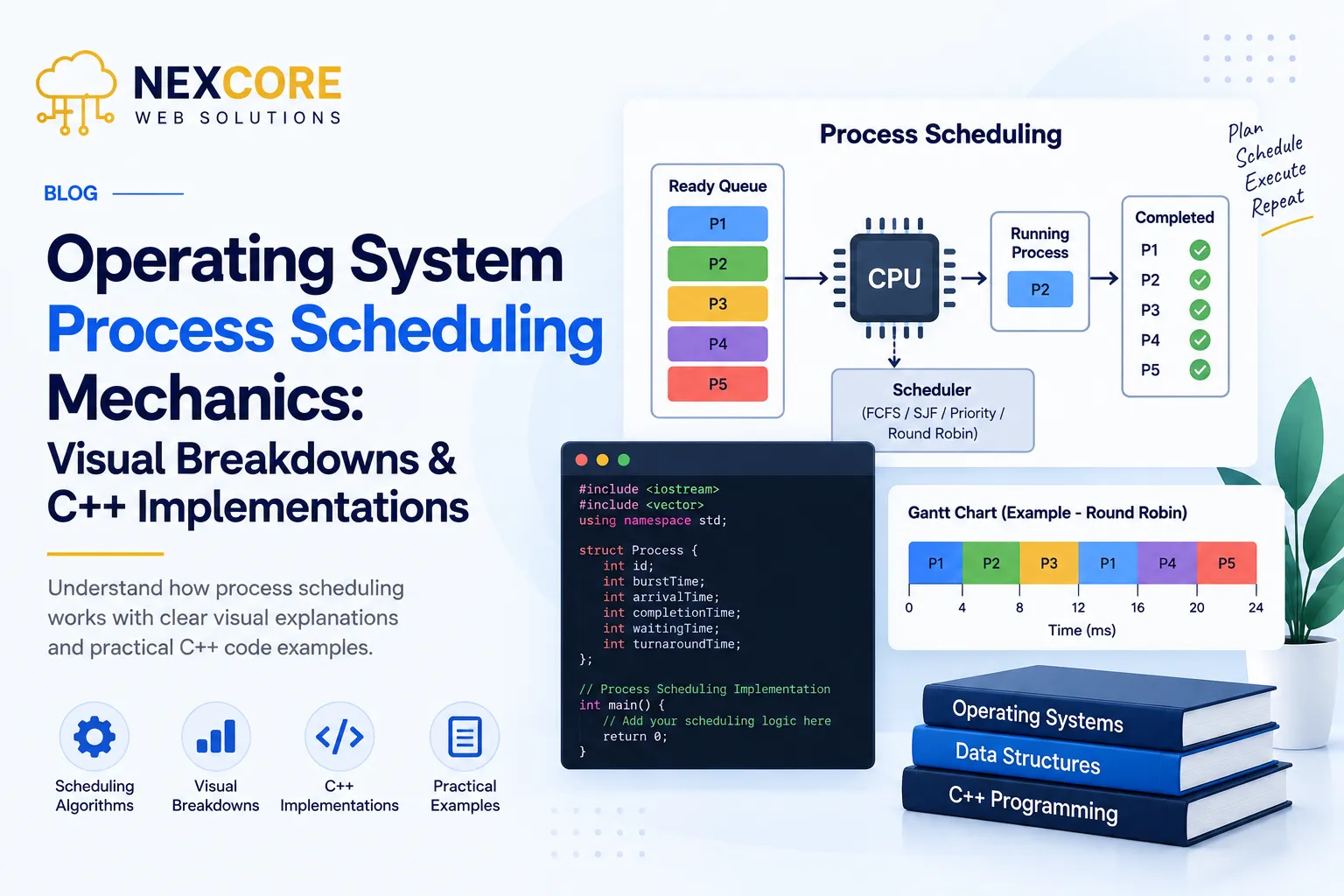
Process scheduling is one of the most important concepts in operating systems because it determines how the CPU selects work when multiple processes are ready to execute. A good scheduling strategy can improve CPU utilization, reduce waiting time, increase responsiveness, and provide fair access to computing resources. For computer science students, scheduling algorithms are also common in operating system examinations, technical interviews, and programming assignments. Algorithms such as First-Come, First-Served, Shortest Job First, Round Robin, and Priority Scheduling use different rules to decide which process runs next. Understanding these rules becomes easier when scheduling is represented with timelines and calculated using practical examples. This article explains the mechanics behind process scheduling and shows how common algorithms can be implemented in C++.
What Is Process Scheduling?
Process scheduling is the mechanism used by an operating system to decide which ready process should receive CPU time. When several processes are waiting, the scheduler evaluates their scheduling characteristics and selects one according to the active algorithm. Important values include arrival time, burst time, completion time, waiting time, turnaround time, and response time. A scheduling decision may occur when a process finishes, blocks for I/O, or is interrupted by another process in a preemptive system. The scheduler therefore plays a central role in controlling how efficiently processes share the processor.
Key Scheduling Metrics
The main scheduling metrics help developers and students compare different algorithms objectively. Turnaround time measures the total time from process arrival until completion, while waiting time measures the time spent waiting in the ready queue. Response time measures how long a process waits before receiving CPU time for the first time. Average values across all processes provide a useful way to compare scheduling strategies. Lower waiting and response times are often desirable, but real operating systems must also consider fairness, throughput, priorities, and workload characteristics.
First-Come, First-Served Scheduling
First-Come, First-Served (FCFS) schedules processes according to their arrival order. It is simple to implement because the ready queue behaves similarly to a standard FIFO queue. FCFS is normally non-preemptive, meaning a process keeps the CPU until it finishes or blocks. Its simplicity is useful for learning scheduling fundamentals, but a long CPU-bound process at the front can make shorter processes wait for a significant amount of time. This effect is commonly known as the convoy effect.
FCFS Visual Breakdown
Suppose three processes arrive in the order P1, P2, and P3, with burst times of 5, 3, and 2 units. A simple Gantt-style timeline would be represented as P1 | P2 | P3, with P1 occupying the first five units, followed by P2 and then P3. Each process starts only after the preceding process completes. This example demonstrates why process order can strongly influence waiting time. A different arrival sequence would produce different waiting and turnaround results even when the burst times remain unchanged.
Shortest Job First Scheduling
Shortest Job First (SJF) selects the process with the smallest CPU burst time among the processes currently available. In its non-preemptive form, the selected process runs until completion. SJF can produce a low average waiting time when burst lengths are known accurately, making it useful as a theoretical benchmark. However, the operating system may not know the exact future CPU burst of a process. Long processes can also experience starvation if shorter jobs continuously enter the ready queue.
Shortest Remaining Time First
Shortest Remaining Time First (SRTF) is the preemptive version of SJF. The scheduler can interrupt a running process when a newly available process has a shorter remaining burst time. This can improve response for short jobs but introduces additional context switches. The extra switching overhead means that theoretical improvements do not always translate directly into better real-world performance. SRTF is especially useful for understanding how preemption changes scheduling decisions.
Round Robin Scheduling
Round Robin is designed to provide fair CPU sharing by assigning each ready process a fixed time quantum. When the quantum expires, the running process is preempted and moved to the end of the ready queue if it still has work remaining. This approach is widely associated with interactive and time-sharing systems because processes receive regular opportunities to run. The quantum size is important because an extremely small value can cause excessive context switching. An excessively large quantum makes Round Robin behave more like FCFS.
Priority Scheduling
Priority Scheduling selects a process according to its assigned priority. Depending on the implementation, it can be preemptive or non-preemptive, and the meaning of a smaller or larger priority value must be clearly defined. Priority scheduling can ensure that important tasks receive CPU attention earlier than less urgent work. However, low-priority processes may experience starvation if higher-priority processes continually arrive. Aging is one technique used to gradually increase the priority of waiting processes and reduce this problem.
C++ Implementation Approach
C++ is well suited for implementing scheduling algorithms because arrays, vectors, queues, sorting functions, and custom structures make process data easy to manage. A simple process structure can store fields such as process ID, arrival time, burst time, priority, completion time, turnaround time, and waiting time. The scheduling function can then arrange or select processes according to the rules of the chosen algorithm. After execution, the program can calculate each metric and display the results in a table. Keeping scheduling logic separate from input and output makes the implementation easier to test and extend.
Example C++ Structure
A basic process representation can use a structure such as struct Process { int id, arrival, burst, priority; };. FCFS can then sort processes by arrival time before calculating their completion times. Round Robin requires a queue and a remaining-time field because processes may return to the ready queue after each time quantum. SJF requires selecting the shortest available burst, while Priority Scheduling requires comparing priority values. Building each algorithm around the same process structure makes it easier to compare their results using identical input data.
Preemptive vs Non-Preemptive Scheduling
The major difference between these approaches is whether the operating system can interrupt a running process before it finishes its CPU burst. Non-preemptive algorithms allow the current process to continue until it completes or blocks, which simplifies implementation and reduces context switching. Preemptive algorithms can respond more quickly to newly available or higher-priority processes but require additional scheduling decisions. Round Robin and SRTF are examples of preemptive approaches, while basic FCFS and non-preemptive SJF do not interrupt running processes. Understanding this distinction is essential when analyzing Gantt charts and calculating scheduling metrics.
Conclusion
Operating system process scheduling connects theoretical concepts with practical CPU management. FCFS demonstrates simple queue-based execution, SJF focuses on shorter jobs, Round Robin emphasizes fair time sharing, and Priority Scheduling gives preference to selected tasks. Preemptive variants introduce additional responsiveness but also increase context-switching considerations. Implementing these algorithms in C++ provides valuable practice with queues, sorting, structures, simulation logic, and performance calculations. For students, drawing a Gantt chart before writing code is an effective way to understand how every scheduling decision affects waiting and turnaround times. Once the mechanics are clear, implementing and comparing scheduling algorithms becomes much easier and provides a strong foundation for operating system interviews and projects.
FAQs
What is process scheduling in an operating system?
Process scheduling is the mechanism through which an operating system selects a ready process to receive CPU time. When multiple processes are waiting, the scheduler applies a defined algorithm such as FCFS, SJF, Round Robin, or Priority Scheduling. The objective can include improving CPU utilization, reducing waiting time, maintaining fairness, or providing faster response for interactive workloads.
Which process scheduling algorithm is easiest to implement in C++?
FCFS is generally one of the easiest scheduling algorithms to implement because processes can be arranged by arrival order and executed sequentially. A C++ program can store process information in a structure or vector and calculate completion, turnaround, and waiting times using simple loops. Its simplicity makes FCFS a useful starting point before implementing algorithms involving queues or preemption.
What is the difference between preemptive and non-preemptive scheduling?
In preemptive scheduling, the operating system can interrupt a running process and assign the CPU to another process. In non-preemptive scheduling, the running process normally continues until its CPU burst finishes or it blocks. Preemptive algorithms can improve responsiveness, but they may introduce additional context-switching overhead. Round Robin and SRTF are common examples of preemptive scheduling approaches.
Why is Round Robin useful for time-sharing systems?
Round Robin gives each ready process a fixed time quantum, allowing processes to receive CPU time repeatedly rather than letting one process occupy the processor indefinitely. This makes it suitable for workloads where responsiveness and fair CPU access matter. The chosen quantum is important because very small values can increase context-switching overhead, while very large values reduce the algorithm’s time-sharing behavior.
How can students practice CPU scheduling algorithms effectively?
Students should begin with small process sets and manually draw Gantt charts before writing C++ code. Calculate completion, turnaround, waiting, and response times by hand to understand the scheduling rules. Then implement each algorithm using a common process structure and compare the results using identical input. Testing different arrival times, burst times, priorities, and time quanta provides a better understanding of how each algorithm behaves.




