
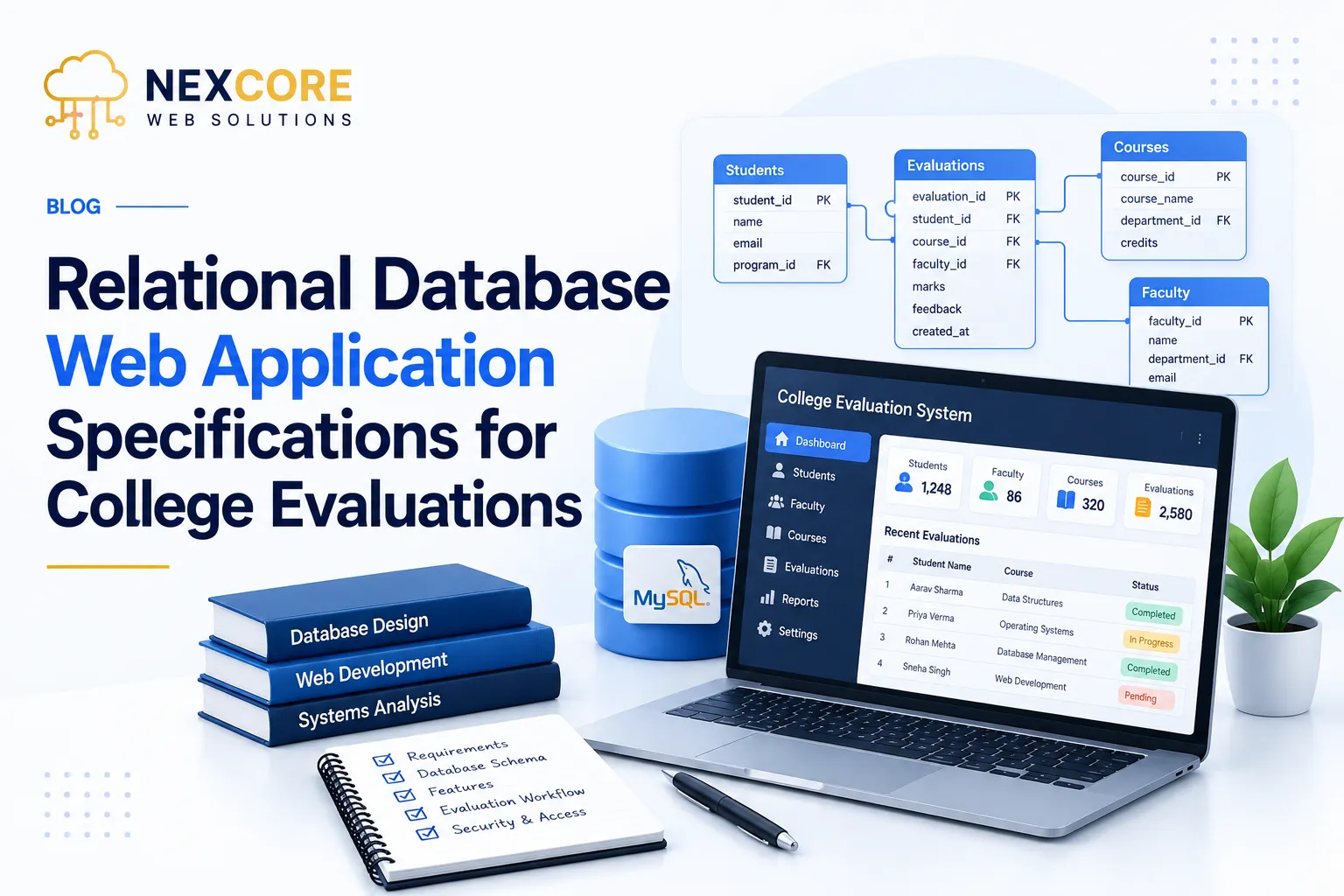
Relational database web applications are valuable college projects because they combine database design, programming, user interface development, and practical business logic in one system. Unlike simple websites, these applications require students to understand how information is stored, connected, retrieved, updated, and protected. A properly documented specification gives the development process a clear direction before coding begins. It also helps evaluators understand the project’s purpose, technical requirements, expected workflows, and database structure. Projects such as student management systems, library platforms, inventory applications, appointment systems, and course portals can all demonstrate relational database concepts effectively. For college evaluations, the goal should be to create a manageable application with a clear data model, reliable functionality, useful documentation, and enough technical depth to demonstrate genuine software development skills.
Understanding Relational Database Applications
A relational database organizes information into tables containing rows and columns. Tables are connected through relationships, allowing an application to store related information without unnecessarily duplicating data. For example, a college management system might contain separate tables for students, courses, instructors, enrollments, and departments. A specification should clearly describe these entities and explain how their relationships support the application’s workflows.
The web application normally contains three major areas: the frontend, backend, and database. The frontend collects user input and displays information, while the backend processes requests, applies business rules, and communicates with the database. The database stores persistent information and enforces relationships through keys and constraints. This separation helps students demonstrate that they understand how different application layers work together.
Key Specification Components
Project Objectives and Scope
Every project specification should begin by defining the problem the application is intended to solve. A student management application, for example, may allow administrators to register students, manage courses, record enrollments, and generate academic reports. The scope should identify what the system will include and what is intentionally excluded. A limited but complete project is easier to develop, test, document, and demonstrate than an oversized system with unfinished modules.
The specification should also identify the intended users and their responsibilities. An administrator may manage records, while teachers can update grades and students can view their academic information. Defining these roles early makes authentication and authorization requirements easier to implement. It also gives evaluators a clear understanding of how different users interact with the application.
Database Design
Database design is one of the most important parts of a relational application specification. Students should identify entities, attributes, primary keys, foreign keys, and relationships before implementing tables. An entity relationship diagram can visually explain how records are connected. For example, one department may contain many courses, while students and courses can have a many-to-many relationship through an enrollment table.
Normalization should also be considered when designing the database. Repeated information should be separated into appropriate tables so that updates remain consistent. For example, storing a student’s department name repeatedly inside every enrollment record can create unnecessary duplication. A properly normalized structure makes the database easier to maintain and reduces the risk of inconsistent information.
Functional Requirements
Functional requirements describe what the application must actually do. They should be written as specific, testable actions rather than broad statements such as “the system should be user-friendly.” A college project might require users to create accounts, add records, search data, update information, delete permitted records, generate reports, and filter results. Each requirement should correspond to a feature that can be demonstrated during evaluation.
Important functional areas may include:
- User registration and secure login.
- Role-based access to application modules.
- Create, read, update, and delete operations.
- Search, filtering, sorting, and pagination.
- Relational reports using multiple tables.
- Input validation and meaningful error messages.
- Data export where appropriate.
These requirements provide a practical checklist for development and testing. They also help students explain exactly which features were completed and how each feature interacts with the database.
Non-Functional Requirements
Non-functional requirements describe qualities that affect how the application operates. Security, performance, reliability, usability, scalability, and maintainability are common examples. Even a college project should validate user input and prevent unauthorized access to restricted records. Database queries should use safe parameterized methods to reduce the risk of SQL injection.
Performance requirements can specify acceptable response behavior for common operations. For example, searching a normal-sized student database should return results without unnecessary delays. The application should also handle invalid requests without exposing technical database errors to users. These details demonstrate that students are considering real-world software quality rather than focusing only on visible features.
Technology and Architecture
Students can build relational web applications using many technology combinations. Common options include HTML, CSS, JavaScript, React, PHP, Laravel, Node.js, Python, Django, Java, MySQL, and PostgreSQL. The selected stack should match the student’s knowledge and project requirements rather than being chosen only because it is popular. The specification should document the chosen technologies and explain their roles within the application.
The architecture should describe how requests move through the system. For example, a user submitting a registration form may send data to a backend endpoint, where validation occurs before a database transaction creates the required records. The server then returns a response that the frontend displays to the user. Describing this workflow helps evaluators understand the complete path from interface interaction to database operation.
Testing and Evaluation Criteria
Testing should be included directly in the project specification instead of being treated as an afterthought. Students should test successful operations as well as invalid input, duplicate records, missing data, unauthorized access, and database failures. Important database relationships should be tested to ensure that foreign key constraints and related records behave correctly. Each major requirement should have at least one test case with an expected result.
For college evaluation, students can organize demonstrations around realistic scenarios. For example, they can create a student, enroll that student in a course, record a grade, and generate a related report. This demonstrates several connected features instead of showing isolated screens. Screenshots, test results, database diagrams, and sample records can provide additional evidence of implementation quality.
Documentation for College Submission
Good documentation makes the technical work easier to evaluate. The project report should include the problem statement, objectives, requirements, architecture, database schema, entity relationship diagram, interface screenshots, testing results, and limitations. Students should explain important design decisions instead of simply inserting code screenshots. Installation instructions should also describe required software, database configuration, environment variables, and startup steps.
Conclusion
A strong relational database web application specification provides a clear foundation for both development and college evaluation. It should explain the project’s objectives, users, functional requirements, database relationships, technology stack, security expectations, testing approach, and documentation requirements. Students should prioritize a well-designed data model and complete core workflows before adding optional features. A project becomes easier to evaluate when its requirements can be directly connected to working functionality and documented test cases. By treating database design, application architecture, validation, security, and testing as equally important parts of the project, students can create a system that demonstrates practical software engineering knowledge rather than simply presenting a collection of web pages.
FAQs
What should a relational database web application specification include?
A specification should include the project objectives, scope, user roles, functional requirements, non-functional requirements, technology stack, database design, application architecture, security requirements, and testing strategy. It should also describe important workflows and expected outputs. Including an entity relationship diagram and clear database definitions makes the specification easier to understand and gives students a useful reference throughout development.
Which database is suitable for a college web application?
MySQL and PostgreSQL are common choices for college web applications because they support relational tables, constraints, joins, transactions, and structured queries. The best choice depends on the project’s requirements and the student’s familiarity with the technology. For most academic systems involving students, courses, orders, appointments, or inventory, either database can provide the relational features needed for a well-designed project.
Why is database normalization important in student projects?
Normalization helps organize related information into appropriate tables and reduces unnecessary duplication. For example, a student’s department information does not need to be repeatedly stored in every enrollment record. Separating related data improves consistency and makes updates easier to manage. Students should understand normalization as a practical database design principle rather than treating it only as a theoretical topic for examinations.
What security features should a college database application have?
A college application should include secure authentication, role-based authorization, input validation, protected database queries, and appropriate session management. Passwords should never be stored as plain text, and sensitive configuration values should remain outside publicly accessible source code. Students should also restrict database operations according to user roles. These measures demonstrate an understanding of basic web application security and responsible data handling.
How can students make their database project easier to evaluate?
Students can make evaluation easier by providing a clear README, database schema, entity relationship diagram, screenshots, test cases, and sample login credentials using fictional data. The demonstration should follow realistic workflows that connect multiple features. Students should also explain important design decisions and known limitations. A clean project structure and straightforward setup instructions allow evaluators to focus on functionality and technical implementation rather than configuration problems.




