
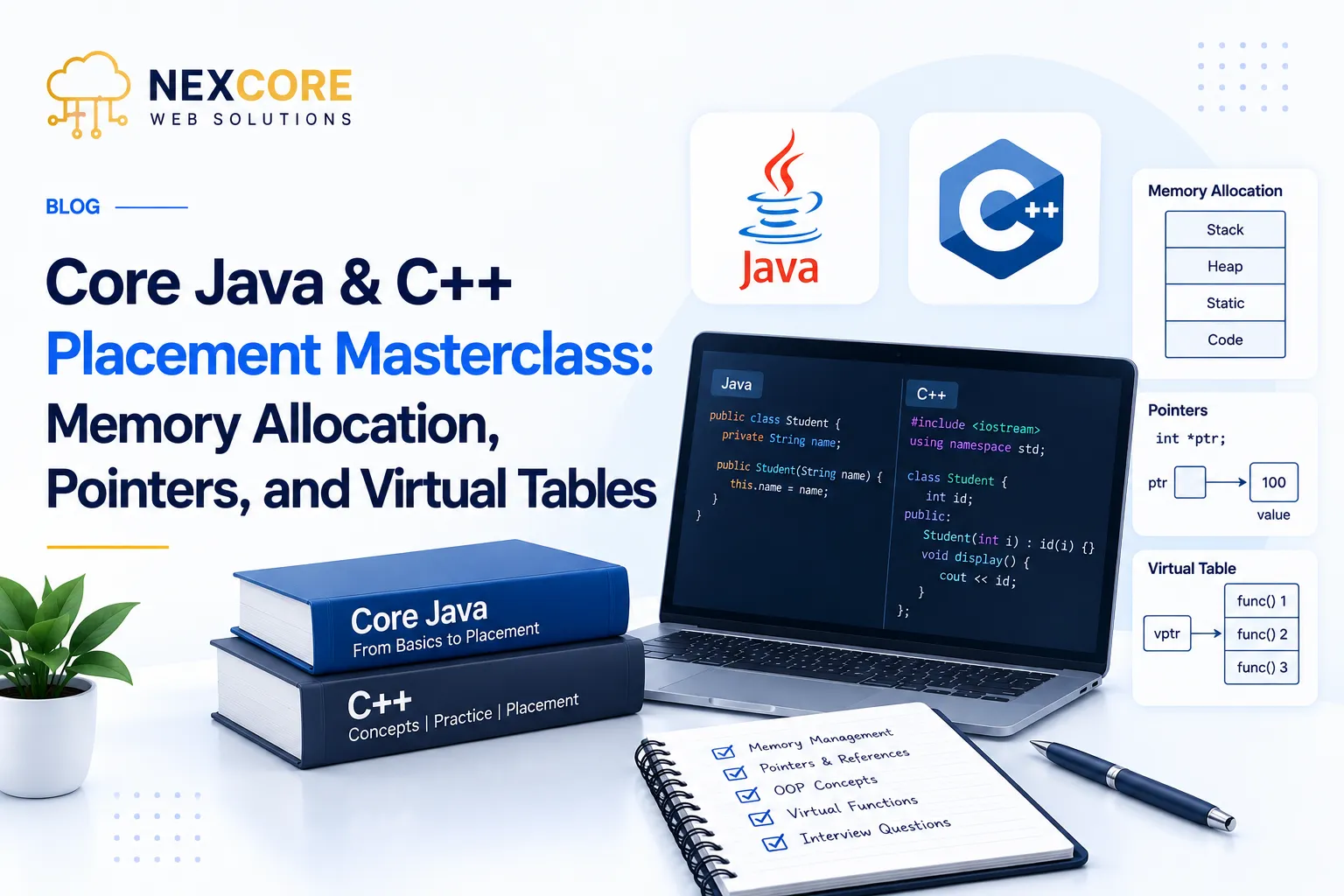
Memory management is one of the most important concepts tested in Core Java and C++ placement interviews. Candidates are often asked to explain how objects are created, where variables are stored, how pointers work, and what happens when a method is called through inheritance. These questions may look theoretical, but they reveal whether a developer understands what happens beneath the code. C++ interviews commonly focus on pointers, stack and heap allocation, references, destructors, and virtual tables, while Java interviews emphasize references, heap objects, stack frames, and garbage collection. Learning these concepts together makes it easier to understand the differences between the two languages. This masterclass covers the fundamentals you need to answer memory and object-oriented programming questions confidently.
Memory Allocation in C++
C++ gives developers direct control over memory allocation, which makes memory management a frequent placement interview topic. Local variables are generally created with automatic storage duration, while dynamically allocated objects typically use the heap. The new operator allocates memory dynamically, and delete releases memory allocated for a single object. For arrays, new[] should be paired with delete[] to avoid incorrect cleanup. Forgetting to release dynamically allocated memory can create memory leaks, while accessing already released memory can cause undefined behavior.
Stack vs Heap in C++
The stack is commonly used for local variables and function call information, making allocation and cleanup relatively fast and automatic. Heap memory is used when an object’s lifetime needs to extend beyond a particular scope or when dynamic allocation is required. Consider a function that creates a local integer and another object using new; the local integer is automatically cleaned up when the function returns, while the dynamically allocated object remains until it is explicitly released. Interviewers often use this distinction to test whether candidates understand object lifetime. Modern C++ also encourages smart pointers such as std::unique_ptr and std::shared_ptr instead of manual memory management in many situations.
Pointers and References in C++
A pointer stores the address of another object and can be used for indirect access or dynamic data structures. The address-of operator obtains an object’s address, while the dereference operator accesses the value stored at that address. Pointers can be reassigned and can also represent a null value, which makes them useful for structures such as linked lists and trees. References provide another way to access an existing object, but they generally must refer to a valid object and cannot simply be reseated like pointers. Understanding pointer arithmetic, null pointers, dangling pointers, and ownership is especially useful for C++ technical interviews.
Common Pointer Interview Traps
Interviewers may show code involving nullptr, local variables, dynamic allocation, or pointer increments and ask candidates to predict the output or identify a bug. A dangling pointer is particularly important because it points to memory whose lifetime has already ended. Dereferencing such a pointer results in undefined behavior rather than a predictable value. Candidates should also distinguish between a pointer to constant data and a constant pointer because their modification rules differ. Explaining the reasoning instead of memorizing syntax usually produces a stronger interview answer.
Memory Management in Java
Java handles memory differently because developers normally do not manually release objects. Objects are created on the heap, while local variables and method execution information are associated with individual thread stack frames. Java’s garbage collector identifies objects that are no longer reachable and can reclaim their memory automatically. However, automatic garbage collection does not mean memory-related problems are impossible. Holding unnecessary references, creating excessive objects, or using poorly designed caches can still contribute to memory pressure and OutOfMemoryError.
Java References vs C++ Pointers
Java references allow programs to access objects, but they do not provide the same low-level pointer arithmetic available in C++. You cannot increment a Java reference to move through memory or directly manipulate arbitrary memory addresses using ordinary Java code. This abstraction improves safety and allows the JVM to manage object locations internally. During interviews, it is useful to explain that Java references behave like managed handles to objects rather than exposing raw memory addresses. This distinction is one of the clearest differences between the two languages.
Virtual Tables in C++
Virtual tables, commonly called vtables, are associated with C++ runtime polymorphism. When a class contains virtual functions, a compiler commonly uses a hidden table of function addresses to support dynamic dispatch, although the C++ standard does not require a specific vtable implementation. An object may contain a hidden pointer, often called a vptr, that connects it to the appropriate virtual function table. When a virtual function is called through a base-class pointer or reference, the runtime can select the overridden implementation associated with the actual object. Interviewers often ask this topic to evaluate both object-oriented and low-level C++ understanding.
Why Virtual Functions Matter
Consider a base class containing a virtual display() function and a derived class that overrides it. If a base-class pointer refers to a derived object, calling display() can execute the derived implementation because of dynamic dispatch. Without virtual dispatch, the call may be resolved according to the static type in situations where runtime polymorphism is required. Candidates should also understand why base classes intended for polymorphic deletion commonly need a virtual destructor. This prevents incomplete destruction when a derived object is deleted through a base-class pointer.
Java and C++ Memory Concepts Compared
Java and C++ both use memory to store objects and execute programs, but they provide very different levels of control. C++ exposes manual allocation, pointers, references, destructors, and deterministic object destruction, while Java relies on managed references and garbage collection. C++ therefore gives greater low-level control but also creates more opportunities for memory-management errors. Java reduces many direct memory errors but requires developers to understand reachability and garbage-collection behavior. Knowing these differences helps candidates give precise answers when interviewers ask them to compare the languages.
Placement Preparation Strategy
A strong preparation strategy should combine theory with small coding exercises. Practice predicting outputs involving pointers, references, constructors, destructors, inheritance, and virtual functions in C++. In Java, focus on object references, garbage collection, stack frames, inheritance, and object lifecycle. Draw simple memory diagrams when studying because visualizing objects, references, and function calls makes abstract concepts easier to remember. Finally, practice explaining each concept in simple language, because placement interviews often evaluate communication and reasoning as much as syntax.
Conclusion
Memory allocation, pointers, references, and virtual tables form an important foundation for Core Java and C++ placement preparation. C++ requires candidates to understand manual and dynamic memory management, pointer behavior, object lifetime, and runtime polymorphism, while Java focuses more on managed memory, references, object reachability, and garbage collection. The most effective preparation method is to connect every theoretical concept with a small coding example and a practical memory diagram. Candidates should also learn the limitations of simplified explanations, such as treating the vtable as a mandatory language feature rather than a common compiler implementation technique. With consistent practice, these topics become easier to explain accurately during technical interviews.
FAQs
What is the difference between stack and heap memory in C++?
Stack memory is commonly used for local variables and function execution data, with automatic cleanup when the relevant scope ends. Heap memory is used for dynamically allocated objects whose lifetime can extend beyond a particular scope. C++ provides operators such as new and delete for dynamic allocation, although modern programs often prefer smart pointers. Understanding object lifetime is essential when comparing stack and heap behavior.
Are pointers available in Java like they are in C++?
Java does not provide raw pointers for ordinary application programming in the same way C++ does. Java uses references to access objects while hiding direct memory addresses and pointer arithmetic from developers. This managed approach improves safety and allows the JVM and garbage collector to control object placement and lifetime. Developers can therefore work with objects without directly manipulating arbitrary memory locations.
What is a virtual table in C++?
A virtual table, or vtable, is a common compiler implementation technique used to support dynamic dispatch for classes with virtual functions. It typically contains information that allows the program to select the appropriate overridden function at runtime. The C++ standard does not mandate a specific vtable design. Interview candidates should explain it as a common implementation mechanism rather than a formal language requirement.
Why are virtual destructors important in C++?
A virtual destructor is important when a class is intended to be used polymorphically and an object may be deleted through a base-class pointer. It allows destruction to proceed through the appropriate derived-class destructor before the base-class destructor. Without the necessary virtual destructor, deleting a derived object through a base pointer can produce undefined behavior. This is a common technical interview topic involving inheritance and object lifetime.
How should students prepare for memory-management interview questions?
Students should combine conceptual study with short coding exercises that demonstrate real behavior. Practice pointers, references, dynamic allocation, constructors, destructors, inheritance, virtual functions, Java references, and garbage collection. Drawing stack and heap diagrams can make difficult concepts easier to understand. Most importantly, practice explaining why the code behaves in a particular way rather than memorizing isolated interview answers.




