
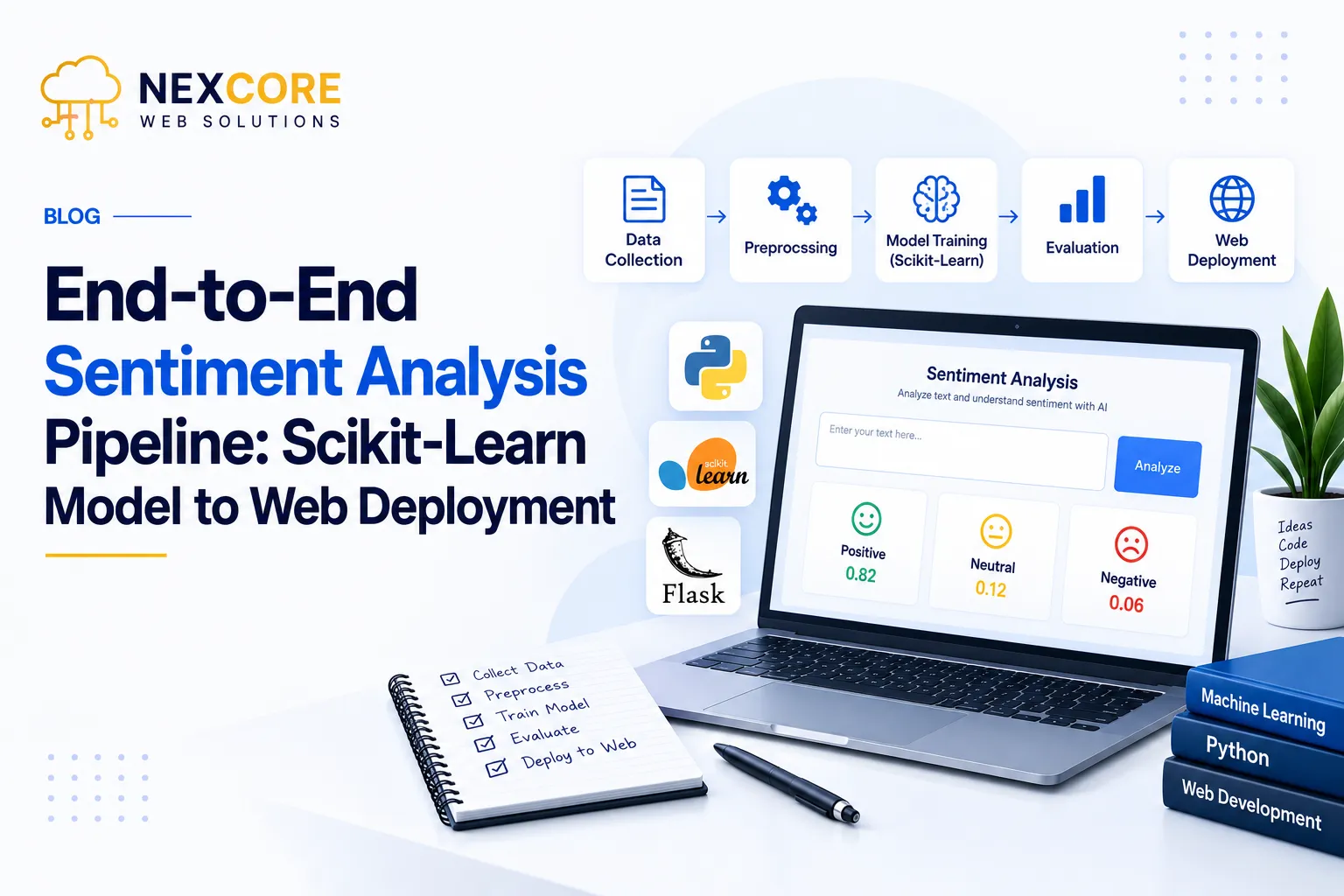
Sentiment analysis is a practical machine learning application that helps businesses understand whether text expresses a positive, negative, or neutral opinion. It can be used for customer reviews, social media comments, survey responses, support tickets, and product feedback. Building a complete sentiment analysis project involves much more than training a classification model. A production-ready pipeline must handle text cleaning, feature extraction, model training, evaluation, serialization, API development, and web deployment. Scikit-Learn provides a straightforward ecosystem for building the machine learning portion, while lightweight Python frameworks can expose the trained model through a web interface. This end-to-end approach is especially useful for students and developers because it demonstrates how a machine learning experiment can become a usable application.
1. Define the Sentiment Analysis Problem
The first step is to clearly define what the model needs to predict. A basic sentiment classifier can categorize text into positive and negative classes, while a more detailed system can include neutral sentiment as a third category. The dataset should contain examples of text paired with reliable sentiment labels so the model can learn meaningful patterns. For example, customer reviews can be labeled according to whether the reviewer expresses satisfaction or dissatisfaction. Clearly defining the input, output, and target users also makes later testing and deployment easier.
2. Prepare and Clean the Text Dataset
Raw text usually contains punctuation, inconsistent capitalization, duplicate records, missing values, and other noise. A preprocessing stage can convert text to a consistent format and remove unnecessary information while preserving words that carry sentiment. Developers should avoid aggressive cleaning that removes useful signals, such as negation words that can change the meaning of a sentence. The dataset should also be divided into training and testing portions before model evaluation. A separate validation strategy can be used when multiple model configurations need to be compared.
Handling Text Carefully
Text preprocessing should be implemented as a reusable function or pipeline rather than scattered across different parts of the project. This prevents the training and deployment environments from applying different transformations to the same input. For example, if training text is converted to lowercase and transformed with a particular vectorizer, incoming web requests must pass through the same transformation. Consistency is essential because machine learning models expect data in the representation they learned during training.
3. Convert Text Into Machine Learning Features
Scikit-Learn models cannot directly understand ordinary sentences, so text must be converted into numerical features. Two common approaches are Bag of Words and TF-IDF, with TF-IDF often providing a useful baseline for sentiment classification. TfidfVectorizer can convert a collection of documents into a numerical matrix based on term importance. Parameters such as vocabulary size, n-gram range, and minimum document frequency can influence model performance. The vectorizer must be fitted only on training data and then reused to transform testing and production inputs.
4. Train a Scikit-Learn Sentiment Model
Once the text has been transformed into numerical features, a classification algorithm can be trained. Logistic Regression, Linear Support Vector Classification, and Multinomial Naive Bayes are common choices for text classification because they can work effectively with sparse feature matrices. Start with a simple baseline instead of immediately using a complicated model. Train the model using the training dataset and compare its predictions against unseen testing examples. The goal is not simply to achieve a high training score, but to build a model that generalizes to new text.
Evaluate Model Performance
Accuracy can be useful when the dataset has balanced classes, but it should not be the only evaluation metric. Precision, recall, and F1-score provide additional information about how the classifier handles different sentiment categories. A confusion matrix can reveal whether positive and negative reviews are frequently being confused. If the dataset is imbalanced, accuracy may create a misleading impression of model quality. Evaluation should therefore reflect the actual problem and the consequences of incorrect predictions.
5. Build a Reusable Machine Learning Pipeline
A Scikit-Learn Pipeline can combine text vectorization and classification into a single reusable object. This approach reduces the risk of accidentally applying different preprocessing steps during training and prediction. The complete pipeline can receive raw text and produce a sentiment prediction without requiring the web application to reproduce the training logic. It also makes model persistence simpler because the vectorizer and classifier can be stored together. This structure is particularly valuable when moving a project from a notebook into a real application.
6. Save the Trained Model
After evaluation, the trained pipeline can be serialized using tools such as Joblib. The saved file can then be loaded by the web application without retraining the model every time the server starts. Keep the model, preprocessing configuration, dependency versions, and training information organized so the deployment environment can reproduce the expected behavior. Model files should also be treated as application assets and stored securely. Never load an untrusted serialized model file because serialization formats can present security risks when handled incorrectly.
7. Create a Web API for Predictions
The next step is to expose the model through a web API. A Python framework such as Flask or FastAPI can provide an endpoint that accepts text and returns the predicted sentiment. The server loads the trained pipeline when the application starts and uses it to process incoming requests. Input validation should reject missing, excessively large, or malformed text before it reaches the model. A simple JSON response can contain the original request identifier, predicted sentiment, and optionally a confidence-related score when the selected model supports meaningful probability estimates.
8. Connect the Model to a Web Interface
A basic frontend can provide a text box where users enter a review or comment and a button that sends the text to the prediction API. JavaScript can handle the request asynchronously and display the returned sentiment without refreshing the entire page. The interface should clearly communicate errors, loading states, and invalid input. Developers should also avoid displaying technical stack traces to visitors because these can expose implementation details. A clean interface turns the machine learning model into something that non-technical users can actually test.
9. Deploy and Monitor the Application
Before deployment, test the application locally with realistic inputs and edge cases. Confirm that the production environment contains the correct Python version, dependencies, model file, and server configuration. The API should use secure communication and appropriate access controls when handling sensitive customer feedback. After deployment, monitor errors, response times, resource usage, and unusual input patterns. Real-world feedback can also reveal language, slang, sarcasm, or domain-specific expressions that were underrepresented in the original dataset.
Conclusion
An end-to-end sentiment analysis project demonstrates the complete journey from raw text to a usable machine learning application. Scikit-Learn can handle feature extraction, model training, evaluation, and pipeline creation, while a Python web framework can expose predictions through an API. The most important engineering principle is consistency: the same preprocessing and model pipeline used during training must be preserved during deployment. Careful evaluation, validation, input handling, secure model loading, and monitoring are equally important. Instead of treating deployment as an afterthought, developers should design the project as a complete system from the beginning. This approach creates a stronger portfolio project and provides practical experience with the workflow used in real machine learning applications.
FAQs
What is the best Scikit-Learn model for sentiment analysis?
There is no single model that is best for every sentiment dataset. Logistic Regression, Linear SVM, and Multinomial Naive Bayes are useful baseline algorithms for text classification, particularly when combined with TF-IDF features. The appropriate choice should be based on testing results, dataset characteristics, speed requirements, and the cost of different prediction errors.
Why should TF-IDF be used with sentiment analysis?
TF-IDF converts text into numerical features while giving greater importance to terms that are informative within a document collection. It can provide a strong and computationally efficient baseline for traditional machine learning classification. However, TF-IDF does not fully understand context, sarcasm, or complex language relationships, so its performance depends heavily on the dataset and problem.
How can a Scikit-Learn sentiment model be deployed as a web application?
A trained Scikit-Learn pipeline can be saved with Joblib and loaded by a Python web server such as Flask or FastAPI. The server can expose an API endpoint that accepts text and returns a prediction. A frontend can then send user input to the endpoint and display the result. This separates the machine learning logic from the user interface.
Why should the vectorizer and model be saved together?
Saving the vectorizer and classifier together helps ensure that production input is transformed exactly as it was during training. If a different vocabulary or preprocessing configuration is used during deployment, the model may receive incompatible features and produce unreliable results. A Scikit-Learn Pipeline provides a convenient way to bundle these components into one reusable prediction workflow.
How can a sentiment analysis application be improved after deployment?
Improvement should begin with monitoring real-world errors and identifying patterns the original training data did not represent. Developers can collect appropriately governed feedback, review incorrect predictions, improve preprocessing, and retrain the model with better examples. Performance should be evaluated on a representative test set after every major change. Monitoring latency, failures, and input quality is also important for maintaining a reliable application.




