
Recursion is one of the most useful programming techniques for solving problems that can be broken into smaller versions of themselves. From navigating file systems and processing tree structures to implementing sorting algorithms, recursive functions appear throughout modern software development. However, recursion also depends heavily on the call stack, a limited area of memory that tracks active function calls. Understanding how stack frames are created, used, and removed helps developers write safer and more efficient recursive code. Without a proper base case or careful memory management, recursive calls can continue until the program runs out of stack space. This article explains recursion call stack mechanics, memory frames, common causes of stack overflow, and practical ways to prevent these failures.
Understanding Recursion and the Call Stack
A recursive function is a function that calls itself to solve a problem. Each call usually handles a smaller portion of the original task until it reaches a condition that stops further calls. This stopping condition is known as the base case, and it is essential for every recursive algorithm. Without a reachable base case, the function continues calling itself indefinitely until the available stack memory is exhausted.
The call stack is a data structure used by a program to keep track of currently active functions. When a function is called, the system places information about that call on top of the stack. When the function finishes, its information is removed, allowing the program to return to the previous function. This last-in, first-out behavior makes the call stack particularly suitable for managing nested and recursive function calls.
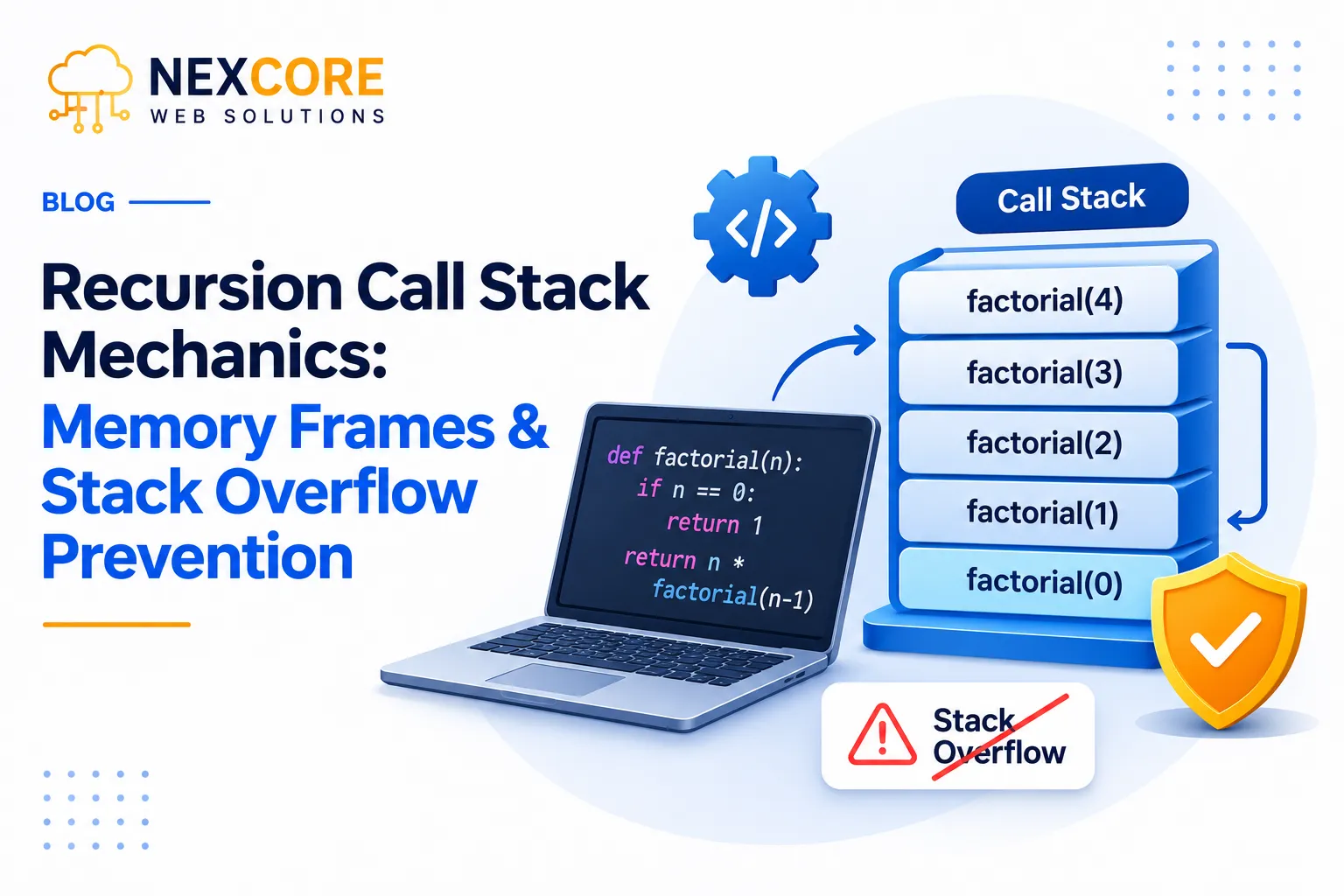
Consider a simple recursive function that calculates a factorial. Calling factorial(4) may trigger calls for factorial(3), factorial(2), and factorial(1) before the base case is reached. Each call remains on the stack while waiting for the next call to return a result. Once the base case completes, the calls are resolved in reverse order until the original function receives its final answer.
How Memory Frames Work During Recursion
What Is a Stack Frame?
A stack frame, sometimes called an activation record, contains the information required to execute one specific function call. The exact contents depend on the programming language and system architecture, but a frame commonly stores local variables, function parameters, return information, and temporary execution data. Every active call receives its own frame, even when the same recursive function is called repeatedly.
This separation is important because each recursive call needs to preserve its own state. For example, a function processing numbers from ten down to one must remember the value associated with every unfinished call. The stack keeps these independent states organized until each call completes. As a result, recursion can appear simple in source code while consuming a growing amount of memory during execution.
Building and Releasing Frames
When a recursive function makes another call, a new stack frame is placed on top of the existing frame. The earlier call pauses and waits while the newer call executes. This process continues until the program reaches the base case and no additional recursive call is needed. The system can then begin removing frames one by one as control returns through the previous calls.
This return process is often called unwinding the stack. During unwinding, each paused function resumes with the result produced by the call beneath it. In a deeply recursive algorithm, hundreds or thousands of frames may exist before unwinding begins. That memory requirement is one reason developers must consider recursion depth when designing algorithms for large inputs.
What Causes a Stack Overflow?
A stack overflow occurs when a program attempts to use more call stack memory than the system allows. The most common cause is uncontrolled recursion, where a function repeatedly calls itself without reaching a valid base case. A simple programming mistake, such as using the wrong comparison operator, can prevent the stopping condition from ever becoming true.
Excessive recursion depth can also cause a stack overflow even when the base case is correct. For example, recursively processing a linked list containing millions of items may create one frame for each item. The algorithm will eventually terminate in theory, but the program may exhaust stack memory long before reaching the final element. This distinction is important because correct logic does not always guarantee safe memory usage.
Large local variables can make the problem worse by increasing the memory required by each stack frame. Complex functions may also call other functions, adding more frames while the recursive process is active. The available stack size varies across operating systems, programming languages, runtime environments, and application settings. Developers should therefore avoid assuming that code safe on one system will handle the same recursion depth everywhere.
Practical Ways to Prevent Stack Overflow
Define a Clear and Reachable Base Case
The first step in safe recursive programming is defining exactly when recursion must stop. The base case should be easy to verify and should handle the smallest valid version of the problem. Developers should also confirm that every recursive call moves closer to that condition. Testing boundary values is especially useful for finding cases where recursion fails to make progress.
For example, a countdown function should reduce its number with every call and stop when it reaches zero. If an incorrect operation increases the value instead, the base case may never be reached. Careful code reviews and debugging tools can reveal these logical errors before they reach production. A well-designed base case protects both program correctness and memory usage.
Consider Iterative Alternatives
Not every recursive problem needs a recursive solution. Many algorithms can use loops and explicit data structures instead of relying on the system call stack. An iterative approach often provides greater control over memory, especially when processing large collections or unpredictable input sizes. For simple linear tasks, iteration is usually easier to scale without risking excessive stack growth.
Some programming languages support tail-call optimization, which can reduce stack usage for specific recursive patterns. However, developers should not depend on this behavior unless their language and runtime clearly guarantee it. A tail-recursive function may still cause a stack overflow in environments without optimization. When handling large or unknown recursion depths, an iterative design is generally the safer choice.
Debugging Recursive Memory Problems
Debugging recursion becomes easier when developers visualize the sequence of function calls. Logging parameters or using a debugger can show whether each call moves toward the base case. Stack traces are also valuable because they reveal repeated function calls and help identify the point where execution failed. Excessively long or repetitive stack traces often indicate uncontrolled recursion.
It is also helpful to test recursive functions with both small and unusually large inputs. Small tests confirm logical correctness, while larger tests expose memory limitations and performance concerns. Monitoring execution time can reveal algorithms that perform unnecessary recursive work. Combining correctness testing with memory awareness leads to more reliable implementations.
Conclusion
Recursion provides an elegant way to solve problems with naturally repetitive or hierarchical structures, but every recursive call has a memory cost. The call stack stores a separate frame for each active function, preserving parameters, local variables, and return information until execution can continue. A missing base case, excessive recursion depth, or large stack frames can eventually trigger a stack overflow. Developers can prevent many problems by ensuring each call makes progress toward a clear stopping condition and by testing realistic input sizes. When recursion depth may become unpredictable, iterative alternatives often offer better memory control. Understanding call stack mechanics helps developers choose recursion confidently while building software that remains stable, efficient, and prepared for real-world workloads.
FAQs
1. What is the relationship between recursion and the call stack?
Recursion relies on the call stack to remember each active function call. Every time a recursive function calls itself, the program creates a new stack frame containing that call’s parameters, local variables, and return information. These frames remain active until the base case is reached. The stack then unwinds, returning results through the earlier calls in reverse order.
2. Why does a missing base case cause a stack overflow?
A missing or unreachable base case allows a recursive function to continue creating new calls without stopping. Each call adds another stack frame and consumes part of the available stack memory. Because the stack has a limited size, the program eventually cannot create another frame. At that point, execution fails with a stack overflow or a similar runtime error.
3. Can a correct recursive function still cause a stack overflow?
Yes, a recursive function can have a valid base case and still exceed the available stack size. This usually happens when the input requires too many nested calls before the stopping condition is reached. Processing a very large linked list recursively is one example. The function is logically correct, but its recursion depth may exceed the memory capacity of the runtime environment.
4. What information is stored in a stack frame?
A stack frame stores the execution information needed for one active function call. Depending on the programming language and system, this can include function parameters, local variables, return addresses, temporary values, and saved processor state. Recursive calls receive separate frames so that each call can preserve its own data while waiting for deeper calls to finish.
5. Is iteration always better than recursion for preventing stack overflow?
Iteration is not always better, because recursion can make certain algorithms clearer and easier to maintain. Tree traversal, divide-and-conquer algorithms, and other hierarchical problems often fit recursion naturally. However, iteration usually provides safer memory behavior for very deep or unpredictable workloads. The best choice depends on the problem structure, expected input size, and runtime limitations.




