
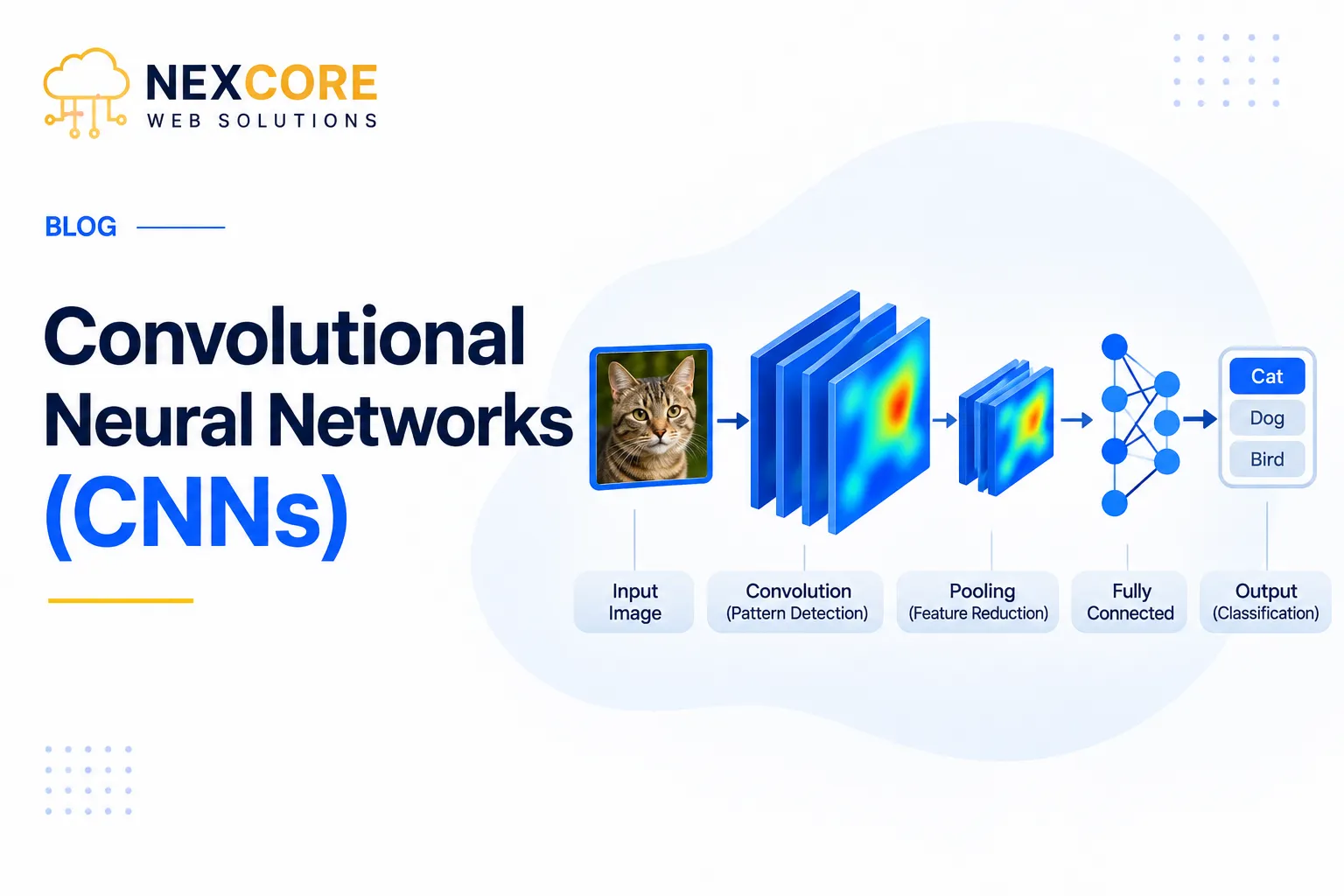
Convolutional Neural Networks, commonly known as CNNs, have transformed the way computers analyze images and other visual data. They power applications such as facial recognition, medical image analysis, self-driving vehicles, and object detection. Unlike traditional neural networks that treat every input value independently, CNNs are designed to recognize patterns within structured data. Their strength comes largely from convolution operations, where small filters scan an input to identify meaningful features, and pooling layers, which reduce data size while preserving important information. Understanding how kernel filters and pooling layers work is essential for anyone learning modern deep learning. These components determine what a CNN learns, how efficiently it processes information, and how well it can recognize patterns in unfamiliar images.
Understanding the Basic Structure of CNNs
A CNN processes visual information through a series of connected layers. An image enters the network as numerical pixel values, often arranged according to its height, width, and color channels. Early layers identify simple patterns such as edges, lines, and color changes. As the data moves deeper into the network, later layers combine these simple patterns to recognize textures, shapes, objects, and more complex visual features.
The convolutional layer is responsible for much of this feature detection. It applies learnable filters to small regions of the input instead of connecting every input value to every neuron. This approach reduces the number of parameters and allows the network to recognize similar patterns in different locations. Pooling layers are often added between convolutional layers to reduce the spatial dimensions of the data and make processing more efficient.
How Kernel Filter Operations Work
What Is a Kernel?
A kernel, also called a filter, is a small matrix of numerical values used to scan an input image or feature map. Common kernel sizes include 3×3 and 5×5, although the best size depends on the network architecture and problem. During training, the CNN adjusts the values inside each kernel to identify useful patterns automatically. A particular filter may eventually become sensitive to vertical edges, curves, textures, or other visual characteristics.
The kernel moves across the input one small region at a time. At each position, the network multiplies corresponding values from the kernel and the input region, then adds the results together. This calculation produces one value in a new feature map. Repeating the process across the full input allows the CNN to create a map showing where a specific feature appears.
Feature Detection Through Convolution
Imagine a kernel designed to detect vertical edges in a grayscale image. When the filter passes over an area containing a strong vertical contrast, its calculation may produce a high value. Areas without that pattern produce lower values, allowing the resulting feature map to highlight likely edge locations. In practice, CNNs learn these filters from training data rather than requiring developers to define them manually.
Multiple filters operate within the same convolutional layer to detect different features simultaneously. One filter might respond strongly to horizontal lines, while another identifies corners or textures. The output from these filters becomes the input for later layers, where increasingly complex patterns can be constructed. This layered learning process is one reason CNNs perform so well on image recognition tasks.
Stride and Padding in Convolution Operations
The movement of a kernel is controlled partly by a setting called stride. A stride of one moves the filter one position at a time, creating a detailed feature map but requiring more calculations. A larger stride moves the filter farther with each step and produces a smaller output. Choosing the stride involves balancing computational efficiency against the amount of spatial information retained.
Padding controls what happens at the borders of an input image. Without padding, a kernel cannot fully center itself over pixels near the edges, causing the output dimensions to shrink after convolution. Padding adds extra values, usually zeros, around the input so that border information can still be processed. Proper padding can preserve feature map dimensions and help the network retain useful information near image boundaries.
The Role of Pooling Layers
Reducing Spatial Dimensions
Pooling layers reduce the height and width of feature maps after convolution. Instead of learning filters, pooling applies a fixed operation to small regions of the input. This reduction decreases the amount of data processed by later layers and can improve computational efficiency. It also helps the network focus on important features rather than exact pixel-level positions.
For example, a 2×2 pooling window can summarize four nearby values into one output value. Reducing the size of feature maps lowers memory requirements and decreases the number of calculations needed by deeper layers. This is particularly useful when processing high-resolution images or building networks with many layers. However, excessive pooling can remove important details and reduce accuracy.
Max Pooling and Average Pooling
Max pooling selects the largest value from each region of a feature map. It is widely used because a high activation often indicates that a meaningful feature was detected in that area. By retaining the strongest response, max pooling can preserve important signals while reducing the feature map size. It can also make the network less sensitive to small changes in an object’s position.
Average pooling calculates the average value within each pooling region. This approach preserves a broader summary of local activations instead of focusing only on the strongest feature. Average pooling is useful in some architectures, particularly near the final stages of a network. The choice between max pooling and average pooling depends on the task, architecture, and type of information the model needs to preserve.
How Convolution and Pooling Work Together
Convolution and pooling layers perform different but complementary roles. Convolution extracts useful features from the input, while pooling reduces the size of those feature representations. A typical CNN repeats this pattern several times, gradually converting raw pixels into higher-level information. Early layers may detect edges, while deeper layers can recognize object parts and complete visual structures.
Consider an image classification system designed to identify different animals. Initial convolutional filters may detect fur textures, edges, and color patterns. Pooling layers reduce the amount of detailed location information while retaining strong feature responses. Deeper convolutional layers can then combine those features to distinguish characteristics associated with cats, dogs, birds, or other categories.
Practical Considerations When Designing CNNs
Selecting kernel sizes, strides, and pooling methods requires experimentation and an understanding of the data. Smaller kernels, particularly 3×3 filters, are common because multiple layers can build complex features while keeping the number of parameters manageable. Larger kernels can capture broader patterns but usually require more computation. The best configuration depends on image resolution, available training data, and the complexity of the classification task.
Modern CNN architectures do not always rely heavily on traditional pooling layers. Some models use strided convolutions to reduce feature map dimensions, while others use global average pooling near the output stage. These alternatives can simplify an architecture or preserve different types of information. Developers should evaluate design choices using validation data rather than assuming that one CNN structure works best for every problem.
Conclusion
Convolutional Neural Networks learn visual patterns by combining kernel filter operations with efficient feature reduction techniques. Kernels scan small regions of an input and create feature maps that reveal important patterns such as edges, textures, and shapes. Pooling layers then reduce spatial dimensions, helping the network process information more efficiently while retaining valuable signals. Stride and padding further control how convolutional operations interact with the input and influence the size of feature maps. Understanding these mechanics makes CNN architecture easier to interpret and design. Whether building an image classifier or studying deep learning fundamentals, developers should balance feature preservation, computational cost, and model accuracy to create reliable and effective neural networks.
FAQs
1. What is the purpose of a kernel in a CNN?
A kernel is a small matrix of learnable values that scans an input image or feature map to detect patterns. During convolution, the kernel performs mathematical calculations on small input regions and produces a new feature map. Different kernels learn to recognize different characteristics, including edges, textures, curves, and increasingly complex visual features in deeper layers.
2. What is the difference between convolution and pooling?
Convolution uses learnable filters to extract meaningful patterns from an image or feature map. Pooling does not normally learn filters; instead, it reduces the spatial size of existing feature maps using operations such as maximum or averaging. Convolution focuses on discovering features, while pooling improves efficiency and helps the network retain important information with fewer data values.
3. Why is max pooling commonly used in CNNs?
Max pooling selects the strongest activation from a small region of a feature map. A strong activation often indicates that a useful feature has been detected, so retaining the maximum value can preserve important information. It also reduces feature map dimensions and computational requirements. Additionally, max pooling can make a model less sensitive to small shifts in feature location.
4. How do stride and padding affect a CNN?
Stride determines how far a kernel moves across the input during convolution. A larger stride produces smaller feature maps and reduces computational work, while a smaller stride preserves more detail. Padding adds extra values around the input boundaries, allowing kernels to process edge regions more effectively. Together, these settings strongly influence output dimensions and feature preservation.
5. Do all modern CNNs use pooling layers?
No, modern CNN architectures can reduce feature map dimensions in several ways. Some networks use strided convolutions instead of traditional pooling layers, while others apply global average pooling near the final output stage. The choice depends on the model’s purpose and architecture. Pooling remains useful, but it is one of several techniques available for managing spatial information.




