
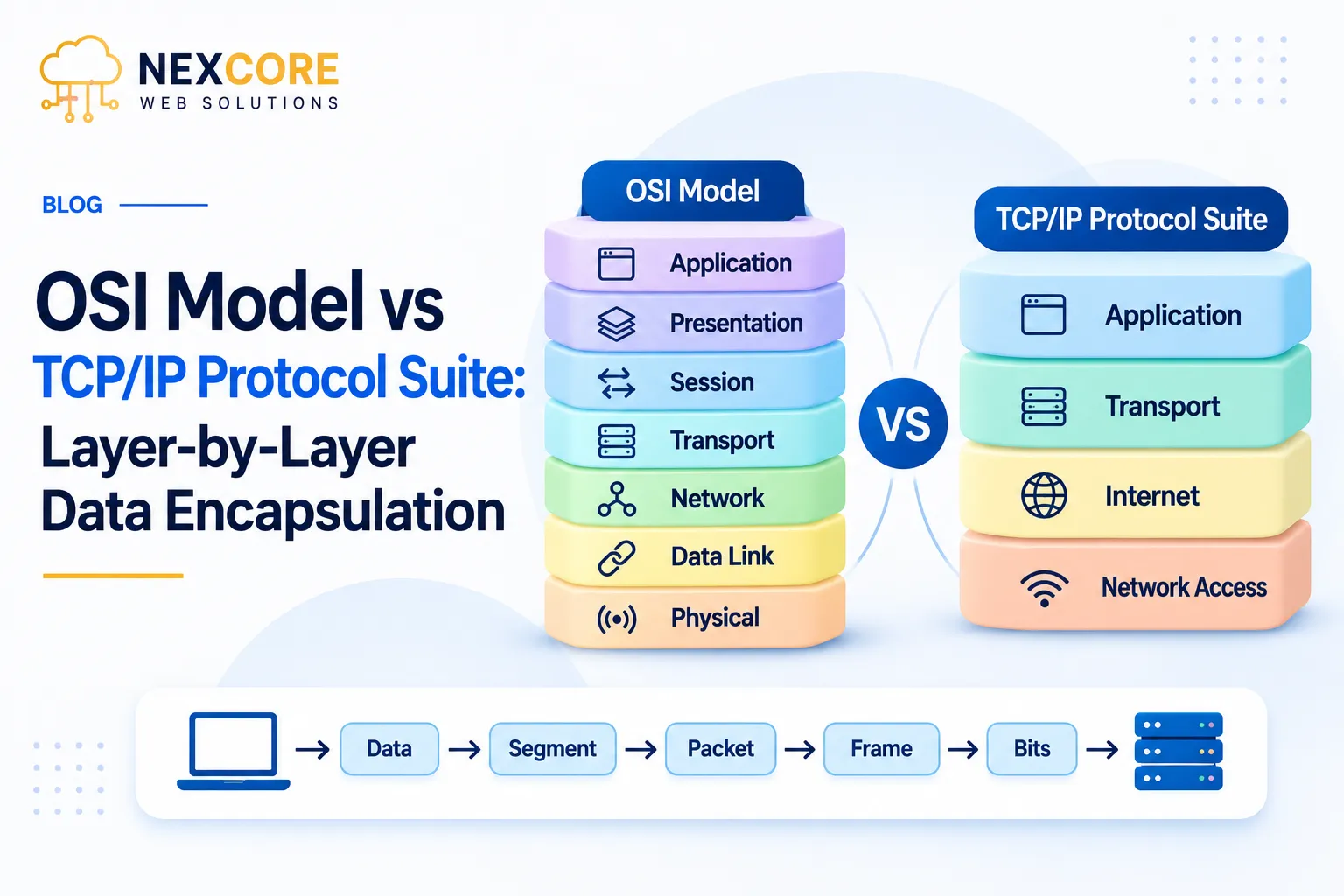
Modern networks depend on a collection of rules that allow computers, servers, smartphones, and other devices to communicate reliably. Two of the most important frameworks for understanding this communication are the OSI model and the TCP/IP protocol suite. While the OSI model provides a seven-layer conceptual framework, TCP/IP represents the practical architecture behind most internet communication. Understanding how these models relate to each other makes networking concepts easier to troubleshoot, design, and secure. One of the most important ideas connecting both models is data encapsulation, where information receives additional headers as it moves through network layers. This article explains the differences between OSI and TCP/IP and follows data through each stage of encapsulation.
Understanding the OSI Model
The Open Systems Interconnection, or OSI, model divides network communication into seven distinct layers. These layers are Application, Presentation, Session, Transport, Network, Data Link, and Physical. Each layer performs specific responsibilities and communicates with the layers immediately above or below it. This separation helps network professionals identify where communication problems occur and understand complex systems more clearly.
The upper layers focus mainly on how applications create, format, and manage information. The lower layers handle addressing, routing, local delivery, and physical transmission across a network. For example, a web browser creates an HTTP request at the application level, while lower layers prepare that request for delivery to a remote server. Although real-world protocols do not always fit perfectly into the OSI structure, the model remains a valuable learning and troubleshooting tool.
Understanding the TCP/IP Protocol Suite
The TCP/IP model is the practical protocol architecture used by the modern internet. It is commonly described using four layers: Application, Transport, Internet, and Network Access. Unlike the OSI model, TCP/IP was developed around working communication protocols rather than as a purely conceptual reference model. Its simpler structure reflects how internet technologies are actually implemented.
The TCP/IP Application layer combines the responsibilities of the OSI Application, Presentation, and Session layers. The Transport layer corresponds closely to the OSI Transport layer, while the Internet layer performs functions similar to the OSI Network layer. Finally, the Network Access layer covers the work handled by the OSI Data Link and Physical layers. This mapping makes it easier to compare the two approaches without assuming they are identical.
OSI vs TCP/IP: Layer-by-Layer Comparison
The biggest difference between the models is the number of layers and their purpose. OSI provides greater detail by separating communication functions into seven categories, whereas TCP/IP combines several functions into broader layers. Neither model should be viewed as a complete replacement for the other. Network engineers often use OSI terminology for education and troubleshooting while relying on TCP/IP protocols for actual network communication.
The OSI Application layer maps broadly to the TCP/IP Application layer, along with the OSI Presentation and Session layers. The Transport layers are similar in both models and handle end-to-end communication. The OSI Network layer maps to the TCP/IP Internet layer, while the remaining OSI layers correspond to Network Access. This relationship provides a useful framework for following data from an application to a physical network connection.
What Is Data Encapsulation?
Data encapsulation is the process of adding control information to data as it travels down through network layers. Each layer adds information required to perform its own communication task, creating a structured package for the next layer. At the receiving device, the process happens in reverse and is called decapsulation. The receiver removes and interprets each layer of information until the original application data becomes available.
Imagine sending a message through a delivery service using several protective packages and labels. The message represents the original data, while each package adds information needed for transportation and delivery. Networking works similarly because different layers need their own addressing and control details. Encapsulation allows independent network technologies to work together without requiring applications to understand every physical delivery method.
Data Encapsulation Through the Network Layers
Application and Upper-Layer Data
Communication begins when an application creates data for transmission. A browser might generate an HTTP request, while an email client creates a message using an email protocol. In the OSI model, the Presentation layer may handle formatting or encryption, and the Session layer manages communication sessions. TCP/IP generally groups these responsibilities into its Application layer.
At this stage, the information is usually referred to simply as data or a message. The application does not need to know whether the information will eventually travel through Wi-Fi, Ethernet, or another network technology. That separation allows developers to build applications without managing low-level transmission details. The lower networking layers handle the delivery process.
Transport Layer: Segments and Datagrams
The Transport layer prepares application data for communication between processes on different devices. TCP provides reliable, connection-oriented communication and divides information into segments. It uses port numbers to identify the correct application and includes control mechanisms for ordered and reliable delivery. UDP offers a simpler, connectionless approach and commonly uses the term datagram.
A streaming application, for example, may choose UDP when low latency is more important than retransmitting every lost packet. A file transfer usually benefits from TCP because complete and correctly ordered delivery is essential. The Transport layer adds its header to the original data, creating a segment or datagram. This header contains information needed for end-to-end communication.
Network Layer: Packets and IP Addressing
The Network layer, called the Internet layer in TCP/IP, handles logical addressing and routing. Internet Protocol adds source and destination IP addresses so routers can move data between different networks. Once the IP information is added, the transport-layer segment becomes part of an IP packet. Routers examine this addressing information to determine the next path toward the destination.
A packet may travel through several routers before reaching its final network. Each router makes forwarding decisions based on network information rather than application content. This layered approach allows applications to communicate across large and complex networks. It also separates end-to-end application communication from the task of finding a route between devices.
Data Link and Physical Layers: Frames and Bits
Before a packet travels across a local network, the Data Link layer places it inside a frame. The frame contains local addressing information, such as source and destination MAC addresses, along with error-detection data. These addresses help devices deliver information across a specific local network segment. When a packet reaches a router, it can be placed into a new frame for the next network connection.
Finally, the Physical layer converts the frame into signals suitable for the transmission medium. These signals may travel as electrical pulses through copper cables, light through fiber optics, or radio waves through Wi-Fi. At this point, data is represented as bits moving across the physical connection. The receiving device then begins the reverse process of decapsulation.
Why Layered Models Matter in Networking
Layered networking models simplify the development and maintenance of complex communication systems. A problem with an Ethernet cable can be investigated separately from an HTTP configuration issue because each belongs to a different layer. This structured approach helps administrators narrow down faults instead of examining every possible component at once. It also allows technologies at one layer to evolve without completely redesigning every other layer.
Security also benefits from understanding layers and encapsulation. Firewalls may inspect network addresses and ports, while application security tools examine higher-level protocols and content. Encryption can protect information at different points in the communication process depending on the protocol and security requirements. A clear understanding of OSI and TCP/IP helps teams choose appropriate controls instead of treating every network threat as the same problem.
Conclusion
The OSI model and TCP/IP protocol suite offer two useful perspectives on how network communication works. OSI provides a detailed seven-layer framework for understanding responsibilities, while TCP/IP describes the practical protocol structure that powers internet communication. Data encapsulation connects these layers by adding the information needed to transport data from one device to another. As information moves downward, it can become a segment, packet, frame, and finally a stream of bits before the receiving device reverses the process. Learning these concepts helps developers and network professionals diagnose problems, design reliable systems, and understand how seemingly simple online actions depend on multiple layers working together.
FAQs
What is the main difference between the OSI model and TCP/IP?
The OSI model is a seven-layer conceptual framework designed to explain networking functions in detail, while TCP/IP is a practical protocol suite used for real internet communication. TCP/IP commonly uses four layers and combines several OSI responsibilities into broader categories. The OSI model is especially useful for education and troubleshooting, whereas TCP/IP focuses on the protocols that devices actually use to communicate.
What is data encapsulation in networking?
Data encapsulation is the process of adding headers and other control information as data moves through networking layers. Each layer adds information needed for a specific responsibility, such as ports, IP addresses, or local hardware addresses. The resulting data units are commonly called segments, packets, and frames. At the destination, decapsulation removes this information layer by layer to recover the original application data.
How do OSI layers map to the TCP/IP model?
The TCP/IP Application layer generally combines the OSI Application, Presentation, and Session layers. Both models contain a Transport layer with similar responsibilities for end-to-end communication. The TCP/IP Internet layer corresponds broadly to the OSI Network layer. Finally, TCP/IP Network Access combines functions associated with the OSI Data Link and Physical layers.
What is the difference between a packet and a frame?
A packet is generally associated with the Network layer and contains logical addressing information, including source and destination IP addresses. A frame operates at the Data Link layer and packages the packet for transmission across a local network. Frames contain local addressing information, such as MAC addresses. As packets move between networks, they can be placed into different frames for each network connection.
Why is understanding data encapsulation important?
Understanding encapsulation helps explain how data travels from an application on one device to an application on another device. It also makes troubleshooting easier because problems can be connected to specific layers and their responsibilities. Network security professionals use layered knowledge to inspect traffic and apply suitable protections. For developers, it provides valuable context about how applications interact with underlying network infrastructure.




