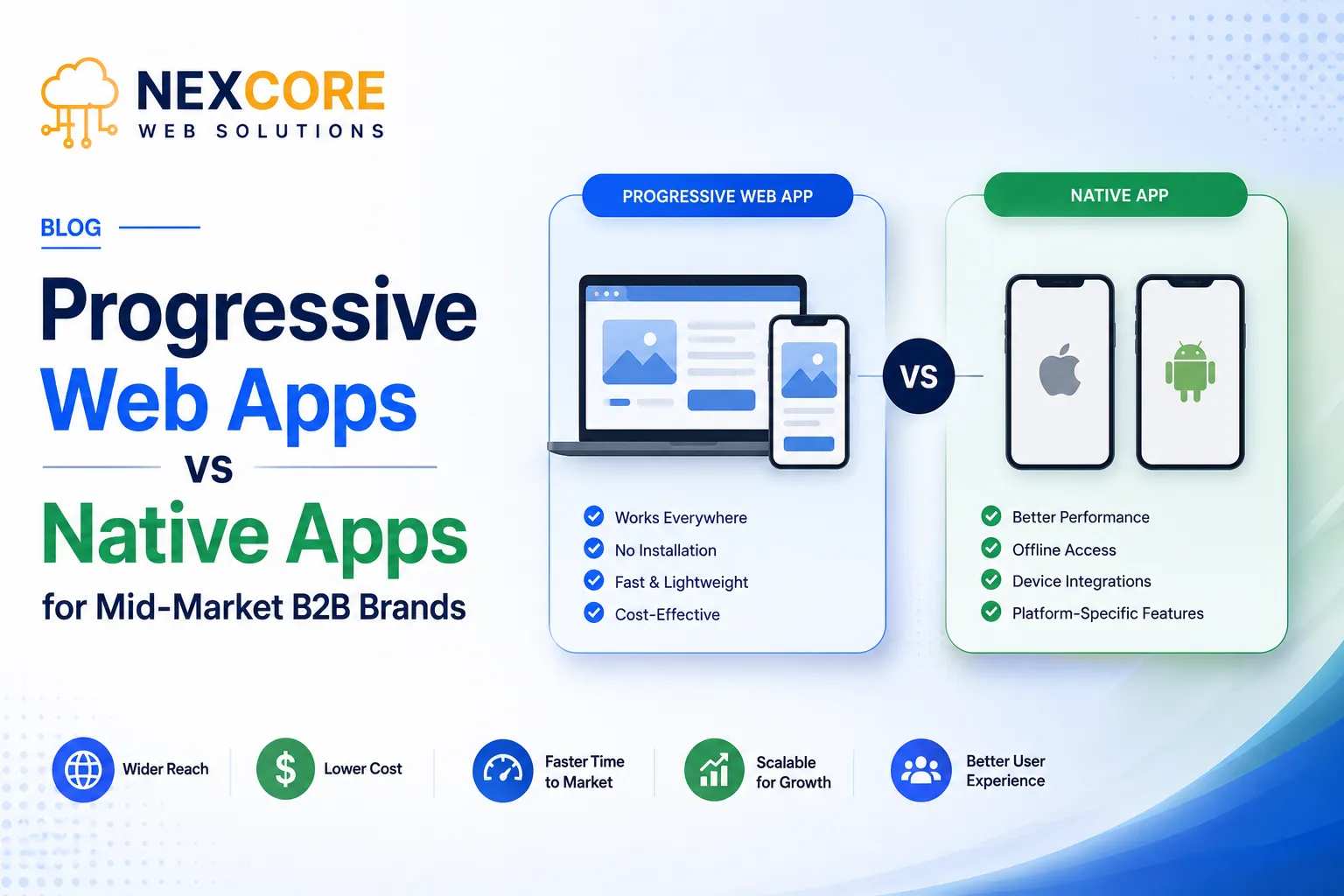
As digital transformation continues to reshape business operations, mid-market B2B companies are investing in mobile experiences to improve customer engagement, streamline workflows, and support sales teams. One of the most important technology decisions during this process is choosing between a Progressive Web App (PWA) and a native mobile application. Both approaches offer unique advantages, but the right choice depends on business objectives, budget, performance requirements, and long-term scalability. While native apps provide deep integration with mobile operating systems, Progressive Web Apps deliver cross-platform accessibility through modern web technologies. Selecting the wrong approach can increase development costs and delay digital initiatives, whereas the right solution can improve operational efficiency and customer satisfaction. Understanding the strengths and limitations of each option helps mid-market B2B brands make informed technology investments that support sustainable business growth.
Understanding Progressive Web Apps
What Is a Progressive Web App?
A Progressive Web App is a web application that delivers an app-like experience through a browser while using modern web technologies. Users can access a PWA without downloading it from an app store, and many PWAs support offline functionality, push notifications, and installation on mobile devices. Since a single codebase serves multiple platforms, businesses can reach a wider audience with lower development and maintenance costs.
Key Benefits of PWAs
Progressive Web Apps are particularly attractive for businesses seeking faster deployment and simplified maintenance. Updates are delivered instantly without requiring users to install new application versions manually. PWAs also perform well across desktops, tablets, and smartphones, creating a consistent user experience regardless of device. This flexibility makes them a practical option for many B2B organizations.
Understanding Native Applications
What Are Native Apps?
Native applications are built specifically for individual operating systems such as Android or iOS using platform-specific programming languages and development frameworks. Because they interact directly with device hardware and operating system features, native apps provide excellent performance and seamless integration. Businesses requiring advanced mobile functionality often choose native development despite the additional investment involved.
Advantages of Native Development
Native applications deliver superior responsiveness, smooth animations, and optimized performance for resource-intensive tasks. They also provide broader access to device capabilities such as cameras, biometric authentication, Bluetooth, GPS, and background processing. These features become valuable for enterprise applications supporting field operations, logistics, or mobile workforce management where hardware integration is essential.
Comparing Development Costs
Initial Investment
Development cost represents an important consideration for mid-market businesses managing limited technology budgets. Progressive Web Apps generally require a single development project because one application supports multiple platforms. Native development often involves building separate Android and iOS applications, increasing development time, testing requirements, and project expenses. Lower initial investment makes PWAs attractive for organizations seeking faster digital transformation.
Long-Term Maintenance
Maintaining multiple native applications requires continuous updates across different operating systems and device versions. Each platform may introduce unique compatibility issues requiring separate testing and maintenance efforts. Progressive Web Apps simplify ongoing maintenance because developers manage one shared codebase. This centralized approach reduces operational complexity while accelerating future feature releases.
User Experience and Performance
Speed and Responsiveness
Native applications typically provide the highest level of performance because they run directly on the device operating system. Complex graphics, offline processing, and intensive computations perform exceptionally well in native environments. Modern Progressive Web Apps have significantly improved performance through browser optimization and efficient caching techniques. For many B2B workflows, these performance differences are no longer substantial.
Accessibility Across Devices
Progressive Web Apps eliminate the need for users to download software through application stores, allowing instant access through a web browser. This simplified onboarding process reduces barriers to adoption for customers, partners, and employees. Native applications require installation before use, which may discourage occasional users. Accessibility often becomes a deciding factor for externally facing B2B solutions.
Security Considerations
Protecting Business Data
Enterprise applications frequently process confidential customer information, contracts, pricing, and financial records. Both PWAs and native applications support secure communication through encryption and strong authentication mechanisms. Regardless of development approach, organizations should implement role-based access control, secure API communication, and continuous security monitoring. Strong application security depends more on implementation quality than application type.
Compliance Requirements
Some industries require strict regulatory compliance regarding data protection and mobile device security. Native applications may offer additional control over device-specific security capabilities such as biometric authentication and hardware-backed encryption. Progressive Web Apps continue improving browser security standards, making them suitable for many enterprise environments. Compliance requirements should influence technology decisions during project planning.
Scalability for Growing Businesses
Supporting Business Expansion
As mid-market organizations expand into new markets, application scalability becomes increasingly important. Progressive Web Apps simplify deployment because new features become immediately available across all supported devices. Native applications require users to download updates through app stores before accessing new functionality. Faster deployment enables businesses to respond more quickly to changing customer requirements.
Integration with Business Systems
Both application types can integrate effectively with customer relationship management platforms, enterprise resource planning systems, inventory software, payment gateways, and cloud services. The overall integration strategy depends more on backend architecture than frontend technology. Well-designed APIs enable either solution to communicate efficiently with enterprise business systems while maintaining scalability.
Choosing the Right Solution
The ideal choice depends on specific business objectives rather than technology trends. Progressive Web Apps often provide the best value for organizations prioritizing rapid deployment, lower costs, broad accessibility, and simplified maintenance. Native applications become more suitable when advanced hardware integration, intensive processing, or highly specialized mobile functionality is essential. Evaluating customer needs, available resources, technical requirements, and long-term business goals helps organizations select the most appropriate development strategy.
Conclusion
Both Progressive Web Apps and native applications offer significant benefits for mid-market B2B brands pursuing digital transformation. PWAs provide cost-effective development, simplified maintenance, and broad accessibility across multiple platforms, making them an attractive solution for many enterprise use cases. Native applications deliver superior performance and deeper integration with device capabilities, making them ideal for applications requiring advanced mobile functionality. Rather than viewing one approach as universally better, businesses should align technology decisions with operational requirements, customer expectations, and future growth strategies. Careful planning ensures organizations invest in mobile solutions that improve efficiency, strengthen customer relationships, and support long-term digital success while maximizing return on investment.
FAQs
1. What is the difference between a Progressive Web App and a native app?
A Progressive Web App runs through a web browser using modern web technologies, while a native app is developed specifically for a mobile operating system such as Android or iOS. PWAs use a single codebase across platforms, whereas native applications require platform-specific development for optimal hardware integration and performance.
2. Are Progressive Web Apps suitable for B2B businesses?
Yes. Progressive Web Apps are an excellent option for many B2B organizations because they provide cross-platform accessibility, lower development costs, faster deployment, simplified maintenance, and support for features such as offline access and push notifications. They are particularly effective for customer portals, sales platforms, and business productivity applications.
3. When should a business choose a native mobile application?
A business should consider native development when the application requires advanced hardware integration, high-performance graphics, extensive offline processing, biometric authentication, or specialized device functionality. Native applications provide greater access to operating system capabilities and often deliver the best user experience for complex enterprise mobile solutions.
4. Which option is more cost-effective for mid-market companies?
Progressive Web Apps are generally more cost-effective because one application supports multiple devices and operating systems. Businesses reduce development, testing, deployment, and maintenance costs compared to maintaining separate Android and iOS applications. This makes PWAs an attractive investment for organizations with limited technology budgets.
5. Can Progressive Web Apps integrate with enterprise business systems?
Yes. Progressive Web Apps can integrate with enterprise systems such as CRM platforms, ERP software, inventory management solutions, payment gateways, and cloud-based services through secure APIs. Their integration capabilities are comparable to native applications when supported by well-designed backend architecture and secure communication protocols.