
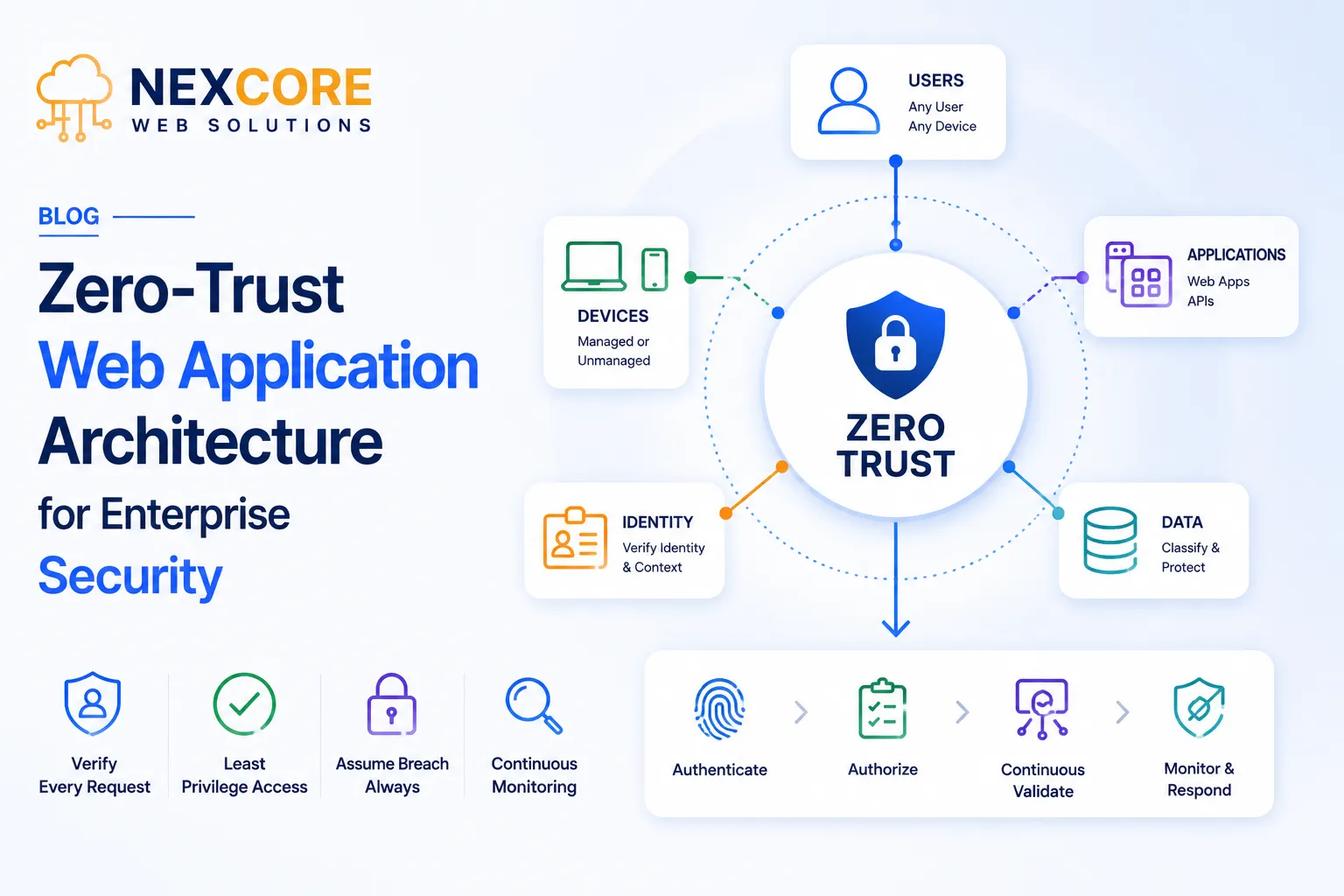
Modern enterprises operate in an environment where cyber threats are more sophisticated than ever. Employees access business applications from multiple devices, customers interact through digital platforms around the clock, and cloud-based services connect countless systems across different locations. Traditional security models that assume everything inside the corporate network is trustworthy are no longer sufficient. This shift has made Zero-Trust Architecture a critical security strategy for protecting enterprise web applications. Instead of automatically trusting users or devices based on their location, zero-trust continuously verifies every request before granting access. Implementing this approach strengthens application security, limits the impact of cyberattacks, and reduces unauthorized access to sensitive information. Understanding the principles of zero-trust web application architecture helps organizations build secure, scalable, and resilient digital platforms capable of defending against modern security threats.
Understanding Zero-Trust Architecture
What Is Zero Trust?
Zero Trust is a cybersecurity model based on the principle of “never trust, always verify.” Every user, device, application, and network request must be authenticated and authorized before accessing protected resources. Trust is not granted simply because someone is connected to the corporate network or has previously logged in. Continuous verification becomes an essential part of every interaction with enterprise systems.
Why Traditional Security Is No Longer Enough
Conventional network security often relied on perimeter-based protection where users inside the corporate network received broad access privileges. Modern organizations operate across cloud platforms, remote work environments, mobile devices, and third-party integrations, making traditional network boundaries less effective. Attackers frequently exploit compromised credentials or vulnerable endpoints to move laterally within systems. Zero-trust minimizes these risks by restricting access at every stage.
Core Principles of Zero-Trust Web Applications
Continuous Identity Verification
User authentication should not occur only during login. Zero-trust systems continuously evaluate user identity throughout active sessions using contextual information such as device health, geographic location, behavioral patterns, and authentication strength. If suspicious activity is detected, additional verification or session termination can occur automatically. Continuous validation significantly reduces the risk of unauthorized access.
Least Privilege Access
Every user should receive only the permissions necessary to perform assigned tasks. Limiting access reduces the potential damage if an account becomes compromised. Role-based access control helps organizations manage permissions efficiently while preventing unnecessary exposure to sensitive business information. Least privilege also simplifies compliance with regulatory security requirements.
Securing Enterprise Web Applications
Strong Authentication
Multi-factor authentication adds an additional security layer beyond traditional passwords by requiring users to verify their identity through multiple independent methods. Combining passwords with hardware tokens, authentication applications, or biometric verification makes unauthorized access significantly more difficult. Strong authentication forms one of the most important foundations of zero-trust security architecture.
Secure API Communication
Modern web applications depend heavily on APIs to exchange information between internal systems and third-party services. Every API request should be authenticated, encrypted, and validated before processing. Secure tokens, encrypted communication channels, rate limiting, and request validation reduce opportunities for attackers to exploit application interfaces. Consistent API security strengthens the overall architecture.
Network and Infrastructure Protection
Micro-Segmentation
Micro-segmentation divides enterprise infrastructure into smaller, isolated security zones rather than allowing unrestricted communication across the entire network. Applications, databases, and services communicate only when explicitly authorized. If attackers compromise one system, segmentation prevents unrestricted movement throughout the environment. This containment strategy significantly limits the impact of security incidents.
Device Verification
User identity alone does not guarantee secure access. Zero-trust also evaluates the security posture of devices requesting application access. Systems may verify operating system updates, endpoint protection, device certificates, and security configurations before permitting access. Preventing compromised or unmanaged devices from connecting reduces organizational risk substantially.
Monitoring and Threat Detection
Continuous Activity Monitoring
Zero-trust architecture depends on ongoing visibility into user behavior, application activity, and network traffic. Security monitoring systems analyze authentication attempts, access patterns, API usage, and unusual behavior to identify potential threats quickly. Real-time monitoring enables organizations to detect attacks before they cause widespread damage. Automated alerts support faster incident response.
Security Analytics
Artificial intelligence and behavioral analytics strengthen zero-trust environments by identifying activities that differ from established usage patterns. Unusual login locations, abnormal data access, or unexpected application behavior may indicate compromised accounts or insider threats. Intelligent analytics help security teams investigate suspicious events more efficiently while reducing false alarms.
Supporting Compliance
Protecting Sensitive Data
Enterprise applications frequently process financial information, healthcare records, customer details, and confidential business documents. Zero-trust security ensures sensitive information remains protected through encryption, strict access controls, secure authentication, and continuous monitoring. Data protection measures support both organizational security objectives and customer trust.
Meeting Regulatory Requirements
Many industries must comply with regulations governing privacy, cybersecurity, and data protection. Zero-trust architecture helps organizations demonstrate strong identity management, access control, audit logging, and security monitoring. These capabilities simplify compliance with regulatory frameworks while improving overall governance and operational transparency.
Building a Zero-Trust Strategy
Successful zero-trust implementation requires more than deploying new security technologies. Organizations should begin by identifying critical assets, classifying sensitive information, reviewing existing access permissions, and strengthening authentication mechanisms. Gradual implementation minimizes operational disruption while allowing security controls to mature over time. Regular security assessments ensure policies remain effective as business requirements evolve and new technologies are introduced.
Conclusion
Zero-trust web application architecture has become an essential cybersecurity strategy for enterprises operating in increasingly complex digital environments. By continuously verifying identities, enforcing least privilege access, securing APIs, segmenting infrastructure, and monitoring user behavior, organizations significantly reduce the risk of unauthorized access and large-scale security breaches. Unlike traditional perimeter-based security models, zero-trust recognizes that threats may originate from both external attackers and compromised internal accounts. Implementing this architecture requires careful planning, strong authentication, continuous monitoring, and ongoing policy improvements, but the long-term security benefits far outweigh the investment. As enterprise applications continue expanding across cloud environments and distributed workforces, adopting zero-trust principles provides a resilient foundation for protecting business operations, customer data, and critical digital assets.
FAQs
1. What is zero-trust architecture?
Zero-trust architecture is a cybersecurity model based on the principle of never automatically trusting users, devices, or applications. Every access request must be authenticated, authorized, and continuously verified before permission is granted. This approach reduces security risks by assuming that every connection should be validated regardless of network location.
2. Why is zero-trust important for enterprise web applications?
Enterprise web applications process valuable business information and are frequently accessed by employees, customers, and third-party services from different locations. Zero-trust strengthens security by verifying every access request, limiting user permissions, securing APIs, and continuously monitoring activity. These measures reduce the likelihood of unauthorized access and data breaches.
3. How does multi-factor authentication support zero trust?
Multi-factor authentication requires users to verify their identity using multiple independent authentication methods rather than relying solely on passwords. Even if login credentials become compromised, attackers cannot easily access protected systems without additional verification. This significantly strengthens identity security within a zero-trust environment.
4. What is micro-segmentation in zero-trust security?
Micro-segmentation divides enterprise infrastructure into smaller security zones where applications and services communicate only through explicitly authorized connections. If one system becomes compromised, attackers cannot move freely across the network. This containment strategy limits the scope of security incidents while improving overall infrastructure protection.
5. Can zero-trust help organizations meet compliance requirements?
Yes. Zero-trust supports compliance by implementing strong authentication, role-based access control, encryption, audit logging, continuous monitoring, and secure data protection practices. These capabilities help organizations satisfy regulatory requirements while improving governance, transparency, and overall cybersecurity posture across enterprise applications.




