
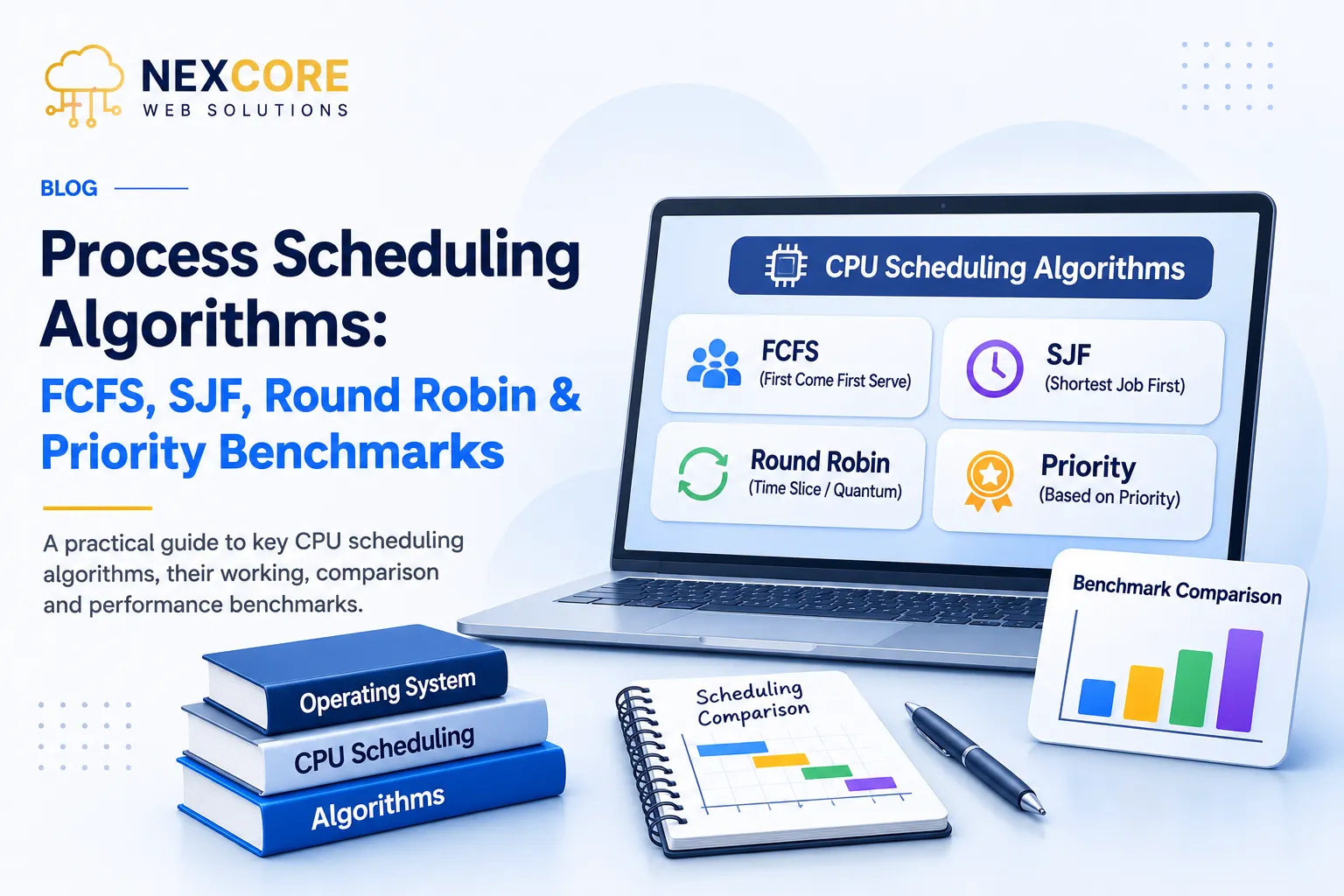
An operating system manages multiple processes that compete for CPU resources. Since a processor can execute only a limited number of instructions at a time, the operating system needs an efficient method to decide which process should run next. This responsibility is handled by CPU scheduling, one of the fundamental functions of process management. Different scheduling algorithms use different rules to distribute processor time, affecting application performance, response time, and overall system efficiency. First Come First Serve (FCFS), Shortest Job First (SJF), Round Robin, and Priority Scheduling are among the most widely studied approaches. Understanding their working mechanisms, advantages, limitations, and performance benchmarks helps developers and computer science students understand how operating systems manage workloads.
What Is Process Scheduling in Operating Systems?
Process scheduling is the mechanism through which an operating system selects a process from the ready queue and allocates CPU execution time to it. A process may be waiting for CPU access, actively executing, or temporarily blocked while waiting for input and output operations. The scheduler manages these states to ensure that available processor resources are used effectively. Its decisions directly influence how quickly applications respond and how efficiently multiple tasks complete.
The operating system uses a scheduling algorithm to determine which process receives CPU time. Some algorithms prioritize the order in which processes arrive, while others consider execution duration, priority levels, or time limits. The main objective is to balance CPU utilization, throughput, waiting time, turnaround time, and response time. No single scheduling algorithm performs best in every environment because different workloads have different requirements.
Understanding Important CPU Scheduling Metrics
Before comparing scheduling algorithms, it is important to understand the measurements used to evaluate their performance. CPU scheduling benchmarks commonly examine waiting time, turnaround time, response time, throughput, and CPU utilization. These metrics help determine whether an algorithm provides fair access to resources and completes tasks efficiently. Understanding them makes performance comparisons more meaningful.
- Waiting Time: The total time a process spends waiting in the ready queue.
- Turnaround Time: The total time between process arrival and completion.
- Response Time: The time between process arrival and its first CPU allocation.
- Throughput: The number of processes completed within a given period.
- CPU Utilization: The percentage of time the processor remains busy executing tasks.
Lower waiting and turnaround times are generally desirable, while higher throughput and CPU utilization often indicate better resource usage. However, these measurements can conflict with one another. For example, an algorithm may improve average waiting time while giving some processes significantly longer delays.
First Come First Serve (FCFS) Scheduling
How FCFS Works
First Come First Serve is one of the simplest CPU scheduling algorithms. It follows a non-preemptive approach, meaning a process continues running until it finishes or blocks for an event such as input or output. Processes enter the ready queue in arrival order, and the scheduler selects the process that has been waiting the longest. This behavior makes FCFS straightforward to implement using a standard FIFO queue.
Consider three processes arriving in the order P1, P2, and P3, with CPU burst times of 8, 4, and 2 milliseconds. FCFS executes them in that same order, regardless of their execution requirements. Although the algorithm is easy to understand, shorter processes may experience unnecessary delays behind longer tasks. This problem is commonly known as the convoy effect.
Advantages and Limitations
FCFS requires minimal scheduling overhead and provides predictable execution based on arrival order. It is suitable for simple workloads where fairness of arrival order matters more than immediate responsiveness. However, it can produce high average waiting times when long processes arrive before short ones. It is also less suitable for interactive systems that require quick responses.
Shortest Job First (SJF) Scheduling
How SJF Works
Shortest Job First selects the process with the smallest expected CPU burst time from the ready queue. In its traditional non-preemptive form, the selected process continues until completion or blocking. By prioritizing shorter tasks, SJF can reduce average waiting time when burst durations are known accurately. This makes it an important scheduling approach for understanding CPU scheduling optimization.
For example, consider three processes with burst times of 8, 4, and 2 milliseconds, all arriving simultaneously. SJF executes the 2-millisecond process first, followed by the 4-millisecond process and finally the 8-millisecond process. This ordering reduces the average waiting time compared with FCFS for this workload. However, accurately predicting future CPU burst durations can be difficult in real operating systems.
Preemptive SJF and Starvation
The preemptive version of SJF is called Shortest Remaining Time First (SRTF). It allows the scheduler to interrupt a running process when another process arrives with a shorter remaining execution time. This can improve responsiveness for short tasks but may increase context-switching overhead. Long-running processes can also experience starvation if shorter processes continue arriving.
Round Robin Scheduling
How Time Quantum Works
Round Robin is a preemptive scheduling algorithm commonly associated with time-sharing systems. Each process receives a fixed amount of CPU time called a time quantum or time slice. If the process does not finish within that interval, the operating system interrupts it and places it at the end of the ready queue. The scheduler then gives the next waiting process an opportunity to execute.
The time quantum has a major influence on Round Robin performance. A very small quantum creates frequent context switches, increasing scheduling overhead and reducing useful CPU execution time. A very large quantum makes Round Robin behave more like FCFS. Selecting an appropriate quantum helps balance responsiveness and execution efficiency.
Priority Scheduling
Priority Scheduling assigns each process a priority value and selects processes according to their assigned importance. Higher-priority processes generally receive CPU access before lower-priority processes. This algorithm can operate in both preemptive and non-preemptive forms, depending on whether a newly arriving high-priority process can interrupt the current task. It is useful in systems where certain operations must receive preferential treatment.
However, low-priority processes may experience starvation when high-priority workloads continuously occupy the processor. Aging helps address this problem by gradually increasing the priority of processes that have waited for extended periods. This allows neglected processes to eventually receive CPU time. Priority Scheduling is particularly useful when workloads have different levels of urgency.
Performance Benchmarks: Comparing Scheduling Algorithms
The following example compares average waiting time using three processes that arrive simultaneously, with CPU burst times of 8, 4, and 2 milliseconds. For Round Robin, assume a time quantum of 2 milliseconds. For Priority Scheduling, assume P1, P2, and P3 have descending priority, with P1 receiving the highest priority.
| Algorithm | Average Waiting Time |
|---|---|
| FCFS | 6.67 ms |
| SJF | 2.67 ms |
| Round Robin | 4.67 ms |
| Priority Scheduling | 6.67 ms |
These figures represent a simplified workload rather than universal performance benchmarks. SJF performs best in this example because it executes shorter processes first. FCFS and Priority Scheduling produce the same result because their execution orders are identical. Round Robin provides more balanced CPU access, although context-switching overhead is excluded from these calculations.
Conclusion
FCFS, SJF, Round Robin, and Priority Scheduling each solve CPU resource allocation differently. FCFS offers simplicity, SJF reduces average waiting time under suitable conditions, Round Robin improves responsiveness through time-sharing, and Priority Scheduling supports workloads with different levels of importance. Their performance depends on process arrival times, CPU burst durations, priority assignments, and scheduling overhead. Developers and computer science students should understand these differences before evaluating operating system performance. Rather than selecting an algorithm based on a single benchmark, it is important to consider the workload and system requirements. Effective process scheduling ultimately balances fairness, responsiveness, throughput, and efficient processor utilization.
FAQs
1. Which CPU scheduling algorithm provides the lowest average waiting time?
Shortest Job First generally provides the minimum average waiting time when all processes are available simultaneously and their CPU burst times are known. It prioritizes shorter tasks, allowing them to finish before longer processes. However, its effectiveness depends on accurate burst-time estimates. In practical operating systems, predicting execution duration can be challenging.
2. What is the main difference between FCFS and Round Robin scheduling?
FCFS executes processes according to their arrival order without interrupting a running process. Round Robin uses a fixed time quantum and allows processes to take turns using the CPU. If a process does not finish within its allocated time, it moves to the end of the ready queue. Round Robin is therefore generally more suitable for interactive systems.
3. Why does starvation occur in Priority Scheduling?
Starvation occurs when low-priority processes continuously wait because higher-priority processes keep receiving CPU resources. This can prevent some tasks from completing within a reasonable period. Operating systems can reduce starvation through aging, which gradually increases the priority of waiting processes. This approach improves fairness while preserving priority-based scheduling.
4. What is the ideal time quantum in Round Robin scheduling?
There is no universally ideal time quantum because the best value depends on process behavior, hardware, and scheduling overhead. A very small quantum increases context switching, while a very large quantum reduces responsiveness and makes the algorithm resemble FCFS. Operating system designers select a suitable value by balancing response time and processor efficiency.
5. Which process scheduling algorithm is best for modern operating systems?
No single traditional scheduling algorithm is best for every modern operating system. Interactive applications benefit from responsive scheduling, while background workloads may prioritize throughput and resource efficiency. Modern operating systems often use more advanced scheduling mechanisms that consider priorities, processor availability, workload characteristics, and fairness. The appropriate approach depends on the system’s intended use.




