
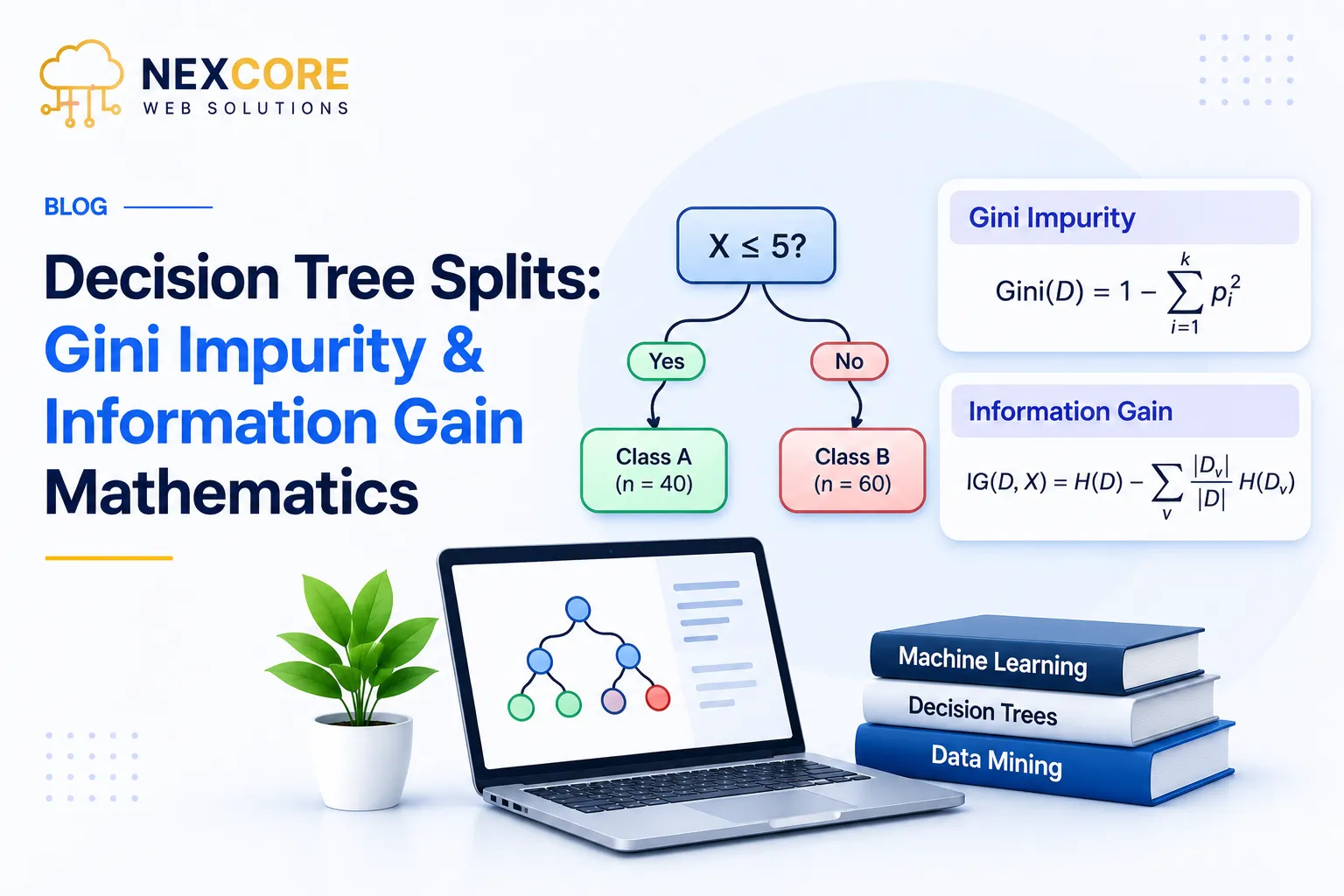
Decision trees are among the most widely used machine learning algorithms for classification and regression tasks. They make predictions by repeatedly dividing datasets into smaller groups based on selected features. However, choosing the right feature and determining the best splitting point are critical to building an accurate decision tree. This is where mathematical measures such as Gini Impurity and Information Gain become important. Both techniques help algorithms evaluate how effectively a split separates different classes within a dataset. Understanding their calculations makes it easier to interpret how decision trees learn from training data. Whether developing a customer prediction model, detecting fraudulent transactions, or analyzing medical information, understanding decision tree splitting mathematics helps build more reliable machine learning solutions.
Understanding Decision Tree Splitting
A decision tree works by dividing data into smaller subsets using conditions based on input features. Each internal node represents a decision, each branch represents an outcome, and each leaf node provides a final prediction. During training, the algorithm examines available features and searches for splits that create more homogeneous groups. This process continues until a stopping condition is reached, such as a maximum depth or minimum number of samples.
Consider a dataset containing information about customers who purchase or do not purchase a product. Features might include age, income, browsing activity, and previous purchases. A decision tree could first divide customers according to income and then examine browsing activity within each resulting group. The objective is to create branches where observations belong predominantly to one target class, making predictions more accurate and interpretable.
What Is Gini Impurity?
Gini Impurity measures how frequently a randomly selected observation would be incorrectly classified if its class label were assigned according to the class distribution within a node. It is commonly used by classification decision trees, particularly the CART algorithm. A lower Gini value indicates that the node contains a more concentrated distribution of classes. A value of zero represents a completely pure node in which all observations belong to the same class.
Gini Impurity Formula
The mathematical formula for Gini Impurity is:
[
Gini = 1-\sum_{i=1}^{n}p_i^2
]
Here, (p_i) represents the proportion of observations belonging to class (i), while (n) represents the total number of classes. The algorithm calculates the squared probability of each class and subtracts their sum from one. This calculation measures the likelihood of classification error under the node’s class distribution.
Practical Gini Impurity Example
Suppose a dataset contains 10 observations, including six positive examples and four negative examples. Their class probabilities are 0.6 and 0.4, respectively. Applying the formula gives:
[
Gini=1-(0.6^2+0.4^2)
]
[
Gini=1-(0.36+0.16)=0.48
]
The resulting impurity is 0.48, indicating that the node contains a mixture of both classes. If all 10 observations belonged to the positive class, the Gini Impurity would become zero. Decision trees prefer splits that produce child nodes with lower weighted Gini Impurity than the original parent node.
How Decision Trees Select Splits Using Gini Impurity
A decision tree evaluates possible splitting conditions for available features and calculates the impurity of the resulting child nodes. It then combines those values using the number of observations in each child as weights. The split producing the lowest weighted impurity is generally selected. This allows the algorithm to prioritize divisions that create cleaner groups rather than simply dividing the dataset into similarly sized subsets.
The weighted Gini calculation is:
[
Gini_{split}=\frac{N_L}{N}Gini_L+\frac{N_R}{N}Gini_R
]
Here, (N_L) and (N_R) represent the number of observations in the left and right child nodes, while (N) represents the total observations. (Gini_L) and (Gini_R) represent their respective impurity values. Weighting ensures that a small child node does not influence the overall result as much as a larger one.
Understanding Information Gain
Information Gain is another important measurement used to evaluate decision tree splits. It is based on entropy, a mathematical measure of uncertainty or disorder within a dataset. A node containing different classes in similar proportions has higher entropy than a node dominated by one class. Information Gain measures how much uncertainty decreases after dividing the dataset using a particular feature.
Entropy Formula
The entropy formula is:
[
Entropy(S)=-\sum_{i=1}^{n}p_i\log_2(p_i)
]
In this expression, (S) represents the dataset and (p_i) represents the probability of class (i). The logarithm uses base two because entropy is commonly measured in bits. For a binary classification problem, entropy reaches zero when every observation belongs to one class and reaches one when both classes are equally represented.
Calculating Information Gain
Information Gain measures the difference between the original dataset’s entropy and the weighted entropy of its child nodes. Its formula is:
[
IG=Entropy(Parent)-WeightedEntropy(Children)
]
Suppose a parent node has an entropy of 0.97 bits, and a proposed split produces two child nodes with a combined weighted entropy of 0.45 bits. The Information Gain becomes:
[
IG=0.97-0.45=0.52
]
This means the split reduces uncertainty by 0.52 bits. A higher Information Gain generally indicates a more useful feature for separating the target classes. The algorithm evaluates available splitting options and selects the one that produces the greatest gain.
Gini Impurity vs Information Gain
Both techniques help decision trees identify useful splits, but they measure node quality differently. Gini Impurity estimates the likelihood of incorrect classification based on class proportions, while Information Gain measures the reduction in entropy after a split. Gini calculations generally involve fewer mathematical operations because they do not require logarithms. Information Gain provides an information-theoretic interpretation of how much uncertainty a feature removes.
| Comparison | Gini Impurity | Information Gain |
|---|---|---|
| Mathematical basis | Probability and squared terms | Entropy and logarithms |
| Main objective | Minimize weighted impurity | Maximize entropy reduction |
| Best split | Lowest weighted Gini | Highest Information Gain |
| Common use | CART classification trees | ID3 and C4.5-based approaches |
| Computational cost | Generally lower | Generally higher |
Neither method guarantees a universally better decision tree. Their selected splits can sometimes differ, particularly when datasets contain several classes or features with different distributions. The final model’s quality also depends on tree depth, feature quality, pruning, and training data.
Practical Applications of Decision Tree Splitting
Decision tree splitting techniques are useful in many real-world machine learning applications. Financial institutions can classify transactions as potentially fraudulent or legitimate by examining spending patterns, transaction amounts, and customer behavior. Healthcare systems can use decision trees to support risk classification based on patient information and test results. Retail businesses can analyze customer characteristics to predict purchasing behavior and improve marketing decisions.
These algorithms are also valuable because their decision paths can be inspected and explained. Analysts can identify which features influenced a prediction and understand the conditions behind individual branches. However, an interpretable decision tree does not automatically guarantee unbiased or reliable predictions. Proper data preparation, validation, and fairness assessments remain important when models influence real-world decisions.
Conclusion
Gini Impurity and Information Gain are fundamental mathematical techniques that help decision trees identify effective dataset splits. Gini Impurity evaluates class mixing within nodes, while Information Gain measures how much uncertainty decreases after a feature-based division. Both approaches encourage the creation of cleaner child nodes and improve classification performance when used appropriately. Understanding their formulas and practical calculations makes machine learning models easier to interpret and evaluate. Developers should also remember that choosing a splitting criterion is only one part of building a reliable decision tree. Appropriate feature selection, depth control, validation, and pruning are equally important for preventing overfitting and maintaining strong performance on unseen data.
FAQs
1. What is Gini Impurity in a decision tree?
Gini Impurity is a mathematical measure that evaluates how mixed the class labels are within a decision tree node. It estimates the probability of incorrect classification when assigning a class according to the node’s class distribution. A value of zero indicates a completely pure node, while higher values indicate greater class mixing. CART commonly uses Gini Impurity when selecting classification splits.
2. What is Information Gain in machine learning?
Information Gain measures how much uncertainty is reduced when a dataset is divided using a particular feature. It calculates the difference between the parent’s entropy and the weighted entropy of its child nodes. A higher Information Gain indicates that a split separates the target classes more effectively. Algorithms such as ID3 use this measurement to select features during decision tree construction.
3. What is the difference between Gini Impurity and Entropy?
Gini Impurity measures class mixing using squared class probabilities, whereas entropy measures uncertainty using logarithmic calculations. Both identify how pure a decision tree node is, but their mathematical approaches differ. Gini Impurity is generally computationally simpler, while entropy provides an information-theoretic interpretation. Both can produce effective classification trees depending on the dataset and algorithm.
4. Why does a decision tree choose the split with the lowest Gini Impurity?
A lower weighted Gini Impurity indicates that the resulting child nodes contain more concentrated class distributions. This makes classification easier because observations within each group are more likely to belong to the same category. The algorithm compares possible splitting conditions and selects the one with the lowest weighted impurity, helping create more informative decision boundaries.
5. Can Information Gain cause overfitting in decision trees?
Yes, Information Gain can favor features that create many distinct groups, potentially producing overly complex trees. Such models may memorize training data instead of learning patterns that generalize to unseen observations. Limiting maximum tree depth, setting minimum samples per leaf, and applying pruning can reduce this risk. Validation data helps determine whether the resulting model performs reliably.




