
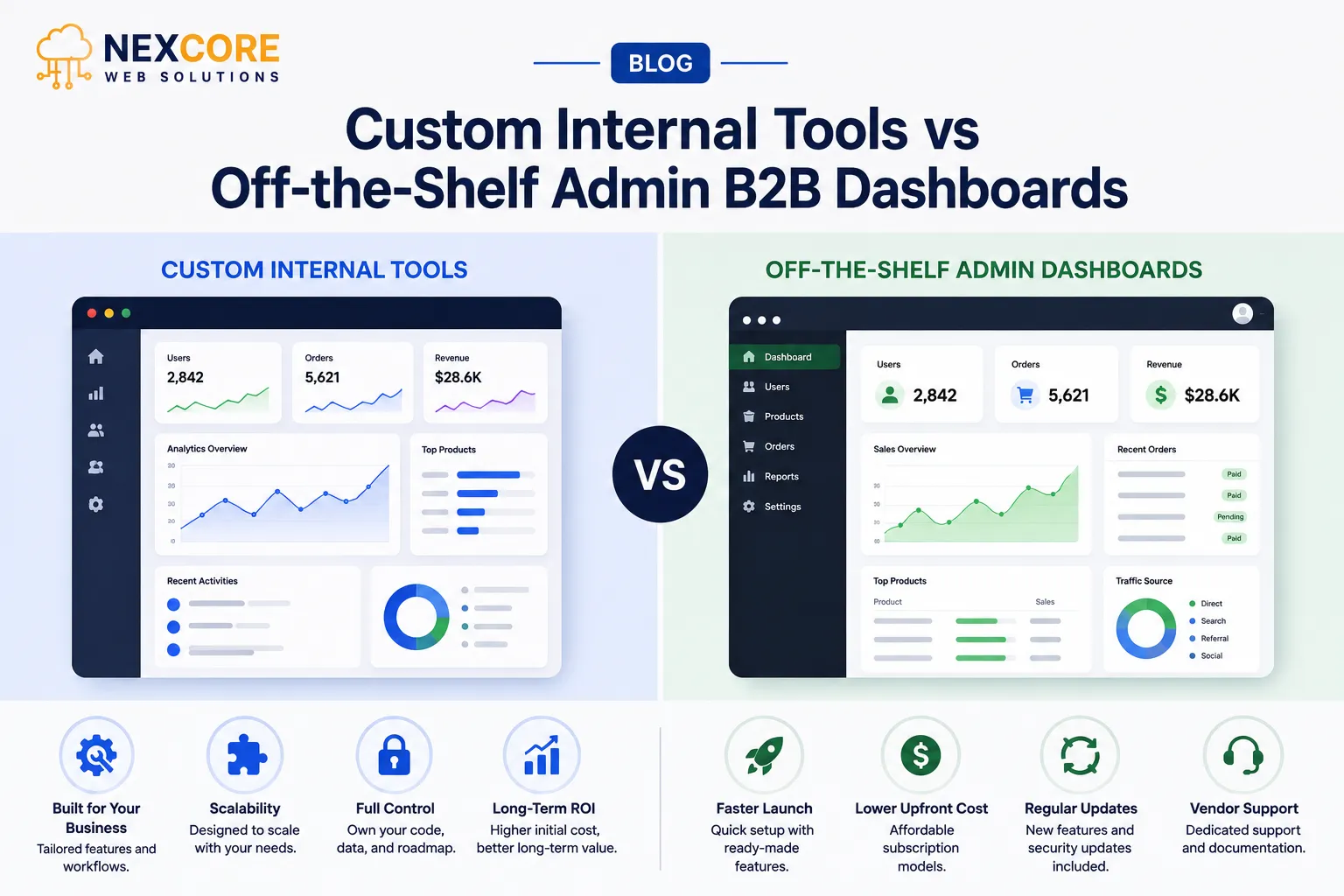
Every growing B2B business depends on internal software to manage operations, monitor performance, and improve employee productivity. Whether handling customer relationships, inventory, finance, sales, or project management, the administrative dashboard often becomes the central workspace for daily business activities. One of the most important technology decisions organizations face is choosing between custom-built internal tools and off-the-shelf admin dashboard solutions. While ready-made platforms provide faster deployment and lower initial costs, custom applications offer greater flexibility and align more closely with unique business processes. The right choice depends on operational complexity, budget, scalability requirements, and long-term business objectives. Understanding the strengths and limitations of both approaches helps organizations invest in administrative systems that improve efficiency while supporting future growth and digital transformation.
Understanding Internal Business Tools
What Are Custom Internal Tools?
Custom internal tools are software applications designed specifically for an organization’s workflows, operational requirements, and business objectives. These solutions are built from the ground up to automate internal processes, manage company data, and improve employee productivity. Unlike commercial software, custom tools reflect the organization’s existing operations rather than requiring employees to adapt their workflows to predefined functionality.
What Are Off-the-Shelf Dashboards?
Off-the-shelf admin dashboards are commercially available software platforms designed to meet common business requirements across multiple industries. They typically include standard features such as reporting, user management, workflow automation, and data visualization. Businesses can deploy these solutions quickly with minimal development effort, making them attractive for organizations seeking immediate operational improvements.
Comparing Development Costs
Initial Investment
One of the largest differences between the two approaches is the initial financial commitment. Off-the-shelf dashboards generally require subscription fees or licensing costs, allowing businesses to begin using the software almost immediately. Custom internal tools require higher upfront investment because they involve planning, design, development, testing, and deployment. However, the additional investment often delivers long-term value through greater operational efficiency.
Long-Term Expenses
Although commercial dashboards appear more affordable initially, recurring subscription fees, user licensing, feature upgrades, and third-party integrations can increase total ownership costs over time. Custom solutions typically involve maintenance and enhancement expenses rather than recurring licensing costs. Organizations should evaluate both short-term implementation budgets and long-term operational costs before making technology decisions.
Flexibility and Customization
Tailored Business Workflows
Every business operates differently, particularly as organizations grow and develop specialized processes. Custom internal tools allow workflows, reports, approval processes, and user interfaces to reflect actual business operations. Employees work within systems designed specifically for their responsibilities rather than adapting to predefined software limitations. This alignment often improves productivity while reducing unnecessary administrative work.
Feature Limitations
Commercial dashboard platforms generally include broad functionality intended to satisfy many different organizations. While these features support common business requirements, highly specialized processes may require workarounds or external integrations. Businesses with unique operational needs often encounter limitations that reduce overall efficiency. Custom development eliminates these restrictions by focusing exclusively on organizational requirements.
Scalability and Growth
Supporting Business Expansion
As organizations expand into new markets or introduce additional services, internal software must evolve accordingly. Custom applications provide greater flexibility for adding new modules, integrations, and automation as business requirements change. Development teams can prioritize features according to strategic objectives rather than depending on external software vendors. This adaptability supports sustainable long-term growth.
Vendor Dependency
Off-the-shelf software depends heavily on vendor roadmaps, pricing policies, and feature availability. Businesses may wait months for requested functionality or adapt processes around software updates they cannot control. Custom internal tools place organizations in direct control of future development priorities. Greater independence allows businesses to respond more quickly to operational changes and market demands.
Integration Capabilities
Connecting Business Systems
Modern B2B organizations rely on numerous digital platforms including enterprise resource planning systems, customer relationship management software, accounting applications, inventory management, and communication tools. Custom internal applications can integrate directly with these systems using APIs designed specifically for organizational workflows. Seamless integration reduces duplicate data entry while improving operational efficiency.
Data Consistency
Managing business information across multiple disconnected systems often leads to duplicate records and inconsistent reporting. Custom dashboards consolidate information into centralized interfaces that improve data accuracy and simplify decision-making. Organizations gain better visibility into operations because employees access consistent information from a unified platform rather than switching between multiple applications.
Security and Compliance
Controlling Sensitive Information
Internal business applications frequently process confidential financial data, customer records, employee information, and proprietary business processes. Custom applications provide greater control over authentication, authorization, encryption, and access management according to organizational security policies. Businesses handling regulated information often benefit from this additional flexibility.
Compliance Requirements
Different industries operate under different regulatory frameworks governing data privacy, financial reporting, and operational security. Custom applications allow organizations to implement compliance requirements directly into application workflows and reporting processes. Commercial platforms may support general compliance features but cannot always accommodate organization-specific regulatory obligations without customization.
Choosing the Right Solution
Selecting between custom internal tools and commercial dashboard platforms depends on business complexity, available resources, future growth expectations, and operational priorities. Organizations with standardized workflows and limited technical requirements often achieve faster results using commercial software. Businesses requiring specialized automation, complex integrations, strict compliance, or highly customized reporting frequently achieve greater long-term value through custom development. Careful evaluation ensures technology investments support measurable business objectives rather than creating unnecessary operational constraints.
Conclusion
Both custom internal tools and off-the-shelf admin dashboards offer valuable advantages depending on organizational requirements. Commercial platforms provide rapid deployment, predictable implementation, and lower initial investment, making them suitable for businesses with common operational needs. Custom applications require greater upfront planning and development but deliver superior flexibility, scalability, integration capabilities, and alignment with unique business processes. Rather than focusing solely on immediate costs, organizations should evaluate long-term operational efficiency, software adaptability, security requirements, and future business growth. Selecting the right administrative platform creates a stronger foundation for productivity, informed decision-making, and digital transformation while ensuring internal technology continues supporting evolving organizational objectives.
FAQs
1. What are custom internal business tools?
Custom internal business tools are software applications developed specifically for an organization’s operational workflows and business requirements. They automate internal processes, manage business data, integrate with existing systems, and improve employee productivity while providing functionality tailored to the organization’s unique operational needs.
2. What are the advantages of off-the-shelf admin dashboards?
Off-the-shelf admin dashboards provide rapid deployment, lower initial implementation costs, built-in features, regular vendor updates, and minimal development effort. They are well suited for businesses with standard operational requirements that need reliable software without investing significant time and resources in custom application development.
3. When should a business choose custom internal tools?
Organizations should consider custom internal tools when they require specialized workflows, advanced integrations, organization-specific reporting, strict compliance controls, or unique automation that commercial software cannot provide efficiently. Custom development offers greater flexibility and scalability for businesses with complex operational requirements.
4. Are custom dashboards more secure than commercial software?
Custom dashboards can provide stronger security when designed according to an organization’s specific security policies and compliance requirements. Businesses gain greater control over authentication, authorization, encryption, and data management. However, security depends on proper implementation, continuous monitoring, and regular software maintenance regardless of application type.
5. Which option provides better long-term value?
The better long-term investment depends on business objectives. Commercial software often delivers faster short-term results with lower initial costs, while custom applications typically provide greater long-term flexibility, operational efficiency, scalability, and integration capabilities. Organizations should evaluate total ownership costs alongside future business growth before making a decision.




