
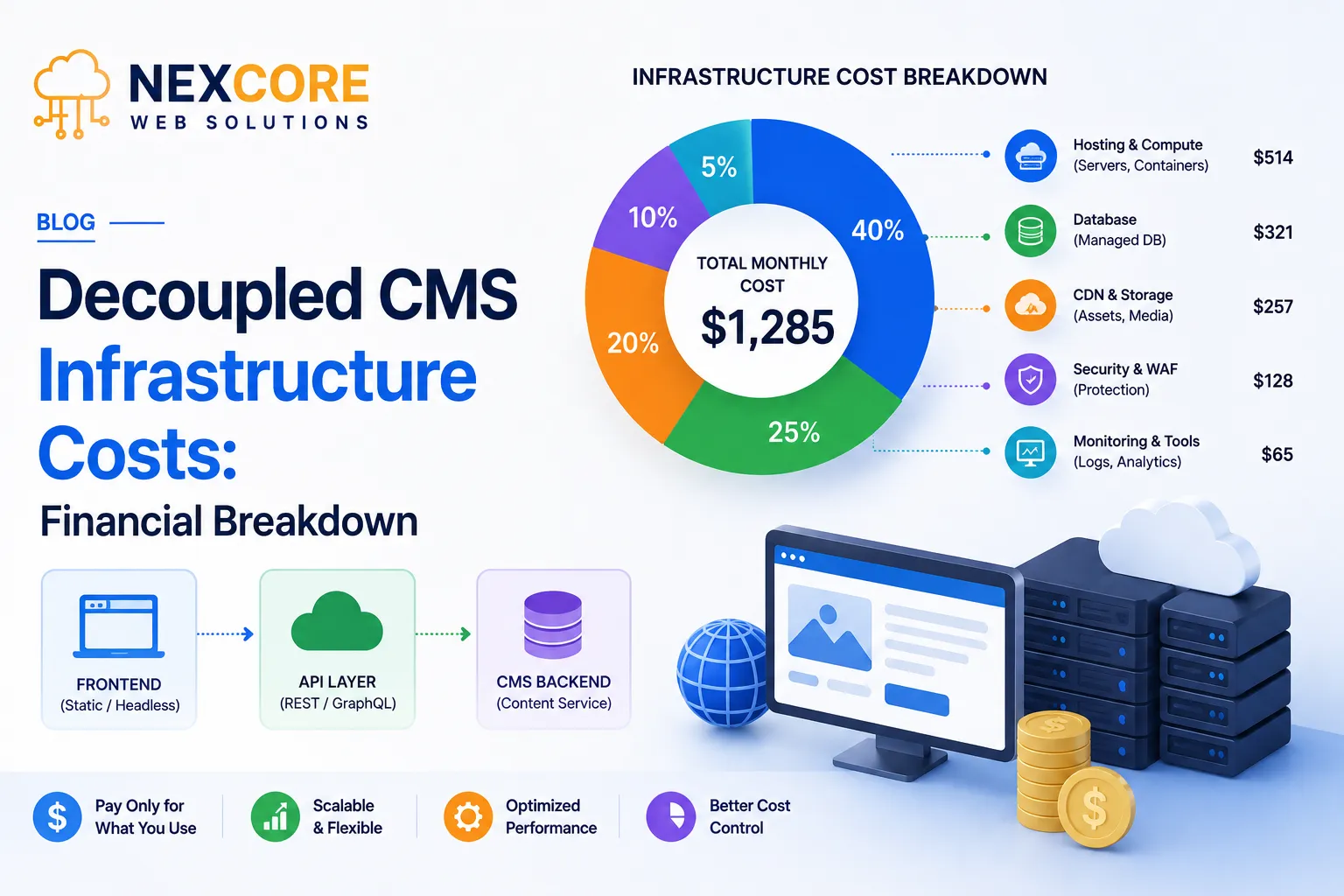
A decoupled content management system (CMS) has become an attractive option for businesses seeking greater flexibility, scalability, and performance. Unlike traditional CMS platforms that combine content management and frontend presentation within a single application, a decoupled architecture separates these components, allowing developers to build modern user experiences while editors continue using a familiar content management interface. Although this approach delivers significant technical advantages, it also introduces additional infrastructure and operational expenses that organizations must understand before investing. Infrastructure costs extend beyond hosting alone and include APIs, frontend deployment, cloud services, security, monitoring, and ongoing maintenance. Evaluating these expenses from both technical and financial perspectives helps businesses determine whether a decoupled CMS provides sufficient long-term value compared to a traditional architecture.
Understanding Decoupled CMS Architecture
What Is a Decoupled CMS?
A decoupled CMS separates content management from the frontend presentation layer. Editors create and manage content within the CMS, while websites, mobile applications, or other digital platforms retrieve that content through APIs. This architecture enables greater flexibility because multiple channels can share the same content repository without depending on a single frontend framework. Businesses benefit from improved scalability and easier integration with modern technologies.
Why Infrastructure Becomes More Complex
Traditional CMS platforms often combine hosting, content management, templates, and frontend rendering within one environment. Decoupled systems distribute these responsibilities across multiple services, including content APIs, frontend hosting, cloud infrastructure, databases, caching, and monitoring tools. While this separation improves flexibility, it also introduces additional infrastructure components that require ongoing management and operational investment.
Core Infrastructure Expenses
Content Management Platform
The CMS itself remains one of the primary infrastructure expenses. Organizations may choose self-hosted solutions requiring dedicated servers or managed cloud CMS platforms with subscription-based pricing. Costs vary according to content volume, API requests, storage requirements, and the number of editorial users. Selecting the appropriate platform depends on both technical requirements and expected business growth.
Frontend Hosting
Since the frontend operates independently from the CMS, it requires its own deployment environment. Static hosting platforms, edge networks, or cloud application services each introduce separate operational costs. Businesses should evaluate deployment frequency, traffic volume, and global performance requirements when estimating hosting expenses. Optimized frontend hosting improves user experience while supporting long-term scalability.
API and Integration Costs
API Usage
APIs form the communication layer between the CMS and frontend applications. Many managed CMS providers include API request limits within their pricing models, with additional charges applying as usage increases. High-traffic websites, mobile applications, and omnichannel platforms may generate millions of API requests each month. Forecasting expected API consumption helps organizations estimate recurring infrastructure expenses accurately.
Third-Party Integrations
Modern digital platforms frequently integrate with customer relationship management systems, marketing automation platforms, search services, payment gateways, analytics solutions, and authentication providers. Each integration may involve subscription fees, API usage costs, or custom development work. Organizations should include these recurring expenses when calculating the total cost of ownership for a decoupled CMS architecture.
Cloud Infrastructure
Compute and Storage
Although static websites reduce server processing requirements, backend services, image optimization, search functionality, and API processing often depend on cloud computing resources. Storage costs also increase as organizations manage larger media libraries and content repositories. Infrastructure planning should consider both current workloads and projected growth to avoid unexpected expenses later.
Content Delivery Networks
Content delivery networks distribute frontend assets across multiple geographic locations, reducing latency for international users. While CDN services improve performance significantly, usage-based pricing depends on bandwidth consumption and geographic distribution. Organizations serving global audiences should account for ongoing CDN costs when evaluating total infrastructure expenditure.
Security and Monitoring
Security Investments
Decoupled architectures require security controls across multiple infrastructure layers rather than a single application. Businesses often invest in web application firewalls, distributed denial-of-service protection, secure authentication, API security, encryption, and vulnerability monitoring. Although these services increase operational costs, they significantly reduce security risks and protect valuable digital assets.
Monitoring and Observability
Distributed architectures require comprehensive monitoring to maintain application reliability. Performance monitoring, error tracking, infrastructure analytics, log management, and uptime monitoring all contribute to operational visibility. These tools help technical teams identify issues before they affect users while supporting continuous performance optimization. Reliable monitoring becomes increasingly valuable as digital platforms expand.
Development and Maintenance Costs
Initial Development
Building a decoupled CMS typically requires more specialized expertise than implementing a traditional CMS. Developers must design APIs, frontend applications, deployment pipelines, authentication systems, and integration workflows. Initial development costs are therefore often higher, particularly for organizations adopting headless technologies for the first time. Careful project planning helps maximize long-term return on investment.
Ongoing Maintenance
Infrastructure expenses continue after deployment through software updates, framework upgrades, API maintenance, cloud optimization, security reviews, and feature enhancements. Development teams must manage multiple services instead of maintaining a single platform. Organizations should budget for continuous maintenance because modern digital ecosystems evolve rapidly as technologies and business requirements change.
Evaluating Return on Investment
Higher infrastructure costs do not necessarily make a decoupled CMS less economical. Faster websites improve customer experiences, omnichannel content delivery increases operational efficiency, and scalable architecture supports future business growth without major redesigns. Organizations should evaluate total business value rather than focusing exclusively on infrastructure expenses. Measuring performance improvements, content productivity, and long-term scalability provides a more accurate understanding of financial return.
Conclusion
Decoupled CMS infrastructure introduces additional expenses across hosting, APIs, cloud services, security, monitoring, integrations, and ongoing maintenance. While these costs exceed those of many traditional CMS implementations, they also provide greater flexibility, scalability, and performance for organizations managing complex digital experiences. Understanding every component of the financial investment enables businesses to make informed architectural decisions based on long-term objectives rather than short-term implementation costs. A thorough financial evaluation should balance operational expenses with measurable business outcomes such as improved customer experience, faster deployments, and simplified omnichannel content management. Organizations that carefully plan infrastructure investments can build modern digital platforms capable of supporting sustained growth while maintaining cost efficiency over time.
FAQs
1. What is a decoupled CMS?
A decoupled CMS separates content management from frontend presentation, allowing websites, mobile applications, and other digital platforms to retrieve content through APIs. Editors continue managing content in a centralized system while developers build independent frontend experiences using modern technologies. This architecture improves flexibility, scalability, and multi-channel content delivery.
2. Why is a decoupled CMS more expensive than a traditional CMS?
A decoupled CMS typically requires separate frontend hosting, API infrastructure, cloud services, security tools, monitoring platforms, and ongoing maintenance. Unlike traditional CMS solutions that combine multiple functions within one environment, decoupled architectures distribute responsibilities across specialized services, increasing both infrastructure complexity and operational costs.
3. What are the biggest infrastructure costs in a decoupled CMS?
Major infrastructure expenses include CMS subscriptions or hosting, frontend deployment, API usage, cloud computing, storage, content delivery networks, security services, monitoring platforms, and third-party integrations. Development and long-term maintenance also contribute significantly to the overall cost of ownership, particularly for enterprise implementations.
4. Is a decoupled CMS suitable for small businesses?
It depends on business requirements. Small businesses with simple websites often achieve better value using traditional CMS platforms because they require less infrastructure and lower maintenance costs. Organizations planning omnichannel experiences, rapid growth, or highly customized digital platforms may benefit more from a decoupled architecture despite the higher investment.
5. How can businesses reduce decoupled CMS infrastructure costs?
Organizations can control costs by selecting appropriate cloud services, optimizing API usage, implementing efficient caching strategies, monitoring infrastructure continuously, removing unnecessary integrations, and automating deployments. Regular cost reviews help identify underutilized resources while ensuring infrastructure investments continue supporting business objectives efficiently.




