
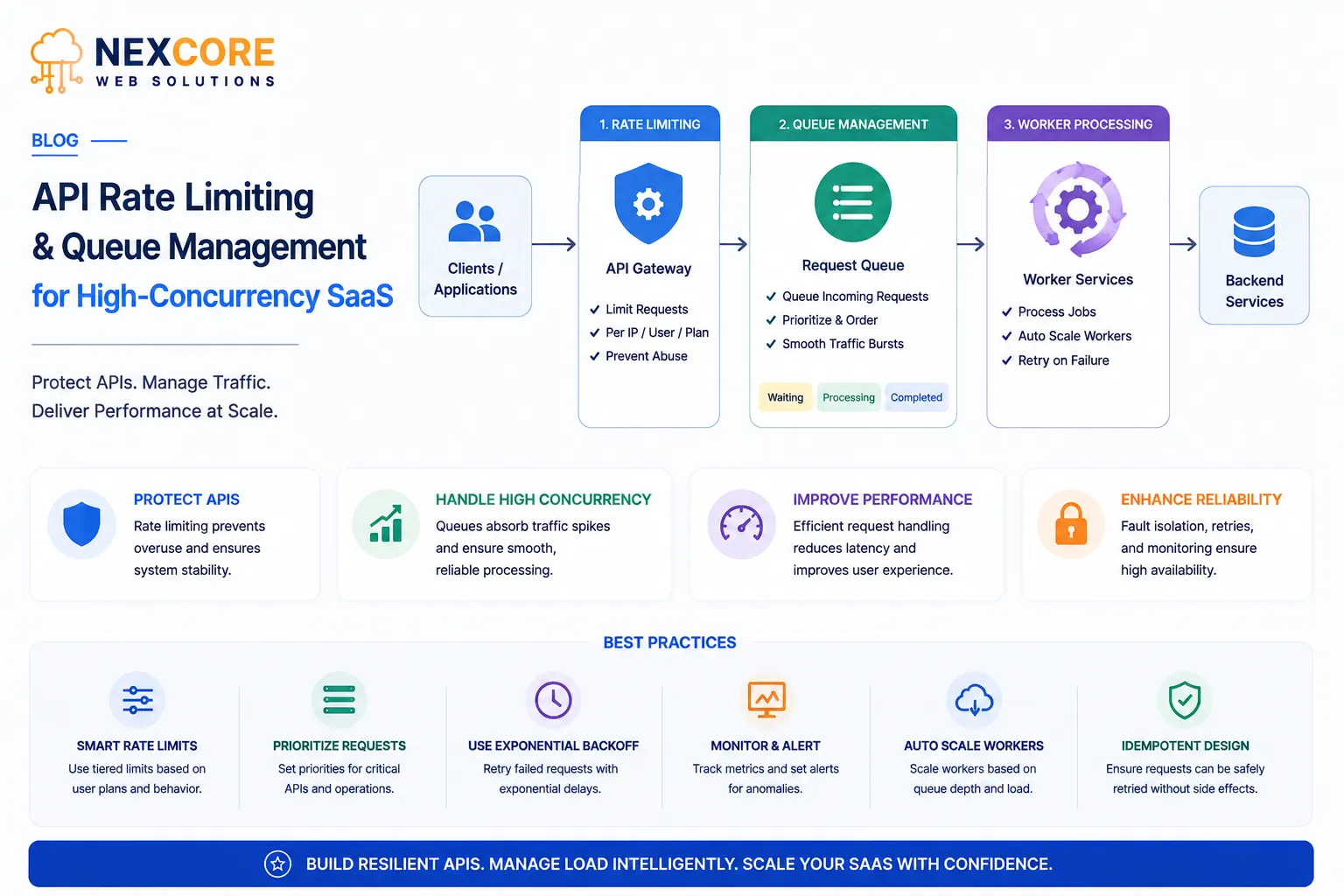
Modern SaaS applications serve thousands or even millions of users who expect fast, reliable, and uninterrupted digital experiences. As customer bases grow, backend APIs must handle enormous volumes of simultaneous requests originating from web applications, mobile devices, third-party integrations, and automated systems. Without proper traffic control, sudden spikes in API requests can overwhelm infrastructure, reduce performance, and cause service outages. API rate limiting and queue management are two essential techniques that help maintain stability under high-concurrency conditions. While rate limiting controls how many requests clients can make within a specific period, queue management ensures excess workloads are processed efficiently instead of being discarded. Together, these strategies improve scalability, protect backend services, optimize resource utilization, and deliver consistent performance even during periods of exceptionally high demand.
Loading Page Title…
Fetching details from the page URL…
Understanding High-Concurrency Challenges
What Is High Concurrency?
High concurrency occurs when a large number of users or systems interact with an application simultaneously. SaaS platforms commonly experience this during product launches, promotional campaigns, scheduled automation tasks, or peak business hours. Large volumes of concurrent API requests place significant pressure on application servers, databases, and network infrastructure. Effective traffic management becomes essential for maintaining reliable performance.
Why APIs Become Bottlenecks
Every user action typically generates one or more API requests that retrieve, update, or process data. As request volumes increase, backend services may struggle to process everything immediately. Without safeguards, excessive traffic can consume available resources, increase response times, and affect every customer using the platform. Protecting APIs prevents cascading infrastructure failures.
Understanding API Rate Limiting
What Is Rate Limiting?
API rate limiting restricts the number of requests a client may submit during a defined period. Limits may apply per user, application, API key, IP address, or subscription plan. When request thresholds are exceeded, additional requests are delayed or rejected according to predefined policies. Controlled request volumes improve service stability while ensuring fair resource distribution.
Protecting Shared Infrastructure
SaaS platforms typically serve many customers through shared backend infrastructure. Without rate limiting, a single customer or automated process could consume excessive resources, reducing performance for everyone else. Rate limiting prevents resource monopolization while maintaining predictable service quality. Fair allocation supports multi-tenant application environments.
Queue Management Fundamentals
Why Queue Management Matters
Not every request requires immediate processing. Background jobs such as report generation, email delivery, image processing, document conversion, and analytics calculations can be placed into queues instead of executing instantly. Queue management distributes workloads over time while preventing backend services from becoming overloaded. This improves responsiveness for high-priority user interactions.
Asynchronous Processing
Asynchronous processing separates user-facing requests from resource-intensive operations. Instead of forcing users to wait while complex tasks complete, applications acknowledge requests immediately and process remaining work in the background. Users receive faster responses while backend systems maintain greater operational efficiency. This approach supports better scalability under heavy traffic.
Rate Limiting Strategies
Fixed Window and Sliding Window
Several algorithms support API rate limiting. Fixed window methods count requests within defined time intervals, while sliding window approaches continuously evaluate request frequency over rolling periods. Sliding windows generally provide smoother traffic control because they avoid sudden request bursts at interval boundaries. Selecting appropriate algorithms depends on application requirements.
Token Bucket Approach
The token bucket algorithm provides flexibility by allowing temporary bursts while maintaining long-term request limits. Clients consume tokens when making requests, and tokens replenish gradually over time. This approach supports occasional traffic spikes without sacrificing infrastructure stability. Many enterprise API gateways implement token bucket rate limiting for production systems.
Designing Effective Queue Systems
Prioritize Critical Tasks
Not every queued operation carries equal importance. Business-critical transactions such as payment processing or authentication should receive higher priority than lower-value background tasks. Priority-based queues ensure essential services continue functioning even during periods of heavy demand. Intelligent scheduling improves both customer experience and operational reliability.
Ensure Fault Tolerance
Reliable queue systems should continue processing workloads despite temporary infrastructure failures. Persistent message storage, automatic retries, dead-letter queues, and monitoring mechanisms help prevent data loss while simplifying recovery. Fault-tolerant architecture strengthens system resilience and minimizes operational disruptions. Reliability becomes increasingly important as SaaS platforms scale.
Monitoring and Optimization
Observe Traffic Patterns
Continuous monitoring provides insight into request rates, queue lengths, response times, processing delays, and infrastructure utilization. Engineering teams can identify unusual traffic behavior before it develops into service degradation. Historical analytics also support capacity planning and infrastructure optimization. Visibility enables proactive performance management.
Refine Policies Over Time
Traffic patterns change as businesses grow, customer behavior evolves, and new integrations are introduced. Rate limits and queue configurations should therefore remain adaptable rather than static. Regular performance reviews help organizations balance user experience with infrastructure protection. Continuous refinement improves long-term operational efficiency.
Security Benefits
Prevent Abuse
Rate limiting helps defend SaaS platforms against denial-of-service attacks, credential stuffing, automated scraping, and excessive API consumption. Restricting request frequency limits the effectiveness of malicious activity while protecting backend services from unnecessary workload. Traffic controls strengthen both security and availability.
Improve Platform Stability
Queue management and rate limiting work together to ensure sudden traffic increases do not overwhelm critical systems. Controlled workloads reduce server failures, database contention, and application instability during peak demand. Stable infrastructure supports better customer satisfaction while reducing operational incidents.
Conclusion
API rate limiting and queue management are fundamental building blocks for scalable, high-concurrency SaaS applications. Rate limiting protects shared infrastructure by controlling request frequency, while queue management distributes workloads efficiently without sacrificing responsiveness. Together, these strategies improve application performance, enhance security, optimize resource utilization, and support consistent customer experiences during periods of heavy demand. Successful implementation requires thoughtful policy design, continuous monitoring, adaptive optimization, and resilient infrastructure capable of evolving alongside business growth. As SaaS platforms continue expanding, organizations that invest in intelligent traffic management create reliable systems prepared to support increasing user activity while maintaining operational excellence and long-term scalability.
FAQs
1. What is API rate limiting?
API rate limiting is a traffic management technique that restricts how many requests a client can send to an API within a specific period. It protects backend infrastructure, ensures fair resource allocation, prevents abuse, and maintains stable application performance during periods of high demand.
2. Why is queue management important in SaaS applications?
Queue management allows applications to process resource-intensive or background tasks asynchronously instead of executing everything immediately. This reduces server overload, improves response times, increases scalability, and ensures business-critical operations continue functioning efficiently even during heavy traffic or peak workloads.
3. What is the difference between rate limiting and queue management?
Rate limiting controls how frequently clients may send API requests, while queue management organizes how accepted workloads are processed. Rate limiting prevents excessive traffic from entering the system, whereas queues distribute approved work efficiently to maintain application performance and infrastructure stability.
4. Which rate limiting algorithm is commonly used?
Several algorithms are widely used, including fixed window, sliding window, leaky bucket, and token bucket. The token bucket algorithm is particularly popular because it allows controlled traffic bursts while maintaining long-term request limits, making it suitable for many enterprise SaaS applications.
5. How do rate limiting and queues improve system reliability?
Rate limiting prevents infrastructure overload by controlling request frequency, while queue management distributes processing over time and supports asynchronous execution. Together they reduce server failures, improve resource utilization, protect critical services during traffic spikes, and maintain consistent application performance for all users.




