
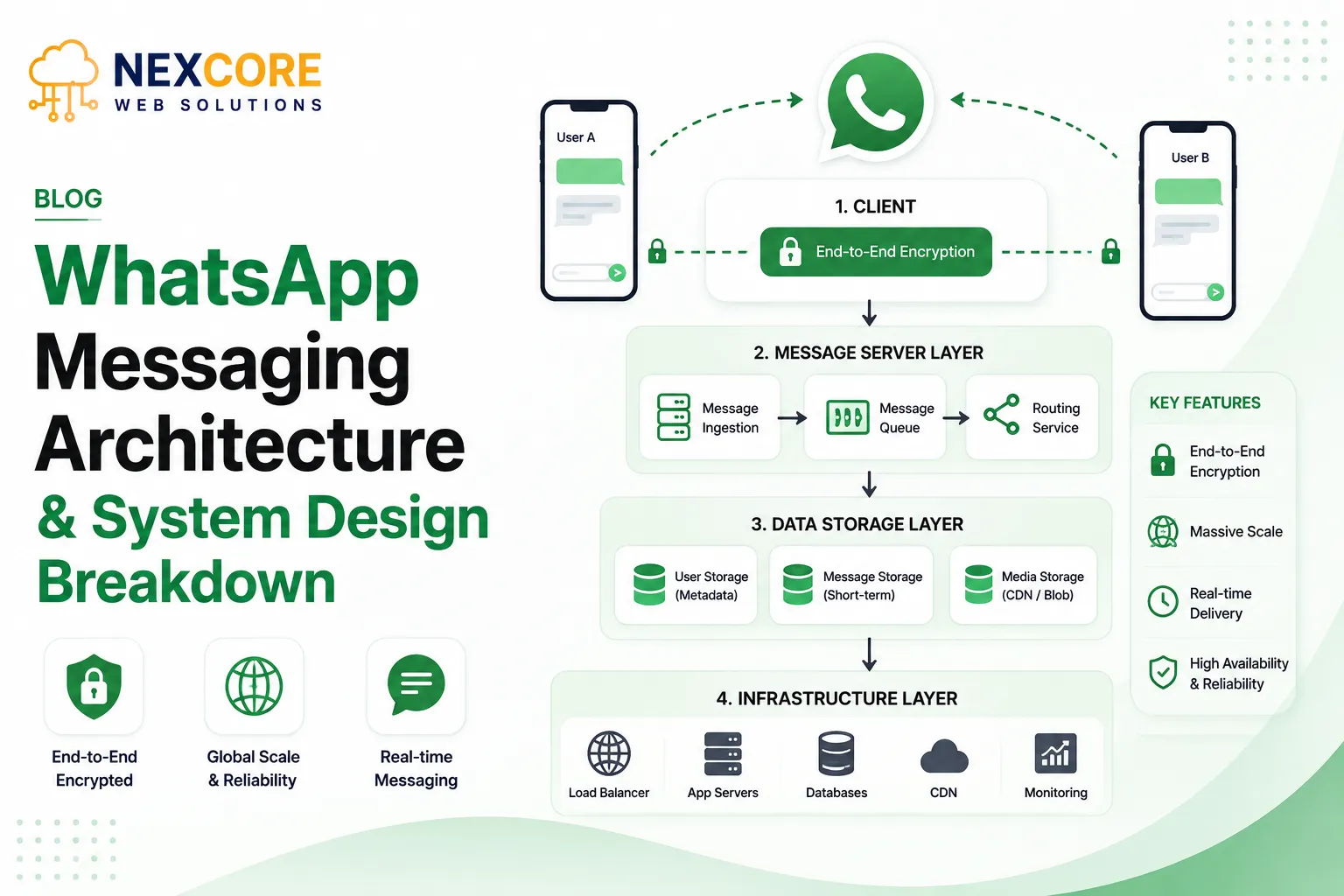
A messaging platform that serves millions of users must do far more than send text from one phone to another. It needs to handle concurrent connections, message delivery, media transfers, temporary network failures, notifications, authentication, encryption, and large traffic spikes without making users wait. WhatsApp is a useful example for understanding these challenges because its user experience depends on fast, reliable communication across many devices and network conditions. The exact internal architecture of WhatsApp is proprietary, so a complete implementation cannot be described from public information alone. However, its observable behavior provides useful lessons for designing a large-scale messaging system. Understanding those architectural principles helps developers reason about distributed systems, event processing, storage, reliability, and real-time communication.
Core Components of a Messaging Architecture
A large messaging platform usually separates responsibilities across several services rather than placing everything inside one application server. A client first communicates with an edge or gateway layer that handles connections, authentication, routing, and traffic management. Behind that layer, messaging services process incoming events and coordinate delivery between users and devices. Supporting systems manage user profiles, conversations, message metadata, media, notifications, monitoring, and security. This separation allows individual components to scale according to their specific workload.
Client and Connection Layer
Messaging clients maintain communication channels with backend infrastructure so new messages can arrive without constant polling. Depending on the platform and network conditions, persistent connections or efficient messaging protocols can reduce unnecessary requests. The connection layer must also handle reconnects because mobile devices frequently switch networks, lose coverage, or enter background states. A resilient design treats disconnections as normal events rather than exceptional failures.
Message Ingestion and Routing
When a user sends a message, the system first needs to authenticate the sender and determine where the message should be routed. The messaging service can assign an identifier, validate the request, and place the event into an internal processing pipeline. A distributed queue or event-streaming layer can absorb sudden traffic increases and prevent temporary spikes from overwhelming downstream services. Routing logic then determines which recipient devices or sessions need to receive the message.
Why Queues Matter
Queues provide a buffer between message producers and consumers. If millions of users send messages during a short period, consumers can process events at a controlled rate instead of forcing every backend component to handle the peak simultaneously. Queue-based architectures also make retries and failure recovery easier because an event can remain available until processing succeeds. However, queue design must account for ordering, duplication, visibility timeouts, dead-letter handling, and backpressure.
Message Delivery and Acknowledgments
Reliable messaging requires more than successfully accepting a message from the sender. The platform needs to determine whether the message has been processed, delivered to an appropriate recipient device, and potentially viewed by the recipient. Different acknowledgment states can communicate these stages to users without requiring the sender to understand the underlying distributed system. Delivery acknowledgments should be designed carefully because network interruptions can cause duplicate requests or delayed responses.
Handling Offline Recipients
A recipient may be offline when a message is sent, so the system needs a temporary delivery strategy. Messages or encrypted payloads can be retained according to the platform’s storage and privacy model until the recipient reconnects. Once the device becomes available, pending messages can be delivered and the system can update the relevant delivery state. This pattern illustrates why reliable messaging requires coordination between connection management, storage, queues, and notification services.
Data Storage Architecture
Messaging systems typically use different storage technologies for different types of information. User profiles, device registrations, conversation metadata, and message-related records have different access patterns and consistency requirements. A distributed database can support high availability and horizontal scaling, while object storage is more appropriate for large media files such as images, videos, and documents. Separating metadata from large binary content prevents media traffic from overwhelming systems responsible for ordinary messaging operations.
Media Processing
Media messages create additional architectural challenges because files are much larger than text messages. A scalable design can upload media separately, process it asynchronously, generate suitable representations, and store it in distributed object storage. Content delivery infrastructure can then serve frequently accessed media from locations closer to users. Upload validation, size limits, encryption, malware protection, and access controls should be considered before media becomes available to recipients.
Security and Privacy
Security must be integrated throughout the messaging architecture rather than added after the system is built. Authentication verifies the identity of users and devices, while authorization determines which resources they can access. End-to-end encryption can protect message content so that intermediaries cannot simply read transmitted conversations, although implementing and operating such systems requires careful cryptographic engineering. Key management, device registration, session handling, abuse prevention, and secure recovery processes are equally important.
Scaling for High Traffic
Horizontal scaling is central to large messaging platforms because adding more application instances can increase processing capacity without relying on one increasingly powerful server. Load balancers distribute traffic across healthy instances, while partitioning allows databases and event streams to distribute workloads across multiple nodes. Stateless services are particularly useful because requests can be handled by different instances without depending on local application state. Stateful connection services require additional coordination because active sessions must remain reachable as infrastructure changes.
Reliability and Failure Recovery
Distributed systems must assume that servers, networks, databases, and third-party dependencies can fail. Messaging architectures therefore need retries, timeouts, circuit breakers, health checks, replication, monitoring, and controlled degradation. Idempotency is especially important because retrying an operation should not accidentally create multiple copies of the same message. Observability tools can track delivery latency, failed requests, queue depth, connection counts, and infrastructure health so engineers can identify problems before they become widespread outages.
Conclusion
WhatsApp-style messaging architecture demonstrates the complexity hidden behind a seemingly simple chat interface. A scalable design needs reliable connections, message ingestion, queues, routing, delivery acknowledgments, distributed storage, media processing, security, monitoring, and failure recovery working together. No single technology solves every problem, and architectural decisions depend on traffic patterns, consistency requirements, privacy expectations, and operational constraints. For developers studying system design, the most important lesson is to design around failure and scale from the beginning. Separating responsibilities, using asynchronous processing where appropriate, protecting data, and measuring real system behavior can create a messaging platform that remains responsive as usage grows.
FAQs
1. What architecture is suitable for a large messaging application?
A large messaging application typically benefits from distributed services that separate connection management, message processing, routing, storage, notifications, and media handling. Event queues can absorb traffic spikes while horizontally scaled services process workloads. The exact architecture depends on requirements such as message ordering, delivery guarantees, latency, privacy, availability, and expected concurrent connections.
2. How do messaging systems handle users who are offline?
When a recipient is offline, the system can retain pending delivery information according to its storage and privacy model. When the recipient reconnects, the messaging service identifies pending messages and attempts delivery. Reliable implementations also handle retries, duplicate requests, acknowledgments, and expired messages so temporary connectivity problems do not cause unnecessary data loss or repeated delivery.
3. Why are queues important in messaging systems?
Queues separate message ingestion from downstream processing and provide a buffer during traffic spikes. Instead of requiring every component to process incoming events immediately, workers can consume queued events at a controlled rate. Queues also support retry mechanisms and asynchronous workflows. However, developers must carefully address ordering, duplicate processing, backpressure, failure handling, and queue monitoring.
4. How can a messaging system scale to millions of users?
Large messaging platforms generally use horizontal scaling, distributed storage, partitioning, load balancing, caching, and asynchronous processing. Stateless services can be replicated across many instances, while connection and data services use specialized strategies for maintaining active sessions and distributing workloads. Capacity planning, observability, automated recovery, and efficient network protocols are also essential as concurrent users and message volume increase.
5. What is the role of encryption in messaging architecture?
Encryption protects information while it moves between systems and devices, but the exact security model depends on the application. End-to-end encryption is designed to prevent intermediaries from accessing message content, while transport encryption protects network communication. A secure architecture must also consider authentication, key management, device verification, secure storage, session security, and account recovery rather than treating encryption as the only security control.




