
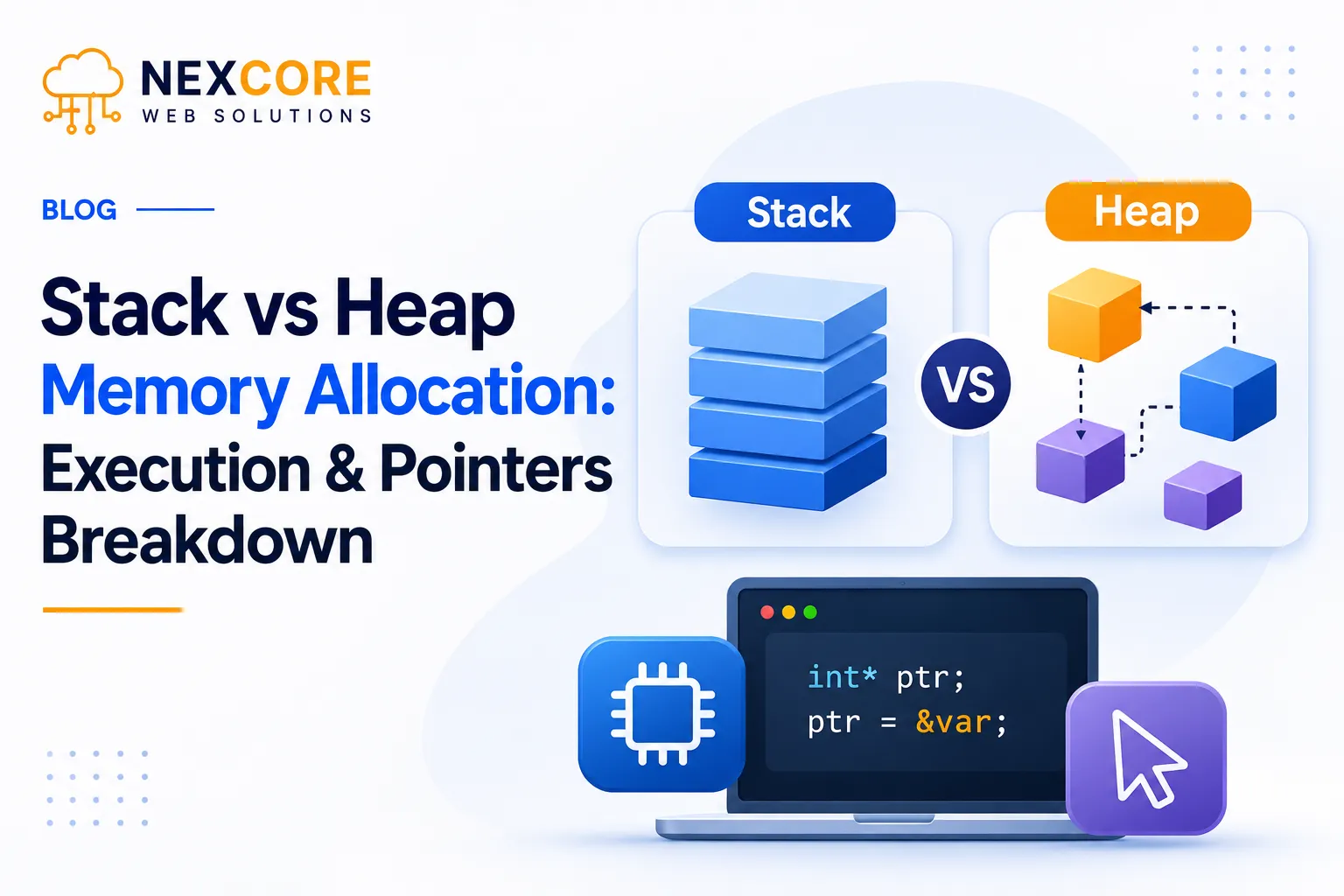
Memory management is one of the most important concepts behind how software actually runs. Every application needs memory to store variables, function calls, objects, and data created while a program is executing. Two major areas involved in this process are the stack and the heap, and each follows a very different allocation model. Understanding the difference helps developers write more efficient code, debug memory-related problems, and use pointers with greater confidence. Although modern programming languages often automate parts of memory management, the underlying concepts still influence application performance and behavior. This guide explains how stack and heap allocation work, how pointers connect to memory, and why choosing the right allocation strategy matters.
Understanding Memory During Program Execution
When a program starts, the operating system provides a virtual memory space that is divided into different regions. These regions can contain executable code, global data, dynamically allocated memory, and temporary function data. The exact layout depends on the operating system, compiler, programming language, and runtime environment. However, the stack and heap remain two fundamental concepts across many programming systems.
The stack is primarily associated with function execution and short-lived local data. The heap is generally used for data that requires a flexible size or lifetime that extends beyond a single function call. A program may use both areas during the same operation, with pointers connecting variables on the stack to objects stored elsewhere. Understanding this relationship makes it easier to follow how data moves through an application.
How Stack Memory Allocation Works
Stack memory follows a structured allocation pattern that is closely connected to function calls. When a function starts, the program creates a stack frame containing information such as local variables, parameters, and return details. When the function finishes, its stack frame is removed automatically. This automatic cleanup makes stack allocation fast and predictable.
Consider a function that stores a user’s age in a local integer variable. The variable can be placed in the function’s stack frame and remains available while that function executes. Once the function returns, the memory used by that local variable is normally released as part of removing the stack frame. The developer does not need to manually request or free that memory.
Stack allocation is efficient because memory management usually follows a simple last-in, first-out pattern. New function calls add frames, while completed functions remove them in reverse order. This approach avoids the complex bookkeeping required for arbitrary memory blocks. The trade-off is that stack memory is limited and is not suitable for every type of data.
How Heap Memory Allocation Works
Heap memory provides a more flexible area for dynamically created data. A program can request memory during execution and use that memory independently of the function that originally requested it. This is useful when the amount of required memory is not known in advance or when data must survive beyond a local function scope. Objects, large data structures, and dynamically sized collections often rely on heap allocation.
Unlike stack memory, heap allocation does not automatically follow the order of function calls. A program can allocate one block, allocate several more blocks, and release them in a completely different order. This flexibility requires additional memory management mechanisms. In languages such as C and C++, developers may need to release dynamically allocated memory manually, while languages with garbage collection automate much of the cleanup process.
Heap allocation can involve more overhead than stack allocation because the memory manager must locate and track suitable blocks. Fragmentation can also occur when allocated and released blocks leave small gaps across the heap. Modern runtimes use different strategies to manage these issues, but unnecessary allocation can still affect application performance. Developers should therefore consider object lifetime and allocation frequency when designing memory-intensive software.
Pointers and Memory Addresses
A pointer is a value that stores the memory address of another piece of data. In lower-level programming languages, pointers provide direct access to memory locations and are commonly used with dynamically allocated objects. For example, a pointer variable might exist on the stack while pointing to a larger object stored on the heap. This arrangement allows a function to work with data without storing the entire object inside its own stack frame.
Pointers are powerful, but they also introduce responsibility. An invalid pointer can reference memory that no longer contains valid data, while an uninitialized pointer may point to an unpredictable location. Accessing memory incorrectly can cause crashes, data corruption, or security vulnerabilities. Languages with stronger memory safety features reduce many of these risks, but developers still benefit from understanding what references represent at a lower level.
Stack vs Heap: Key Execution Differences
The most important difference between stack and heap memory is how allocation and lifetime are managed. Stack data is usually tied directly to a function’s execution and is removed when that function completes. Heap data can remain available until it is explicitly released or automatically collected by the runtime. This difference affects speed, flexibility, and the way applications handle complex data.
Stack memory is generally faster for small, temporary values because allocation requires minimal bookkeeping. Heap memory is more suitable for data with a dynamic size or an unpredictable lifetime. A large array created inside a function, for example, may be impractical for a limited stack but manageable through dynamic allocation. The correct choice depends on the application’s requirements rather than a simple rule that one memory area is always better.
Common Memory Problems Developers Should Understand
Stack Overflow
A stack overflow occurs when a program consumes more stack memory than the available limit. Deep recursion is a common cause because every function call adds another stack frame. Large local variables can also increase stack usage. Developers can reduce the risk by limiting recursion depth, restructuring algorithms, or moving large data structures to more suitable storage.
Memory Leaks and Dangling References
A memory leak happens when allocated memory remains unavailable for reuse because the program no longer needs it but fails to release it. This can gradually increase memory consumption and eventually affect application stability. A dangling pointer or reference occurs when code attempts to use memory after the underlying object has been released. Both problems highlight why memory ownership and object lifetime should be clearly understood during development.
Choosing the Right Memory Strategy
Developers should begin by considering how long data needs to exist. Small values used only during a function call are often well suited to automatic storage associated with the stack. Data that must be shared, resized, or preserved beyond a local scope may require dynamic allocation or a runtime-managed object. The programming language and its memory model also influence the best approach.
Performance testing should guide decisions in large applications. Moving every object to the stack or heap without understanding its lifetime rarely produces the best result. Instead, developers should reduce unnecessary allocations and choose data structures appropriate for the workload. Clear ownership rules also make complex systems easier to maintain and debug.
Conclusion
Stack and heap memory serve different but equally important roles during program execution. The stack provides fast, structured storage for function calls and temporary data, while the heap offers flexibility for dynamically sized and longer-lived objects. Pointers and references connect these memory areas and allow programs to work efficiently with data stored at different locations. Understanding these fundamentals helps developers recognize issues such as stack overflow, memory leaks, and invalid memory access before they become serious production problems. The best memory strategy depends on data lifetime, application requirements, and the language being used. By treating memory allocation as a design decision rather than an invisible implementation detail, developers can build more reliable and efficient software.
FAQs
What is the main difference between stack and heap memory?
The stack is generally used for temporary data associated with function execution, while the heap is used for dynamically allocated data with a more flexible lifetime. Stack memory is usually managed automatically as functions start and finish. Heap memory requires manual management or runtime services such as garbage collection, depending on the programming language.
Are pointers always stored on the stack?
No, a pointer can be stored in different memory locations depending on how it is declared and used. A local pointer variable is commonly stored within a stack frame, while the data it points to may be stored on the heap. Pointers can also be part of objects or global data structures stored in other memory regions.
Why is stack allocation usually faster than heap allocation?
Stack allocation usually follows a simple and predictable structure based on function calls. Adding or removing a stack frame requires less bookkeeping than finding and managing arbitrary blocks of dynamic memory. Heap allocation must often track available space and object lifetimes. The exact performance difference depends on the language, runtime, and operating system.
What causes a stack overflow?
A stack overflow happens when a program uses more stack memory than the available limit. Deep or uncontrolled recursion is a common cause because every recursive call creates another stack frame. Large local variables can also contribute to excessive stack usage. Developers can prevent many cases by controlling recursion and managing large data carefully.
Can garbage-collected languages still have memory problems?
Yes, garbage collection reduces the need for manual memory release, but it does not eliminate every memory problem. Applications can still retain references to objects they no longer need, preventing those objects from being collected. Excessive allocation can also increase garbage collection activity. Developers should understand object lifetimes and monitor memory usage even in managed environments.




