
Machine learning models are often judged by a simple question: how many predictions were correct? While accuracy provides a useful starting point, it does not always reveal how well a model performs in real-world situations. A model that detects fraudulent transactions, medical conditions, or security threats can appear highly accurate while still missing the cases that matter most. The confusion matrix provides a clearer way to examine prediction results by separating correct and incorrect decisions into meaningful categories. From this matrix, developers and data scientists can calculate precision, recall, F1-score, and accuracy. Understanding how these metrics work helps teams evaluate models more carefully and choose measurements that match the actual risks of their applications.
What Is a Confusion Matrix?
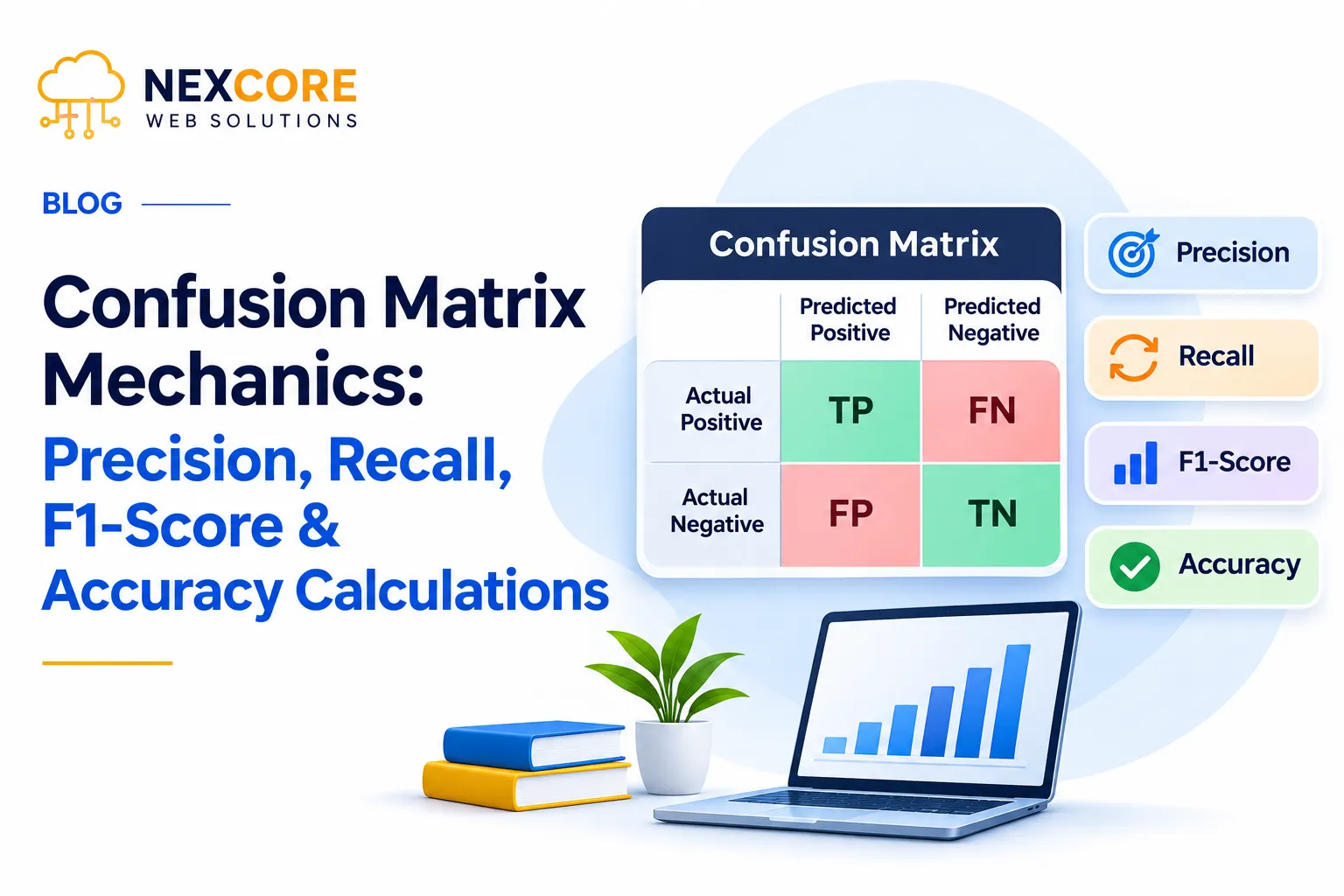
A confusion matrix is a table used to compare a classification model’s predictions with the actual outcomes. In a binary classification problem, it organizes results into four categories: true positives, true negatives, false positives, and false negatives. These categories show not only whether a prediction was correct but also the type of mistake the model made. This distinction is essential when different errors have different consequences.
For example, imagine a model designed to detect fraudulent credit card transactions. A transaction correctly identified as fraud is a true positive, while a legitimate transaction correctly approved is a true negative. A legitimate transaction incorrectly flagged as fraud becomes a false positive. A fraudulent transaction that passes through the system becomes a false negative, which may be the most serious error for the business.
Understanding the Four Core Outcomes
True positives occur when the model predicts the positive class and the actual result is also positive. True negatives occur when the model correctly identifies a negative case. Together, these values represent successful predictions, but they do not explain whether the model performs equally well across both classes. This is why accuracy alone can sometimes create a misleading impression.
False positives and false negatives represent the two main types of classification errors. A false positive occurs when the model incorrectly predicts that a positive condition exists, while a false negative occurs when the model fails to identify a real positive case. The importance of each error depends on the application. In medical screening, missing a serious condition may be more harmful than requesting an unnecessary follow-up test.
Calculating Accuracy
Accuracy measures the proportion of all predictions that the model classified correctly. The calculation is simple: add true positives and true negatives, then divide the result by the total number of predictions. In formula form, accuracy equals (TP + TN) divided by (TP + TN + FP + FN). It provides a broad overview of model performance.
Suppose a model makes 100 predictions and correctly classifies 90 of them. Its accuracy is 90 percent, which initially sounds impressive. However, accuracy becomes less useful when one class appears much more frequently than another. If only five of those 100 cases are positive, a model could predict every case as negative and still achieve 95 percent accuracy while detecting none of the important positive cases.
Precision: Measuring Prediction Reliability
Precision measures how often a positive prediction is actually correct. It is calculated by dividing true positives by the total number of positive predictions, including false positives. The formula is precision equals TP divided by (TP + FP). High precision means the model produces relatively few false alarms.
Consider an email spam filter that identifies 50 messages as spam, with 45 of those messages actually being unwanted. The model has high precision because most messages it flagged were genuinely spam. This metric becomes especially important when false positives are expensive or disruptive. A system that incorrectly blocks important business emails, for example, may create serious problems even if its overall accuracy is high.
Recall: Measuring Detection Coverage
Recall measures how effectively a model identifies all actual positive cases. It is calculated by dividing true positives by the total number of actual positives, including false negatives. The formula is recall equals TP divided by (TP + FN). A high recall score means the model misses fewer positive cases.
Imagine a security system that must identify malicious login attempts. Missing a genuine attack could expose sensitive systems, making false negatives particularly costly. In this situation, developers may prioritize recall even if the system generates some additional false alerts. The appropriate balance depends on the operational consequences of each type of mistake.
The F1-Score and Balanced Evaluation
Precision and recall often create a trade-off because improving one metric can reduce the other. A model can increase recall by classifying more cases as positive, but this may also create more false positives and lower precision. The F1-score combines both measurements into a single value using their harmonic mean. Its formula is 2 multiplied by precision and recall, divided by precision plus recall.
The harmonic mean makes the F1-score sensitive to imbalance between the two metrics. A model cannot achieve a strong F1-score by performing extremely well in precision while performing poorly in recall. This makes F1 particularly useful for imbalanced classification problems where both false positives and false negatives matter. However, teams should still review precision and recall separately to understand the model’s actual behavior.
Choosing the Right Metric for Your Model
There is no universal metric that works best for every machine learning problem. Accuracy is useful when classes are reasonably balanced and both types of mistakes have similar consequences. Precision is often more important when false positives create significant costs, while recall becomes critical when missing a positive case is dangerous. The F1-score offers a useful balance when both concerns deserve attention.
Model evaluation should also consider the business or operational context behind the numbers. A fraud detection system, for example, may accept more false positives to reduce financial losses from missed fraud. A recommendation system may focus on precision to avoid showing users irrelevant results. Metrics are most useful when they reflect the actual goals and risks of the system.
Using Confusion Matrices in Production
A confusion matrix should not be treated as a one-time evaluation tool used only during model development. Production data can change over time, causing model performance to decline or shift between classes. Monitoring the matrix regularly helps teams identify whether false positives or false negatives are increasing. This makes it easier to investigate data drift and adjust models before performance problems become serious.
Teams should also evaluate metrics across different datasets, user groups, and operating conditions. An overall score can hide weaknesses affecting a smaller but important group of cases. Threshold adjustments can also change the balance between precision and recall. Regular testing ensures that performance decisions remain connected to real-world outcomes rather than relying on a single headline number.
Conclusion
A confusion matrix turns model predictions into a detailed picture of what a classification system gets right and wrong. Accuracy provides a useful overview, but precision and recall reveal whether positive predictions are reliable and whether important cases are being detected. The F1-score helps balance these two measurements when both false positives and false negatives matter. Together, these metrics provide a stronger foundation for evaluating machine learning performance.
The most useful metric depends on the problem a model is designed to solve. Developers should consider the cost of each possible error instead of automatically optimizing for the highest accuracy score. By examining confusion matrices and monitoring precision, recall, F1-score, and accuracy over time, teams can make more informed decisions. A successful model is not simply the one with the best number, but the one whose performance matches the real-world requirements of its application.
FAQs
What is the main purpose of a confusion matrix?
A confusion matrix provides a detailed breakdown of a classification model’s predictions by separating them into true positives, true negatives, false positives, and false negatives. This helps developers understand the specific types of errors a model makes. Unlike accuracy alone, the matrix shows whether the system is missing important cases or generating too many incorrect positive predictions.
Why can accuracy be misleading in machine learning?
Accuracy can be misleading when the dataset contains significantly more examples of one class than another. A model may achieve a high accuracy score simply by predicting the majority class every time. For example, a fraud detection model could classify nearly every transaction as legitimate and still appear accurate. Precision, recall, and the confusion matrix provide a clearer view of performance.
What is the difference between precision and recall?
Precision measures how many positive predictions made by a model are actually correct, making it useful for evaluating false positives. Recall measures how many of the actual positive cases the model successfully identifies, making it useful for evaluating false negatives. The choice between them depends on which type of error has greater consequences in the specific application.
When should the F1-score be used?
The F1-score is useful when both precision and recall are important and a balanced evaluation is needed. It is particularly valuable for imbalanced datasets where accuracy may not provide meaningful information. Because the F1-score uses the harmonic mean, it penalizes large differences between precision and recall. Teams should still examine both underlying metrics for a complete evaluation.
Can a model have high precision but low recall?
Yes, a model can have high precision while having low recall if it makes positive predictions very cautiously. Most cases it identifies may be correct, but it may fail to detect many other genuine positive cases. This approach can be appropriate when false positives are costly. However, it may be unsuitable for applications where missing positive cases creates significant risks.




