
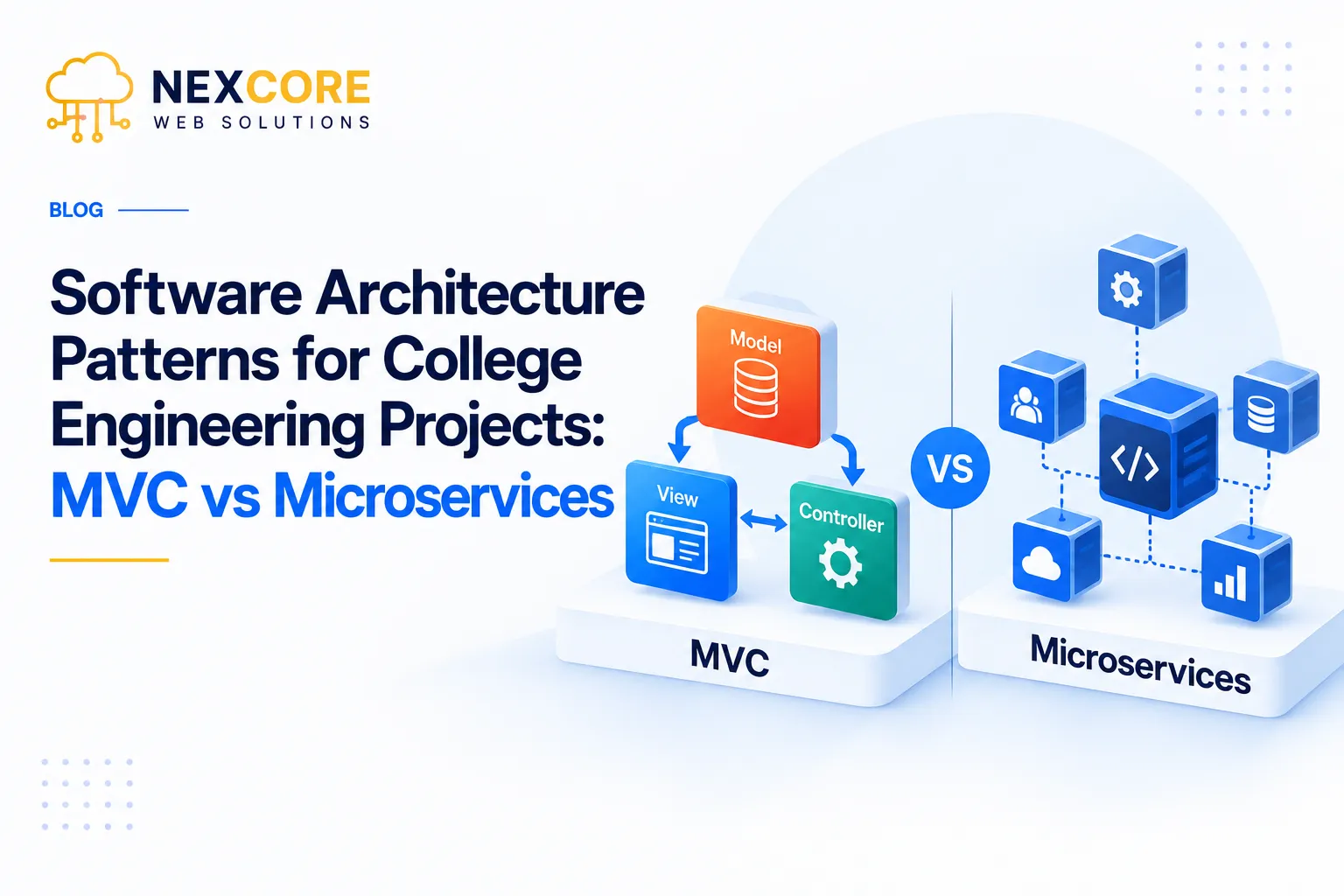
Choosing a software architecture is an important part of developing a college engineering project because architecture determines how the application is organized, tested, maintained, and expanded. Two approaches students commonly encounter are Model-View-Controller (MVC) and microservices architecture. MVC separates an application into presentation, data, and control responsibilities, while microservices divide a system into smaller independently deployable services. Both can support real-world applications, but they solve different problems and introduce different levels of complexity. For a student project, the right choice should depend on the application’s scope, team size, technical requirements, and learning objectives. Understanding these differences helps students build projects that are easier to explain during evaluations and demonstrate practical software engineering skills.
Understanding the MVC Architecture
MVC is a structural pattern that separates an application into three primary responsibilities: Model, View, and Controller. The Model represents application data and related operations, while the View manages what users see and interact with. The Controller receives user requests, coordinates application logic, and determines the appropriate response. This separation prevents presentation code and data-handling code from becoming unnecessarily mixed together.
How MVC Works in a College Project
Consider a college library management application built using a web framework. A student could use the Model to represent books, students, issue records, and returns, while Views display forms and library information. Controllers could process requests such as adding a book, searching for available books, or recording a returned item. Because each responsibility has a defined location, students can demonstrate a clear connection between user actions, application logic, and stored data.
MVC is particularly useful for applications where most functionality belongs to one application and database. A student management portal, attendance system, inventory application, or appointment platform can often be structured effectively using MVC. Development can remain relatively straightforward because the application is usually built and deployed as one unit. Debugging is also easier for students who are still learning architectural concepts because requests generally move through a predictable application flow.
Understanding Microservices Architecture
Microservices architecture takes a different approach by dividing an application into multiple smaller services. Each service is responsible for a specific business capability and can communicate with other services through APIs or messaging mechanisms. For example, an e-commerce application might have separate services for users, products, orders, payments, and notifications. Instead of one application containing all functionality, the system becomes a collection of cooperating components.
Microservices in Student Projects
A college project can use microservices when it has clearly separated functional areas that justify independent services. For example, a campus platform could contain authentication, student profiles, course management, examination scheduling, and notifications as separate services. Each service can have its own codebase, deployment process, and potentially its own database. This approach can expose students to concepts such as service communication, API design, containerization, distributed logging, and independent deployment.
However, microservices also introduce additional operational complexity. Students must consider service discovery, network failures, API contracts, authentication between services, configuration management, monitoring, and deployment. A simple application may not benefit from these additional components. Creating multiple services merely to make a project appear advanced can increase development time without solving a genuine architectural problem.
MVC vs Microservices: Key Differences
The biggest difference is that MVC primarily organizes responsibilities within an application, whereas microservices organize an entire system around independently deployable services. MVC can exist inside a microservice because an individual service may use controllers, models, and views or API layers internally. Therefore, these approaches are not always direct alternatives. One describes application structure, while the other describes system decomposition and deployment.
Development and Maintenance
MVC generally requires fewer infrastructure components and is easier to develop on a limited student schedule. A team can work with one repository, one primary application process, and a centralized database. Microservices require stronger coordination because changes may affect service contracts and communication between components. Testing also becomes more involved because developers need to verify both individual services and their interactions.
Scalability Considerations
Microservices can allow individual services to scale independently when different parts of an application have different workloads. For example, a notification service might receive significantly more requests than an administrative service. MVC applications can also scale effectively by running multiple instances of the application, but scaling individual business capabilities independently is less direct. For most college applications, however, scalability requirements are usually modest, making simplicity an important consideration.
Choosing the Right Pattern
Students should begin by identifying the actual requirements instead of selecting architecture based on popularity. A project with a small team, limited functionality, and a single database may be easier to implement and demonstrate using MVC. A larger project involving several clearly independent business domains may provide a legitimate reason to explore microservices. The architecture should make the project easier to manage rather than introduce complexity without a clear purpose.
Practical Evaluation Criteria
Before choosing an architecture, students can examine several factors:
- Project scope: How many independent modules are required?
- Team size: Can the team realistically maintain multiple services?
- Deployment: Is independent deployment actually necessary?
- Database needs: Do different modules require separate data ownership?
- Learning objectives: Which architecture concepts must the project demonstrate?
- Testing requirements: Can the team test the chosen architecture thoroughly?
These questions provide a more practical foundation than simply choosing the architecture that sounds more advanced.
Common Mistakes Students Should Avoid
One common mistake is treating architecture as documentation rather than an engineering decision. Students may create complicated diagrams but implement most functionality inside one large component. Another mistake is introducing microservices without understanding service boundaries, resulting in tightly coupled services that behave like a distributed monolith. MVC projects can also suffer when controllers contain database queries, business rules, validation, and response formatting all at once. Clear responsibility boundaries matter more than the number of folders or services in a project.
Conclusion
MVC and microservices address different architectural concerns, so students should evaluate them according to the actual requirements of their engineering projects. MVC offers a structured way to organize application responsibilities and is often practical for projects with a unified codebase and straightforward deployment needs. Microservices provide independent service boundaries and can be valuable for larger systems with distinct business capabilities, but they require more knowledge and operational planning. A strong college project is not necessarily the one with the most complicated architecture. It is the one where the architecture can be clearly justified, correctly implemented, tested, documented, and explained during evaluation.
FAQs
What is MVC architecture in software engineering?
MVC stands for Model-View-Controller and separates an application into three major responsibilities. The Model manages data and related operations, the View handles presentation, and the Controller coordinates requests and application behavior. This separation helps developers organize code more clearly. Students often use MVC for web applications such as library systems, attendance portals, inventory systems, and management dashboards.
Is microservices architecture suitable for college projects?
Microservices can be suitable when a project contains several clearly independent business capabilities and the team has enough time to manage distributed components. It can provide practical experience with APIs, service communication, deployment, and monitoring. However, microservices introduce additional complexity. For a small application, a simpler architecture may provide a more manageable development and testing process.
Are MVC and microservices alternatives to each other?
They are not always direct alternatives because they describe different architectural levels. MVC organizes responsibilities within an application, while microservices divide a larger system into independently deployable services. An individual microservice can itself use an MVC-style internal structure. Therefore, a project can potentially use both concepts when their respective responsibilities make sense.
Which architecture is easier for engineering students to implement?
MVC is generally more straightforward because students can develop and deploy the application as a unified system. The development environment usually requires fewer infrastructure components, and debugging request flows can be simpler. Microservices require additional consideration for network communication, service failures, deployment, authentication, and monitoring. The appropriate choice ultimately depends on the project’s scope and learning objectives.
What should students consider before choosing an architecture?
Students should examine project scope, team size, database requirements, deployment needs, testing capacity, and academic objectives. They should also consider whether the architecture solves an actual project requirement. A simpler architecture can be appropriate when the system is small, while a distributed design may be justified when functionality is genuinely divided into independent domains. The architecture should be explainable and practical rather than complicated for appearance.




