
Building a Node.js and Express API is easy when an application contains only a few routes, but maintaining that API becomes more challenging as features, developers, and business rules grow. Without a clear architecture, route handlers can become overloaded with database queries, validation logic, authentication checks, and response formatting. A scalable folder structure separates these responsibilities so that each part of the application has a focused purpose. Middleware patterns add another layer of organization by allowing common operations such as authentication, logging, validation, and error handling to run consistently across requests. When these concepts are applied together, an Express application becomes easier to test, debug, extend, and deploy without turning every new feature into a major refactoring exercise.
Why API Architecture Matters
A well-designed API architecture creates boundaries between different responsibilities. Routes should primarily define endpoints and connect incoming requests to the appropriate application logic, while controllers handle request-level behavior and services contain reusable business rules. Database access can be isolated inside models or repositories, preventing SQL or database-specific operations from spreading throughout the codebase. This separation makes individual components easier to understand and replace. It also helps teams work on different features without repeatedly modifying the same large files.
The Problem with a Monolithic Express File
A beginner-friendly Express application often starts with everything inside app.js or server.js. Routes, authentication, database queries, validation, and error handling may all appear in the same file. This approach can work for a small prototype, but the file becomes difficult to navigate as endpoints increase. Changes made for one feature can accidentally affect another because responsibilities are tightly coupled.
A Scalable Folder Structure
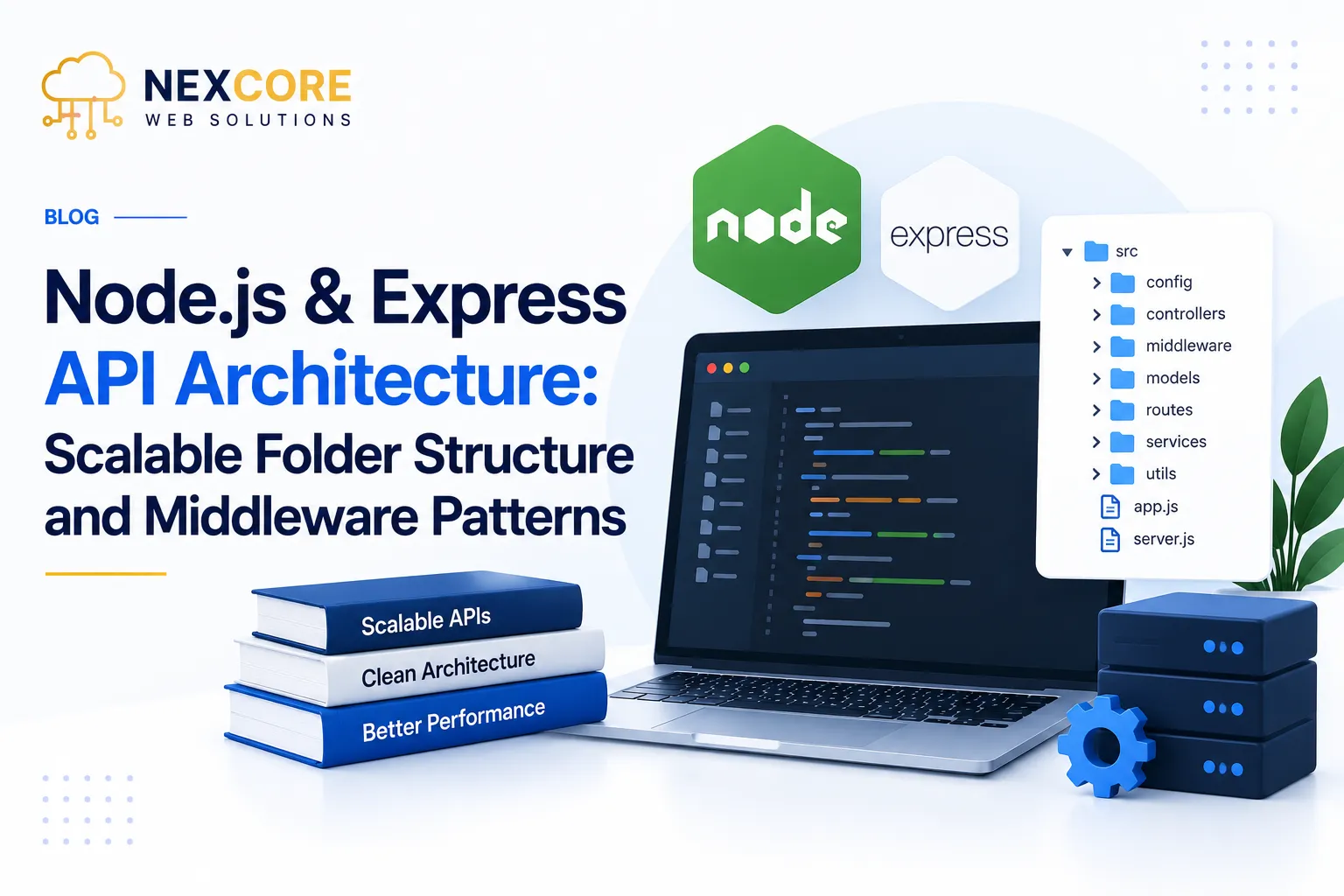
A practical structure can organize an Express project around responsibilities and application features. A common arrangement includes folders such as routes, controllers, services, models, middlewares, validators, config, and utils. The routes directory defines URL paths and HTTP methods, while controllers coordinate individual requests. Services contain business logic that may be reused by different controllers, and models or repositories manage database interactions. Configuration files can hold environment-dependent settings without scattering them throughout the application.
Example Project Organization
A project might follow a structure similar to this:
src/
├── config/
├── controllers/
├── middlewares/
├── models/
├── routes/
├── services/
├── validators/
├── utils/
├── app.js
└── server.js
The exact structure does not need to be identical for every project. A smaller application may combine some directories, while a larger system may organize code by feature, with each feature containing its own routes, controller, service, and validation modules. The important principle is consistency. Developers should be able to predict where a particular responsibility belongs without searching through unrelated files.
Understanding Express Middleware
Middleware functions are central to Express because they can access the request and response objects and determine whether processing should continue. They can execute before a route handler, modify request data, return a response, or pass control to another middleware function. This makes middleware suitable for concerns that apply to multiple endpoints. Common examples include request logging, authentication, authorization, input validation, rate limiting, and centralized error handling.
Authentication Middleware
Authentication middleware verifies whether a request comes from an identified user. For example, an API may read a bearer token from the Authorization header and validate it before allowing access to protected routes. If authentication succeeds, the middleware can attach user information to the request object for later use. If authentication fails, it should stop the request and return an appropriate HTTP response rather than allowing the protected controller to execute.
Validation Middleware
Validation middleware checks whether incoming request data follows the application’s expected structure. A registration endpoint might require a valid email address, a sufficiently strong password, and a non-empty name. Keeping validation outside the controller prevents controllers from becoming long collections of input checks. It also creates reusable validation rules that can be applied consistently across related endpoints.
Centralized Error Handling
Error handling is another area where middleware improves maintainability. Instead of adding repetitive try/catch response logic to every route, applications can pass errors to a centralized error-handling middleware. That middleware can log technical details while returning a controlled response to the client. Production systems should avoid exposing stack traces, database details, or internal configuration through API responses.
Async Controller Patterns
Asynchronous operations are common in Node.js because APIs frequently communicate with databases, external services, and file systems. Controllers should handle rejected promises consistently so unexpected errors reach the application’s error-handling layer. Whether an application uses wrapper utilities or explicit try/catch blocks, the chosen pattern should remain consistent. Consistency prevents some errors from being handled correctly while others become unhandled promise rejections.
Route and Service Separation
Routes should remain focused on mapping HTTP requests to application operations. For example, a user route might connect POST /users to a user controller without containing the complete registration process. The controller can extract request information and call a user service, while the service performs business operations such as checking whether an account already exists. This separation makes business logic reusable from other interfaces, such as background jobs or administrative tools.
Middleware Ordering and Security
Middleware execution order matters because Express processes middleware in the sequence in which it is registered. Request parsing should happen before code that expects parsed request bodies, while authentication should run before protected controllers. Security-related middleware such as rate limiting and security headers should be configured thoughtfully according to application requirements. Developers should also validate untrusted input and avoid trusting client-provided authorization information without verification.
Conclusion
A scalable Node.js and Express API depends less on having a complicated architecture and more on maintaining clear responsibilities. Separating routes, controllers, services, models, validation, configuration, and middleware prevents individual files from becoming difficult to maintain. Middleware provides a clean mechanism for handling cross-cutting concerns such as authentication, validation, logging, and centralized errors. The best structure will vary according to application size and team requirements, so developers should avoid copying a folder layout without understanding why each boundary exists. Start with simple separation, establish consistent conventions, and introduce additional layers only when the application’s complexity justifies them.
FAQs
What is the best folder structure for a Node.js Express API?
There is no single structure that works for every Express application. A common scalable arrangement separates routes, controllers, services, models, middleware, validators, configuration, and utilities. Smaller projects can use fewer layers, while larger applications may organize these responsibilities by feature. The key objective is to create predictable boundaries so developers can locate and maintain code efficiently.
Why should business logic be separated from Express routes?
Separating business logic from routes keeps HTTP-specific code from becoming tightly coupled with application rules. Controllers can process requests and call services, while services perform operations that represent the application’s business behavior. This approach improves testing and reuse because business logic can potentially be called from different entry points without depending directly on Express request and response objects.
What is middleware in Express?
Middleware is a function that participates in processing an HTTP request before the final response is produced. It can inspect or modify the request, generate a response, or pass control to another middleware or route handler. Common middleware responsibilities include authentication, validation, logging, request parsing, rate limiting, and error handling.
How should authentication middleware work?
Authentication middleware should obtain credentials from the incoming request and verify them using the application’s authentication mechanism. When verification succeeds, relevant user information can be attached to the request for downstream handlers. When credentials are missing or invalid, the middleware should stop processing and return an appropriate unauthorized response. Protected routes should never rely solely on client-provided identity claims.
When should an Express application use services?
Services become particularly useful when application logic grows beyond simple request handling. If multiple controllers need the same business operation, moving that logic into a service can reduce duplication. Services are also useful when database operations, external API calls, validation rules, and business decisions would otherwise make controllers difficult to understand. For very small APIs, introducing many layers may add unnecessary complexity.




