
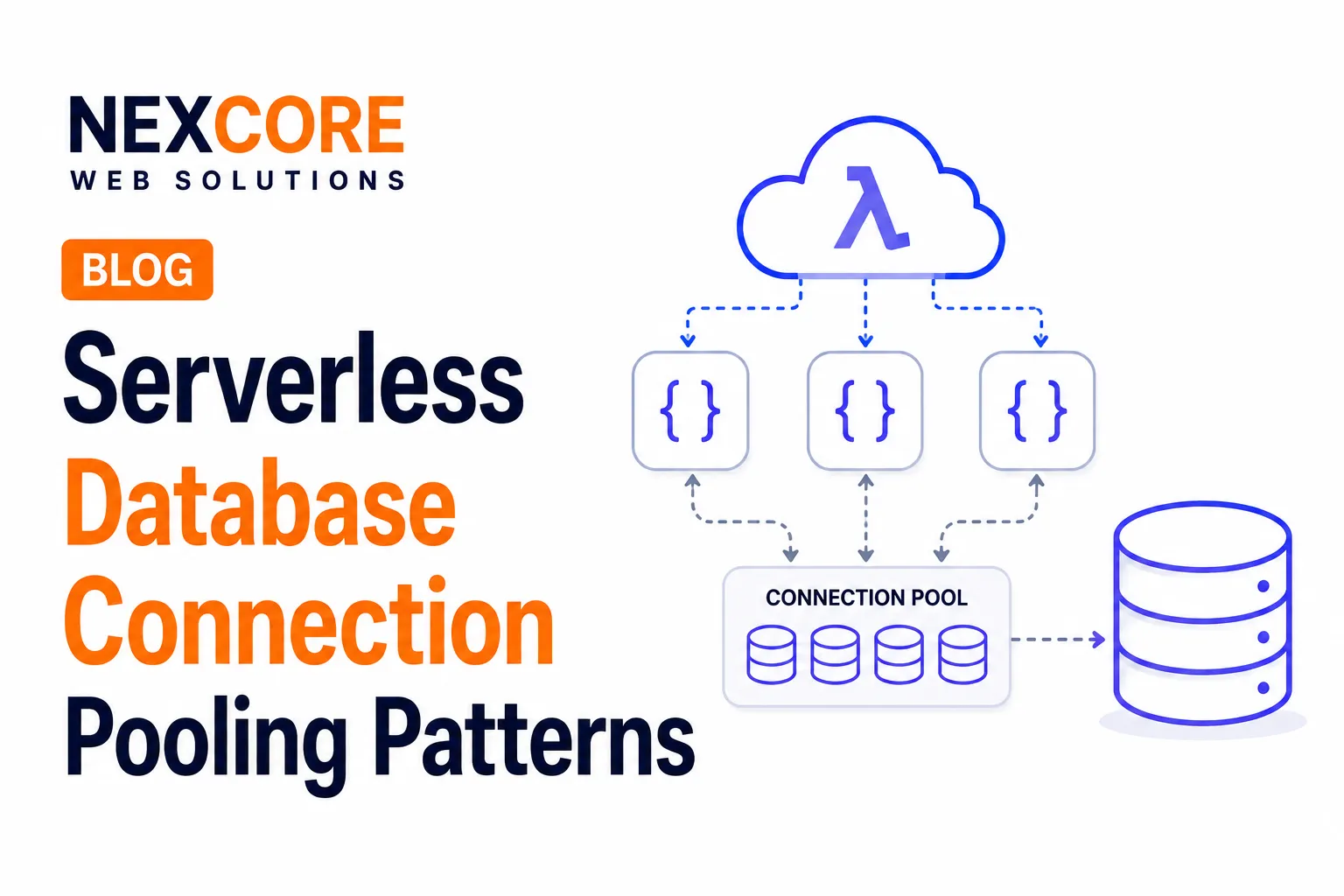
Serverless applications change how developers think about database connectivity. Traditional servers often keep application processes alive for long periods, allowing a database connection pool to remain available and reuse established connections. Serverless functions, however, can start and stop dynamically, creating many execution environments during traffic spikes. If every invocation opens a new database connection, the database can quickly become overloaded even when the application itself scales successfully. This makes serverless database connection pooling an important architecture concern for APIs, web applications, background jobs, and event-driven systems. Effective pooling patterns reduce connection overhead, protect database capacity, and improve response times. The challenge is finding a design that works with short-lived compute, concurrent invocations, connection limits, cold starts, and unpredictable traffic.
Why Traditional Connection Pools Struggle
A conventional connection pool works well when a small number of long-running application servers handle many requests. Each server maintains a set of reusable database connections and returns them to the pool after queries finish. In a serverless environment, dozens or hundreds of isolated execution environments may appear during a traffic surge. Each environment can potentially create its own pool, multiplying the number of database connections unexpectedly.
The Connection Storm Problem
Imagine a function configured with a pool of ten connections. If the platform creates 100 concurrent instances, the theoretical connection demand could reach 1,000 connections. A relational database with a much smaller connection limit may start rejecting requests or spending excessive resources managing connections. The result can be a database bottleneck even though the serverless platform reports healthy function scaling. Connection limits must therefore be treated as a shared system resource rather than something each function can manage independently.
Pattern 1: Reuse Connections Within Warm Instances
One of the simplest approaches is to create a database client outside the function handler. When a serverless execution environment remains warm, subsequent invocations can reuse the existing client and its connection. This avoids establishing a new connection for every request. However, developers should understand that this is opportunistic reuse rather than a guarantee of persistent connections.
const { Pool } =require("pg");constpool=newPool({ max: 2, idleTimeoutMillis: 10000});exports.handler =async () => {constresult=awaitpool.query("SELECT id, name FROM users LIMIT 10" );return { statusCode: 200, body: JSON.stringify(result.rows) };};
Keeping the pool size small is important because every concurrent serverless environment can create its own resources. The correct settings depend on database capacity, function concurrency, query duration, and the number of functions sharing the database. A large pool inside every function is usually counterproductive.
Pattern 2: Use a Managed Connection Pooler
A managed connection pooler places a connection-management layer between serverless functions and the database. Functions connect to the pooler, while the pooler manages a smaller set of database connections behind the scenes. This approach can absorb bursts of application connections without requiring the database itself to accept every client connection directly. It is particularly useful when serverless workloads generate highly variable concurrency.
Why Poolers Help
A pooler can centralize connection management and reduce the impact of short-lived function instances. It may also provide better control over connection limits, idle sessions, and traffic distribution. The exact behavior depends on the provider and database technology, so developers should evaluate transaction handling, session features, prepared statements, and connection lifetime requirements before selecting a pooler.
Pattern 3: Serverless-Friendly Database Drivers
Some database services and drivers are designed specifically for serverless workloads. They may use HTTP-based access, transaction-aware pooling, or infrastructure that handles database connections outside individual function instances. This can reduce the pressure caused by direct TCP connections from rapidly scaling functions. The trade-off is that performance characteristics and supported database features can differ from traditional direct connections.
Pattern 4: Transaction Pooling
Transaction-level pooling can be effective when applications only need a database connection while a transaction is actively executing. After the transaction finishes, the underlying connection can be returned to the shared pool. This allows many short requests to reuse a relatively small number of database connections. However, applications relying on session-specific state must be carefully evaluated because a subsequent transaction may use a different underlying connection.
Pattern 5: Limit Serverless Concurrency
Connection pooling should be considered together with function concurrency. If a serverless platform allows unlimited scaling while the database supports only a fixed number of connections, the database becomes the limiting component. Setting an appropriate concurrency limit can prevent sudden connection spikes and keep database utilization within safe boundaries. This may slightly restrict application scaling, but controlled scaling is often better than allowing the database to become unavailable.
Calculating Connection Capacity
A useful starting point is to estimate how many concurrent connections the database can safely support. Subtract connections required by administration, monitoring, replicas, and other applications from the database’s practical capacity. Then determine how many connections each serverless instance can reasonably use and how many instances can run concurrently. This calculation should include other services sharing the same database because their connections compete for the same resource.
Handling Timeouts and Failures
Serverless database operations should have sensible connection and query timeouts. Without limits, stalled connections can remain occupied and reduce capacity during traffic spikes. Retry logic also requires caution because aggressive retries can multiply database load when the database is already struggling. Exponential backoff, bounded retries, and clear failure handling are generally safer than immediately repeating every failed query.
Cold Starts and Connection Initialization
Cold starts can add connection-establishment latency, especially when the database is geographically distant from the function. Keeping clients initialized outside the handler can reduce repeated setup during warm executions. Application architecture should also consider deploying compute close to the database when practical. Lower network latency benefits both connection establishment and query execution.
Monitoring Connection Usage
Connection metrics should be monitored alongside function metrics. Useful signals include active connections, idle connections, connection errors, query latency, database CPU, function concurrency, timeout rates, and rejected requests. A sudden increase in database connections that closely follows function concurrency can indicate that connection reuse or pooling is not working as intended. Monitoring allows teams to identify connection exhaustion before it becomes a major outage.
Common Mistakes
One frequent mistake is configuring a large connection pool because traditional server deployments commonly use larger pool sizes. Another is creating a new database client inside every function invocation. Developers may also overlook connections created by background jobs, scheduled functions, migrations, and administrative tools. Finally, optimizing connection counts without considering slow queries can hide the real problem because long-running queries keep connections occupied for longer periods.
Choosing the Right Pattern
The best pattern depends on workload characteristics and database architecture. Warm-instance reuse may be sufficient for moderate workloads, while high-concurrency systems often benefit from managed pooling or serverless-aware database services. Transaction pooling can help applications with short database operations, while concurrency limits provide an additional safety boundary. The architecture should prioritize predictable database utilization rather than simply maximizing function-level scalability.
Conclusion
Serverless database connection pooling requires a different approach from traditional long-running application servers. The main challenge is preventing rapidly scaling function instances from creating more database connections than the database can safely handle. Reusing clients across warm executions, keeping per-instance pools small, using managed poolers, applying transaction-level pooling, and controlling concurrency are practical ways to manage this risk. Developers should also configure sensible timeouts, limit retries, monitor connection behavior, and measure query performance under realistic traffic. The strongest architecture treats database capacity as a shared constraint and designs serverless scaling around it. With careful planning, serverless applications can remain highly responsive without turning database connections into a hidden scalability bottleneck.
FAQs
1. Why is database connection pooling difficult in serverless applications?
Serverless platforms can create many independent execution environments as traffic increases. Each environment may establish its own database connections, causing connection counts to grow much faster than expected. Traditional connection pools assume a smaller number of long-running application processes, so their settings may not translate directly to serverless workloads. Limiting pool sizes, reusing clients, and using centralized pooling can help control this behavior.
2. Should I create a database connection inside every serverless function?
Usually, repeatedly creating a new connection for every invocation is inefficient and can exhaust database connection limits. A common approach is to initialize the database client outside the function handler so warm execution environments can reuse it. However, the exact implementation depends on the runtime, database driver, and hosting platform. The pool size should remain conservative because multiple instances can exist simultaneously.
3. What is a managed connection pooler?
A managed connection pooler is a service or infrastructure layer that sits between application clients and the database. Serverless functions can establish connections to the pooler while the pooler maintains a controlled number of underlying database connections. This helps absorb bursts of application concurrency without requiring the database to create a separate connection for every client. Features and behavior vary between providers.
4. How many database connections should a serverless function use?
There is no universal number because the correct pool size depends on database capacity, function concurrency, query duration, and the number of applications sharing the database. Small per-instance pools are often safer than large ones because many serverless instances can run concurrently. Teams should calculate total potential connection demand and validate the configuration using realistic load tests before production deployment.
5. Can serverless applications overwhelm a database?
Yes. Serverless compute can scale rapidly while the database has fixed limits on connections, CPU, memory, and query throughput. If application concurrency increases without corresponding database controls, connection exhaustion or query saturation can occur. Concurrency limits, connection pooling, efficient queries, caching, and monitoring can reduce this risk. Database capacity should always be included in the overall serverless scalability plan.




