
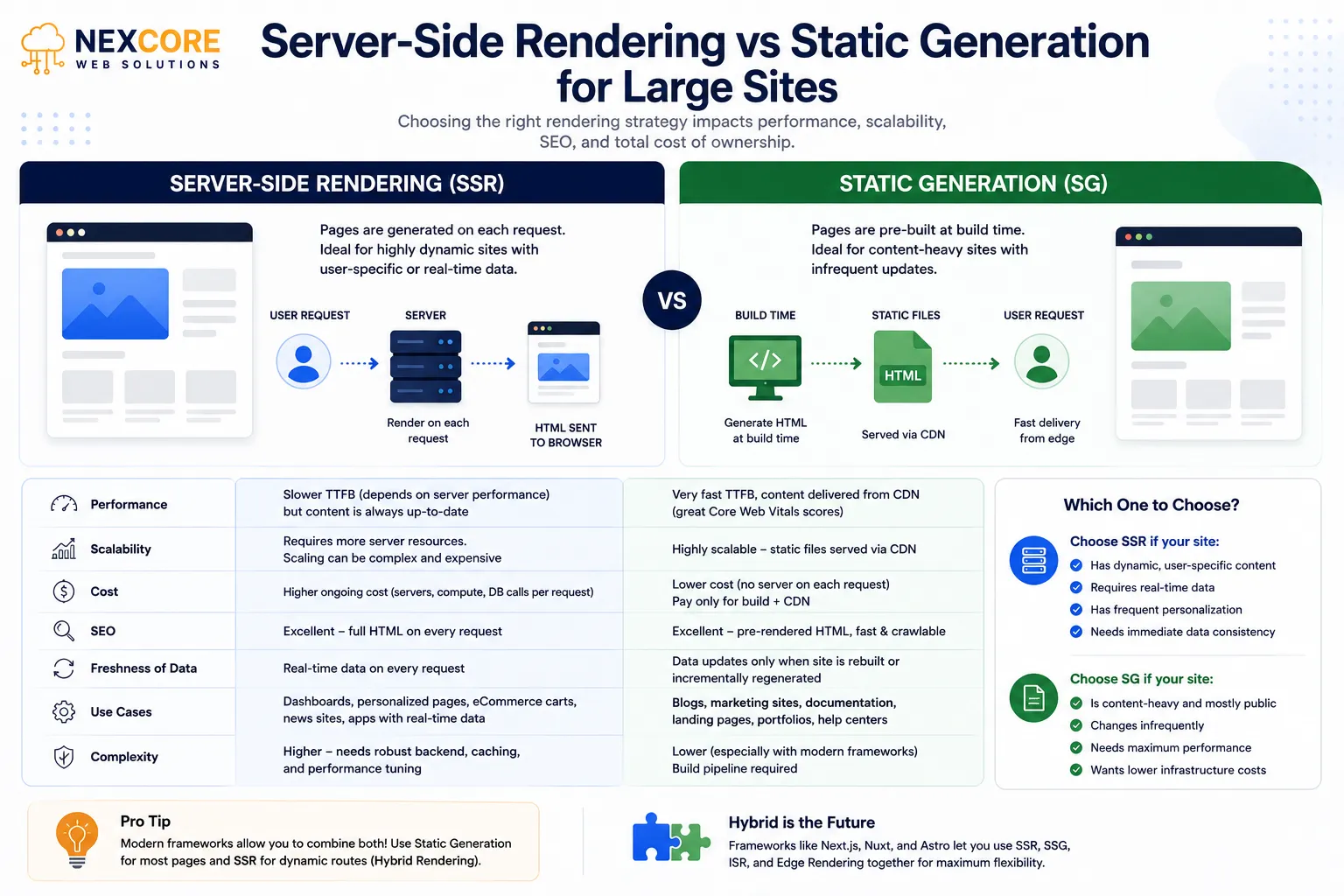
Choosing the right rendering strategy is one of the most important architectural decisions when building a large website. Enterprise portals, eCommerce platforms, SaaS products, media publications, and documentation websites all require fast performance, strong search engine visibility, and the ability to scale as traffic grows. Two of the most widely used rendering approaches are Server-Side Rendering (SSR) and Static Site Generation (SSG). Each offers distinct advantages depending on the type of content, update frequency, infrastructure requirements, and user expectations. While SSR generates pages dynamically for each request, SSG builds pages ahead of time during deployment. Understanding the strengths, limitations, and practical use cases of both approaches helps organizations design high-performing websites that balance speed, scalability, maintainability, and long-term operational efficiency.
Understanding Rendering Strategies
What Is Server-Side Rendering?
Server-Side Rendering generates HTML on the server whenever a user requests a page. The server retrieves the required data, renders the page, and sends fully prepared HTML to the browser. This approach allows users to receive fresh content immediately without waiting for extensive client-side processing. SSR is particularly useful for websites with frequently changing information or personalized user experiences.
What Is Static Site Generation?
Static Site Generation creates HTML pages during the build process instead of generating them when users visit the website. These prebuilt files are deployed to web servers or content delivery networks and served instantly to visitors. Since no server-side rendering occurs during requests, websites typically achieve excellent loading speeds and reduced infrastructure demands. Static generation is highly effective for content that changes infrequently.
Performance Comparison
Speed and User Experience
Static websites generally load faster because browsers receive prebuilt HTML directly from edge servers without waiting for backend processing. Reduced server computation improves page response times while lowering latency for global users. Faster loading enhances user satisfaction and contributes to stronger Core Web Vitals performance. Large content-driven websites often benefit significantly from these performance improvements.
Dynamic Content Delivery
Server-Side Rendering provides advantages when content changes continuously throughout the day. Product availability, account dashboards, pricing information, inventory status, and personalized recommendations can be generated using current data whenever users access a page. This ensures visitors always receive accurate information without requiring frequent site rebuilds. Businesses relying on real-time updates often prefer SSR for this reason.
Search Engine Optimization
Crawling and Indexing
Both SSR and Static Site Generation can produce search-engine-friendly HTML that is easily crawled and indexed. Since content is rendered before reaching the browser, search engines can interpret page structure efficiently without relying heavily on JavaScript execution. Strong metadata, semantic HTML, structured data, and quality content remain equally important regardless of rendering strategy.
Content Freshness
Websites publishing frequently updated information must ensure search engines always access current content. Server-Side Rendering naturally serves the latest available data with every request. Static websites can also remain current through incremental regeneration or scheduled rebuilds, although update frequency depends on deployment workflows. Selecting the appropriate strategy depends largely on publishing requirements.
Scalability Considerations
Handling High Traffic
Large websites serving millions of visitors require architectures capable of maintaining consistent performance during traffic spikes. Static websites scale exceptionally well because identical files can be distributed across global content delivery networks with minimal server processing. Reduced backend workloads lower infrastructure costs while supporting significant traffic growth. This simplicity improves operational reliability.
Server Resource Usage
Server-Side Rendering requires processing resources for every incoming request because pages are generated dynamically. CPU utilization, database access, and memory consumption increase as traffic grows. Efficient caching, load balancing, and optimized application architecture help reduce these resource demands. Organizations should carefully evaluate expected traffic before selecting SSR as the primary rendering approach.
Development and Maintenance
Build Complexity
Static Site Generation may require longer build times as website size increases. Large websites containing thousands of pages can experience extended deployment processes because every affected page must be generated before publication. Incremental build technologies help reduce deployment duration by rebuilding only modified content. Efficient build pipelines become increasingly important for enterprise websites.
Development Flexibility
Server-Side Rendering provides greater flexibility for applications requiring authentication, user-specific content, real-time dashboards, and interactive business workflows. Developers can access server resources during page generation without exposing sensitive logic to browsers. This flexibility makes SSR particularly suitable for enterprise applications where personalization and secure data access play important roles.
Cost and Infrastructure
Hosting Requirements
Static websites generally require simpler hosting environments because they serve prebuilt files rather than executing application logic continuously. Content delivery networks efficiently distribute static assets worldwide, reducing operational costs while improving performance. Organizations with predictable content often benefit from this lightweight infrastructure model.
Operational Expenses
Server-Side Rendering usually involves higher operational expenses because backend servers remain responsible for rendering pages dynamically. Additional infrastructure may include application servers, databases, caching layers, monitoring systems, and load balancers. Although these components increase operational complexity, they enable sophisticated application functionality that static architectures cannot always provide independently.
Choosing the Right Approach
The ideal rendering strategy depends on business objectives rather than technical trends. Static Site Generation performs exceptionally well for documentation, marketing websites, blogs, knowledge bases, and corporate websites with relatively stable content. Server-Side Rendering becomes more appropriate for personalized applications, online marketplaces, financial systems, customer portals, and platforms requiring continuously updated information. Many modern architectures combine both approaches, allowing static and dynamic rendering to coexist where each provides the greatest value.
Conclusion
Server-Side Rendering and Static Site Generation each solve different technical challenges for large websites. Static generation delivers exceptional speed, simplified infrastructure, and outstanding scalability for content that changes infrequently, while Server-Side Rendering provides flexibility for dynamic, personalized, and real-time applications. Rather than treating one approach as universally superior, organizations should evaluate content update frequency, performance requirements, operational costs, scalability objectives, and user expectations before selecting a rendering strategy. In many enterprise environments, hybrid architectures provide the best balance by combining the strengths of both techniques. Careful planning ensures websites remain fast, maintainable, search-engine friendly, and capable of supporting long-term digital growth as business requirements continue evolving.
FAQs
1. What is the difference between Server-Side Rendering and Static Site Generation?
Server-Side Rendering creates HTML dynamically whenever users request a page, ensuring content is always generated using the latest available data. Static Site Generation creates HTML during the build process before deployment, allowing pages to be served instantly without additional server processing. The choice depends on whether content changes frequently or remains relatively stable.
2. Which approach offers better performance for large websites?
Static Site Generation generally provides faster page loading because prebuilt files are delivered directly from content delivery networks without requiring server-side rendering. However, Server-Side Rendering performs better for websites requiring real-time or personalized content. Performance depends on the application’s specific requirements rather than rendering technology alone.
3. Is Server-Side Rendering better for SEO?
Both Server-Side Rendering and Static Site Generation support excellent search engine optimization because they deliver fully rendered HTML to search engines. Strong content quality, semantic markup, structured data, metadata, and internal linking remain more important for SEO success than the rendering method itself.
4. When should businesses choose Static Site Generation?
Businesses should consider Static Site Generation for websites containing mostly stable content, such as corporate websites, blogs, documentation portals, landing pages, and marketing websites. This approach offers excellent performance, simplified hosting, lower infrastructure costs, and outstanding scalability while maintaining strong search engine visibility.
5. Can a website use both SSR and Static Site Generation?
Yes. Many modern web frameworks support hybrid rendering, allowing different pages to use different rendering strategies. Marketing pages, documentation, and blogs can use Static Site Generation, while authenticated dashboards, personalized content, and frequently updated sections use Server-Side Rendering. This hybrid approach combines performance, flexibility, and scalability within a single application.




