
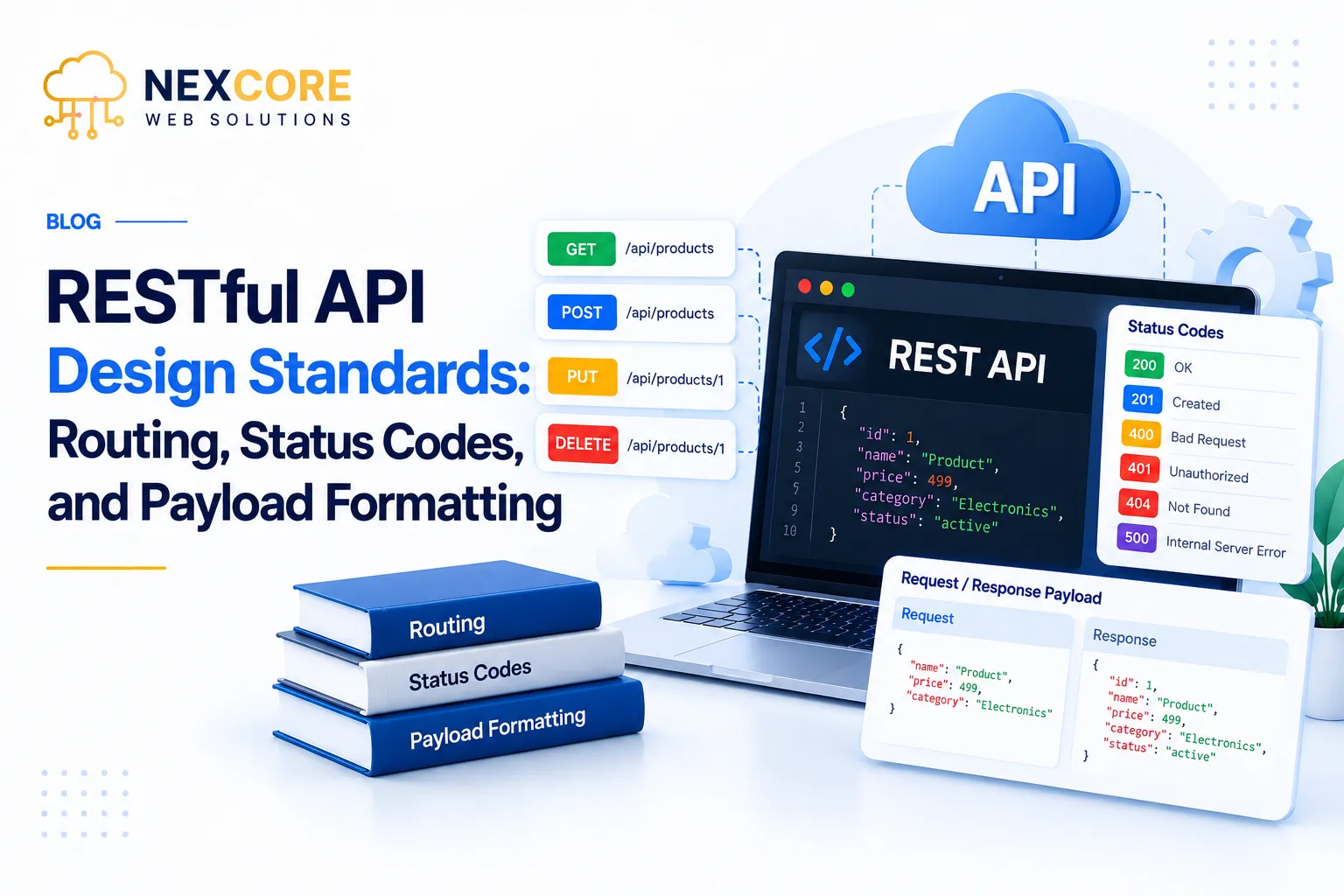
RESTful APIs provide a structured way for applications to communicate over HTTP, making them a common foundation for modern web and mobile systems. A well-designed API is not simply a collection of endpoints that return data; it should have predictable routes, meaningful HTTP status codes, consistent payloads, and clear behavior across different operations. These standards become especially important as an application grows and multiple developers or client applications consume the same API. Poorly designed routes or inconsistent responses can make integrations difficult to maintain and troubleshoot. By following practical REST conventions from the beginning, developers can create APIs that are easier to understand, test, document, secure, and extend without repeatedly changing existing client-side code.
Understanding RESTful API Design
REST, or Representational State Transfer, is an architectural style built around resources and standard HTTP operations. Instead of designing endpoints around actions such as /getUsers or /createUser, REST APIs generally represent resources through nouns such as /users and use HTTP methods to describe the requested operation. This approach creates a predictable interface that clients can understand without learning a different convention for every endpoint. Stateless communication also means that each request should contain the information necessary for the server to process it.
Common HTTP Methods
The most frequently used HTTP methods are GET, POST, PUT, PATCH, and DELETE. GET retrieves resources, POST generally creates a new resource, PUT replaces an existing resource, PATCH modifies part of an existing resource, and DELETE removes a resource. Developers should use these methods consistently instead of creating custom action-style routes for ordinary CRUD operations. Clear method semantics also make APIs easier to test with tools such as Postman, command-line clients, or automated integration tests.
Designing Clean API Routes
Good routing begins with meaningful resource names and a consistent URL hierarchy. A typical API might use /api/v1/users for a collection and /api/v1/users/42 for a specific user identified by ID. Nested resources can represent relationships when the relationship is meaningful, such as /users/42/orders, but excessive nesting can make routes difficult to use. Versioning through a path such as /api/v1/ can also provide a controlled way to introduce breaking changes.
Query Parameters and Filtering
Query parameters are useful for filtering, sorting, searching, and pagination without creating numerous specialized endpoints. For example, /products?category=books&page=2&limit=20 can communicate several optional requirements while keeping the main resource route unchanged. Servers should validate query parameters and define sensible defaults for missing or invalid values. Pagination is particularly important for large collections because returning thousands of records in a single response can increase latency, memory consumption, and network traffic.
Choosing HTTP Status Codes
HTTP status codes communicate the outcome of a request and should be used consistently. Successful GET requests commonly return 200 OK, while a successful resource creation can return 201 Created. A DELETE operation may return 204 No Content when the operation succeeds without needing to return a response body. Client-side problems may use 400 Bad Request, 401 Unauthorized, 403 Forbidden, or 404 Not Found, while server-side failures generally use 5xx responses.
Avoiding Misleading Status Codes
A technically successful HTTP request does not necessarily mean that the requested business operation succeeded. For example, returning 200 OK for every request and placing an error message inside the JSON body makes client behavior unnecessarily complicated. Clients should be able to make an initial decision based on the HTTP status code before processing the payload. The chosen status code should therefore describe the actual result of the operation rather than simply indicating that the server generated a response.
Formatting API Payloads
Consistent payload formatting is just as important as consistent routing. JSON is widely used for REST APIs because it is lightweight, readable, and supported by virtually every modern programming language. Response objects should use predictable property names and data types, while collections should follow a stable structure. For example, an application might consistently return an object containing data, meta, and errors fields when its API design requires those concepts.
Designing Error Responses
Error responses deserve the same attention as successful responses because developers frequently depend on them while debugging integrations. A useful error payload can include a machine-readable error code, a human-readable message, and optional details identifying invalid fields. For example, a validation response might identify email as invalid rather than returning only a generic “Request failed” message. Error messages should avoid exposing passwords, tokens, internal stack traces, database details, or other sensitive implementation information.
Validation and Data Consistency
API validation should occur at the server boundary even when the frontend already validates user input. Client-side validation improves user experience, but it cannot be treated as a security control because requests can be generated independently of the application interface. Servers should validate required fields, data types, allowed values, lengths, and business rules before processing requests. Consistent validation also prevents different endpoints from accepting contradictory representations of the same resource.
Security Considerations
REST API design must account for authentication, authorization, transport security, and input handling. APIs should normally use HTTPS so credentials and sensitive data are protected during transmission. Authentication determines who the requester is, while authorization determines whether that requester can perform the requested operation. Rate limiting, secure token handling, careful CORS configuration, and protection against injection attacks are also important parts of a production API.
Documentation and Versioning
Even a technically well-designed API can become difficult to use without accurate documentation. Documentation should explain available endpoints, parameters, request bodies, response structures, authentication requirements, and common error conditions. OpenAPI-based specifications can help teams maintain machine-readable API documentation and generate supporting tools. When an API must introduce a breaking change, versioning and a clear migration strategy can prevent existing clients from unexpectedly failing.
Conclusion
RESTful API design is primarily about creating predictable communication between software systems. Resource-oriented routes, appropriate HTTP methods, meaningful status codes, consistent JSON structures, and useful error responses provide a strong foundation for maintainable applications. Developers should also consider validation, security, pagination, documentation, and versioning rather than treating routing as the only design concern. A practical API should make common operations obvious to both humans and machines while remaining stable as requirements evolve. By applying these standards consistently across an application, development teams can reduce integration problems, simplify testing, and create APIs that remain understandable as the system becomes larger and more complex.
FAQs
1. What makes an API RESTful?
A RESTful API generally organizes functionality around resources and uses standard HTTP methods to operate on those resources. It commonly follows stateless communication, where each request contains the information needed to process it. Consistent resource naming, meaningful status codes, predictable representations, and cache-related considerations can further support a REST-oriented design. The exact implementation may vary because REST is an architectural style rather than a single mandatory specification.
2. Which HTTP status code should be returned after creating a resource?
A successful resource-creation request commonly uses 201 Created. The response can include the newly created representation and, where appropriate, a Location header identifying the new resource. Using 201 instead of a generic 200 communicates the result more precisely to clients. The exact response body depends on the API contract and whether the server returns the created resource immediately.
3. Should REST APIs always return JSON?
JSON is a common choice for REST APIs because it is compact, readable, and broadly supported across programming languages and platforms. However, REST itself does not require JSON exclusively. An API can use other representations when there is a practical reason to do so. The important consideration is consistency: clients should know what representation to expect and how content negotiation is handled.
4. What is the difference between PUT and PATCH?
PUT is generally used to replace the representation of an existing resource, while PATCH is intended for partial modifications. For example, updating an entire user representation may use PUT, whereas changing only a user’s phone number may use PATCH. The exact semantics should be documented because APIs sometimes implement these methods differently. Clients should follow the specific contract rather than assuming undocumented behavior.
5. Why are consistent API responses important?
Consistent responses make client development, testing, debugging, and maintenance easier. If different endpoints use unrelated structures for similar operations, frontend and integration code must contain additional special cases. A predictable response contract allows developers to build reusable handling for success, validation failures, authentication errors, and other conditions. Consistency also makes API documentation clearer and reduces confusion when multiple teams work with the same service.




