
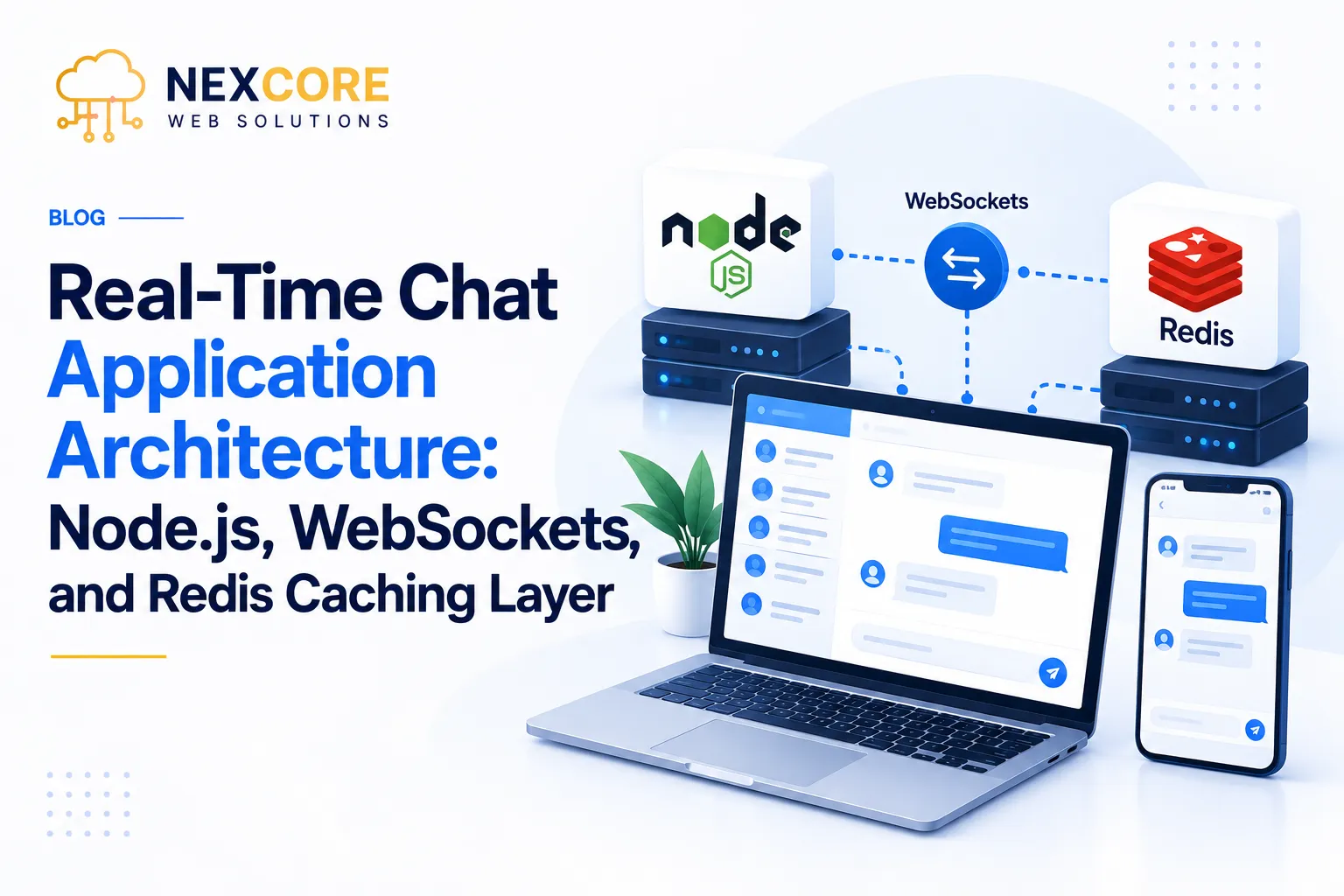
Real-time chat applications need to deliver messages quickly while supporting many users who may be connected simultaneously. Unlike traditional request-response websites, chat systems must maintain active connections and react immediately when a user sends or receives a message. A practical architecture often combines Node.js for backend processing, WebSockets for persistent real-time communication, and Redis for fast shared data access. Each component handles a different responsibility, allowing the application to remain responsive as usage grows. Node.js manages application logic and connections, WebSockets provide low-latency message delivery, and Redis can support caching, presence information, sessions, and communication between server instances. Understanding how these layers work together gives developers a strong foundation for designing scalable real-time applications.
Core Architecture of a Chat Application
A typical chat architecture contains a frontend client, a Node.js application server, a WebSocket layer, Redis, and a persistent database. The frontend establishes a WebSocket connection after authentication and keeps that connection available for real-time events. The Node.js server validates messages, applies application rules, and coordinates communication with other services. Redis provides fast temporary storage or coordination, while a database can preserve conversations, users, and message history.
Request and Message Flow
When a user sends a message, the client transmits an event through its WebSocket connection. The server authenticates the sender, validates the message structure, and determines which recipient or conversation should receive it. The message can then be persisted in a database while the real-time event is delivered to connected clients. Separating persistent storage from real-time delivery prevents the WebSocket layer from becoming the only source of truth.
Node.js for Real-Time Backend Processing
Node.js is well suited to applications that manage many concurrent network connections because its event-driven architecture can handle asynchronous operations efficiently. A chat server may need to process connection events, authentication checks, database operations, message delivery, and presence updates without creating a separate blocking thread for every connection. Developers can organize these responsibilities into modules such as authentication, conversations, messages, notifications, and WebSocket handlers. Clear separation becomes increasingly important as the application gains more features.
Managing WebSocket Connections
A WebSocket connection remains open between the client and server, allowing either side to send events without repeatedly establishing new HTTP requests. Common events include connection, authentication, message, typing indicator, read receipt, and disconnect. The server should validate incoming events instead of trusting client-provided information. It should also handle unexpected disconnects gracefully because mobile networks, browser changes, and temporary connectivity problems are common in real-world applications.
WebSockets and Real-Time Communication
WebSockets provide bidirectional communication over a persistent connection. This makes them useful for chat because the server can immediately push an incoming message to a connected client. Traditional polling requires the client to repeatedly ask whether anything has changed, which can introduce unnecessary requests and delays. WebSockets instead allow the server to transmit an event when an actual change occurs.
Handling Rooms and Conversations
Most chat applications need a concept of rooms or channels. A room can represent a private conversation, group chat, support session, or project discussion. When a user joins a room, the server associates the connection with that room and can broadcast relevant events only to its members. This approach prevents unrelated users from receiving unnecessary data and keeps message routing manageable.
Redis as a Caching Layer
Redis is an in-memory data store that can provide very fast access to frequently requested information. In a chat application, it can store temporary data such as online presence, session information, room membership, rate-limit counters, and frequently accessed conversation metadata. This reduces repeated database queries for information that changes frequently or does not need permanent storage. Developers should still define expiration policies carefully so temporary data does not remain indefinitely.
Redis for Presence Tracking
Online presence is a common example of data that benefits from Redis. When a user connects, the application can record a presence key with an expiration period. Activity can refresh that information, while expiration naturally handles cases where a device disappears without sending a clean disconnect event. This is more reliable than assuming every connection will terminate gracefully.
Scaling Across Multiple Node.js Servers
A single WebSocket server can work for a small application, but larger systems may require multiple Node.js instances. This creates a routing challenge because two users in the same conversation may connect to different server instances. A message received by one instance must therefore be delivered to users connected through another instance. Redis can help coordinate events between these application servers.
Redis Pub/Sub Pattern
A common architecture uses Redis Pub/Sub to distribute real-time events between Node.js instances. When one server receives a chat message, it can publish an event to a Redis channel associated with the relevant conversation. Other server instances subscribed to that channel can receive the event and forward it to their connected clients. This allows WebSocket connections to remain distributed while maintaining coordinated message delivery.
Database and Reliability Considerations
Redis should not automatically replace a persistent database for chat history. Conversation messages often need durable storage so users can retrieve them after reconnecting or changing devices. A database can store users, conversations, messages, timestamps, delivery status, and other long-term records. The application can use Redis for fast temporary state while using the database as the durable record.
Security and Validation
Real-time applications require strong authentication and authorization because WebSocket connections can remain active for long periods. The server should verify identity during connection establishment and confirm that users are permitted to access requested rooms. Incoming messages should be validated for size, format, and content expectations. Rate limiting is also important because an unrestricted client could generate excessive messages or connection attempts.
Performance and Monitoring
Performance testing should measure more than message delivery speed. Developers should monitor active connections, message throughput, Redis latency, database response times, CPU usage, memory consumption, and WebSocket disconnect rates. Load testing can reveal bottlenecks that are not visible during development with only a few users. Logging and metrics should also make it possible to trace a message through authentication, processing, persistence, and delivery.
Conclusion
A production-oriented real-time chat application benefits from clearly separated responsibilities across Node.js, WebSockets, Redis, and persistent storage. Node.js manages asynchronous backend logic, WebSockets provide continuous two-way communication, and Redis supports fast temporary state and coordination between multiple server instances. A database remains important for durable conversation history and user data. As the application grows, developers should focus on authentication, room management, connection recovery, scaling, monitoring, and failure handling rather than treating real-time delivery as the only requirement. Building these components incrementally provides a practical path from a simple chat prototype to a system capable of supporting larger numbers of concurrent users.
FAQs
Why is Node.js commonly used for real-time chat applications?
Node.js uses an event-driven, asynchronous programming model that works well with applications handling many network connections. A chat server frequently performs tasks such as receiving messages, querying databases, managing WebSocket connections, and broadcasting events. Node.js can coordinate these operations without requiring a separate blocking execution flow for every connection, making it a practical choice for real-time backend services.
Why are WebSockets useful for chat applications?
WebSockets maintain a persistent connection between a client and server and allow both sides to send messages whenever needed. This is particularly useful for chat because the server can immediately push a new message, typing indicator, or notification to a connected client. Unlike frequent polling, WebSockets do not require the client to repeatedly ask whether new information is available.
What role does Redis play in a chat application?
Redis can provide fast access to temporary or frequently changing information. Chat applications can use it for online presence, session data, room membership, rate limiting, caching, and communication between multiple Node.js servers. Redis can also support Pub/Sub patterns that allow events received by one application instance to reach users connected through other instances.
Should chat messages be stored in Redis or a database?
Redis can be useful for temporary state and fast coordination, but long-term chat history generally requires persistent storage. A database can preserve messages so users can retrieve conversations after reconnecting or switching devices. Redis can complement the database by handling frequently accessed temporary information and real-time coordination, rather than serving as the only permanent storage layer.
How can a WebSocket chat application scale?
A scalable architecture can run multiple Node.js instances behind a suitable load-balancing layer while using shared infrastructure for coordination. Redis Pub/Sub or another messaging mechanism can distribute events between application instances when users in the same conversation are connected to different servers. Persistent storage should handle durable records, while monitoring and load testing help identify connection, CPU, memory, Redis, and database bottlenecks.




