
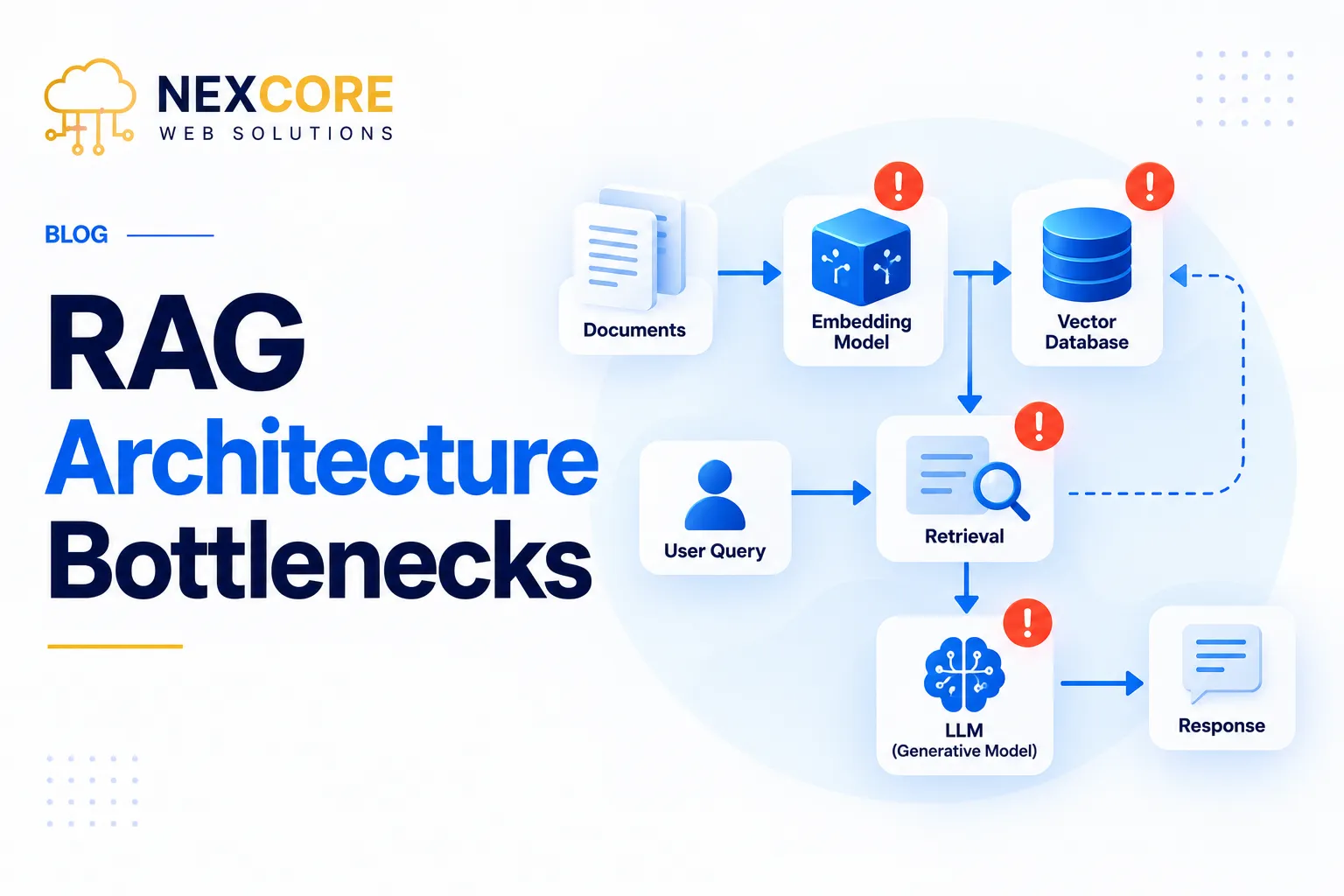
Retrieval-Augmented Generation (RAG) helps large language models answer questions using external documents, internal knowledge bases, and business data. However, a RAG application is only as reliable as the information it retrieves before generating a response. Vector-only databases can identify semantically similar passages, but they may overlook exact product codes, technical identifiers, names, and specific phrases that matter in enterprise searches. Poor retrieval can increase hallucinations, waste context-window space, and reduce the accuracy of generated answers. Hybrid search and re-ranking address these weaknesses by combining different retrieval methods and improving the order of candidate results. For teams building production AI systems, understanding these techniques is essential for balancing relevance, latency, infrastructure costs, and answer quality.
Why Vector-Only RAG Architectures Reach Their Limits
Vector search converts documents and queries into numerical embeddings that represent semantic meaning. A retrieval system compares these representations to identify passages that are conceptually related to the user’s question. This works well when users describe a subject differently from the wording used in the source documents. For example, a question about reducing server expenses may retrieve documents discussing infrastructure optimization even when those exact words are absent.
However, semantic similarity does not always equal factual relevance. A support engineer searching for error code ERR-1047 needs an exact match, not a passage that discusses a similar networking problem. Embeddings may also blur distinctions between product versions, legal clauses, configuration parameters, or similarly named entities. When the retrieval stage returns weak evidence, the language model may produce a plausible answer that fails to address the actual question.
Hybrid Search: Combining Semantic and Keyword Retrieval
How Hybrid Retrieval Works
Hybrid search combines dense vector retrieval with sparse keyword-based retrieval, such as BM25. Dense retrieval captures conceptual relationships, while sparse retrieval rewards meaningful word matches and distinctive terms appearing in the query and documents. Using both approaches allows a system to retrieve semantically relevant passages without losing important exact terminology. This combination is particularly valuable for technical documentation, enterprise search, product catalogs, and customer support knowledge bases.
Imagine an engineer asking, “How do I fix authentication error AUTH-203 in version 4.2?” Vector search may identify general authentication troubleshooting guidance, while keyword search can locate documents containing the exact error identifier and software version. The system combines the candidate lists to build a broader pool of potentially useful evidence. This improves retrieval coverage, although the final quality still depends on ranking, document structure, and query design.
Merging Results Effectively
Hybrid retrieval needs a strategy for combining results from different scoring systems. Raw vector similarity scores and BM25 scores usually have different scales, so adding them directly may produce unreliable rankings. Reciprocal Rank Fusion (RRF) is a common alternative that combines rankings using each document’s position in the result lists. Weighted score fusion is another option when the scores can be calibrated and the relative contribution of each retrieval method is tuned against evaluation data.
Re-Ranking: Improving the Quality of Retrieved Evidence
Hybrid search can increase recall, but its candidate list may still contain irrelevant or repetitive passages. A re-ranker evaluates the relationship between the query and each candidate more carefully, often using a cross-encoder or another model designed for relevance scoring. Unlike typical bi-encoder retrieval, which embeds queries and documents separately, a cross-encoder processes their relationship together. This deeper comparison can distinguish a passage that directly answers a question from one that merely shares similar terminology.
A practical architecture retrieves perhaps several dozen candidates using hybrid search, then applies a re-ranker to select a smaller group for the language model. The exact candidate count depends on corpus size, latency targets, model cost, and retrieval quality. Re-ranking can improve precision, but it adds computation and response time. Teams should therefore measure whether the improvement in answer quality justifies the additional processing.
Common RAG Bottlenecks Beyond Retrieval
Poor Document Chunking
Even strong search models struggle when documents are divided into unsuitable chunks. Very small chunks may omit definitions or surrounding context, while very large chunks can introduce irrelevant material and consume more of the model’s context window. Structure-aware chunking can preserve headings, tables, code blocks, and related paragraphs more effectively than arbitrary fixed-length splitting. Teams should evaluate chunk size and overlap using representative questions rather than choosing settings by convention alone.
Query Complexity and Context Overload
Users often submit ambiguous questions, combine multiple requests, or use terminology that differs from the indexed content. Query rewriting can clarify intent, expand abbreviations, or generate alternative search terms before retrieval. However, rewriting should preserve critical identifiers and constraints rather than replacing them with broader language. Sending too many low-quality passages to the language model can also dilute useful evidence and increase token costs, making focused context selection important.
A Practical Hybrid RAG Pipeline
A production retrieval pipeline should begin by normalizing the query without removing meaningful technical details. It can then run dense vector search and sparse keyword search in parallel, merge their candidates using RRF or calibrated score fusion, and apply a re-ranker to prioritize the strongest matches. The system should select a limited set of passages based on relevance, diversity, and available context space. Finally, the language model generates an answer grounded in the retrieved evidence, with citations or document references when the application supports them.
Monitoring should cover each stage rather than focusing only on the final response. Retrieval metrics such as Recall@K and Mean Reciprocal Rank can reveal whether relevant documents appear in the candidate set, while ranking metrics such as NDCG help assess ordering quality. End-to-end evaluation should also measure answer correctness, citation accuracy, latency, and cost. A staged evaluation makes it easier to identify whether failures originate in indexing, retrieval, re-ranking, or generation.
Choosing the Right Strategy for Production
Not every RAG application requires an elaborate pipeline. A small knowledge base with straightforward questions may perform adequately with vector search and carefully prepared documents. Hybrid search becomes more valuable when exact terms, identifiers, or rare phrases matter alongside semantic similarity. Re-ranking is especially useful when initial retrieval finds relevant material but places it too low in the candidate list.
Teams should test these approaches against a representative dataset of real user questions and verified relevant documents. Compare vector-only retrieval with hybrid search, then measure the additional effect of re-ranking separately. Track quality alongside latency and infrastructure costs so that improvements remain commercially practical. The best architecture is the simplest one that consistently retrieves the evidence required for accurate answers.
Conclusion
Vector-only retrieval provides a useful foundation for RAG, but semantic similarity alone may not meet the needs of complex enterprise applications. Hybrid search combines the conceptual strengths of embeddings with the precision of keyword matching, while re-ranking improves the relevance of the candidates ultimately passed to the language model. Together, these techniques can strengthen retrieval quality when implemented and evaluated carefully. They do not guarantee accurate answers, because document quality, chunking, query interpretation, and generation behavior remain important. Start with a representative evaluation dataset, measure retrieval and answer quality separately, and introduce each additional component only when results justify its cost. This evidence-driven approach produces a RAG architecture that is more reliable, efficient, and easier to maintain.
Frequently Asked Questions
1. What is hybrid search in RAG?
Hybrid search combines dense vector retrieval with sparse keyword-based retrieval to find relevant documents using both semantic meaning and exact terms. Vector search helps identify conceptually related passages, while keyword methods such as BM25 can locate specific identifiers, names, and phrases. Their results are combined into a candidate list, improving retrieval coverage for applications where both meaning and precise terminology matter.
2. Why is re-ranking useful in a RAG pipeline?
Re-ranking evaluates retrieved candidates more deeply to identify which passages are most relevant to a particular query. A cross-encoder can compare the query and each document together, often improving ranking precision over initial retrieval alone. Because re-ranking requires additional computation, systems usually apply it to a limited candidate pool. Its value should be confirmed through relevance measurements and end-to-end answer evaluation.
3. Is hybrid search always better than vector search?
No. Hybrid search can improve retrieval when exact keywords and semantic meaning both matter, but it adds configuration and evaluation requirements. Some small or narrowly focused datasets may already perform well with vector search alone. The appropriate approach depends on query patterns, document structure, and relevance requirements. Compare both methods using real questions and verified relevant documents before selecting a production design.
4. How do you evaluate RAG retrieval quality?
Use a test dataset containing representative questions and the documents that should answer them. Metrics such as Recall@K measure whether relevant documents appear among the retrieved candidates, while Mean Reciprocal Rank and NDCG assess ranking quality. Also evaluate generated-answer correctness, citation accuracy, latency, and cost. Separating retrieval metrics from generation metrics helps pinpoint the stage responsible for failures.
5. Does re-ranking increase RAG latency?
Yes, re-ranking usually adds processing time because the system must score multiple candidate passages after initial retrieval. The impact depends on the model, candidate count, hardware, and serving configuration. Teams can control overhead by retrieving a manageable pool, batching candidate evaluations where supported, and caching suitable results. Measure the quality improvement against the added latency to determine whether re-ranking is worthwhile.




