
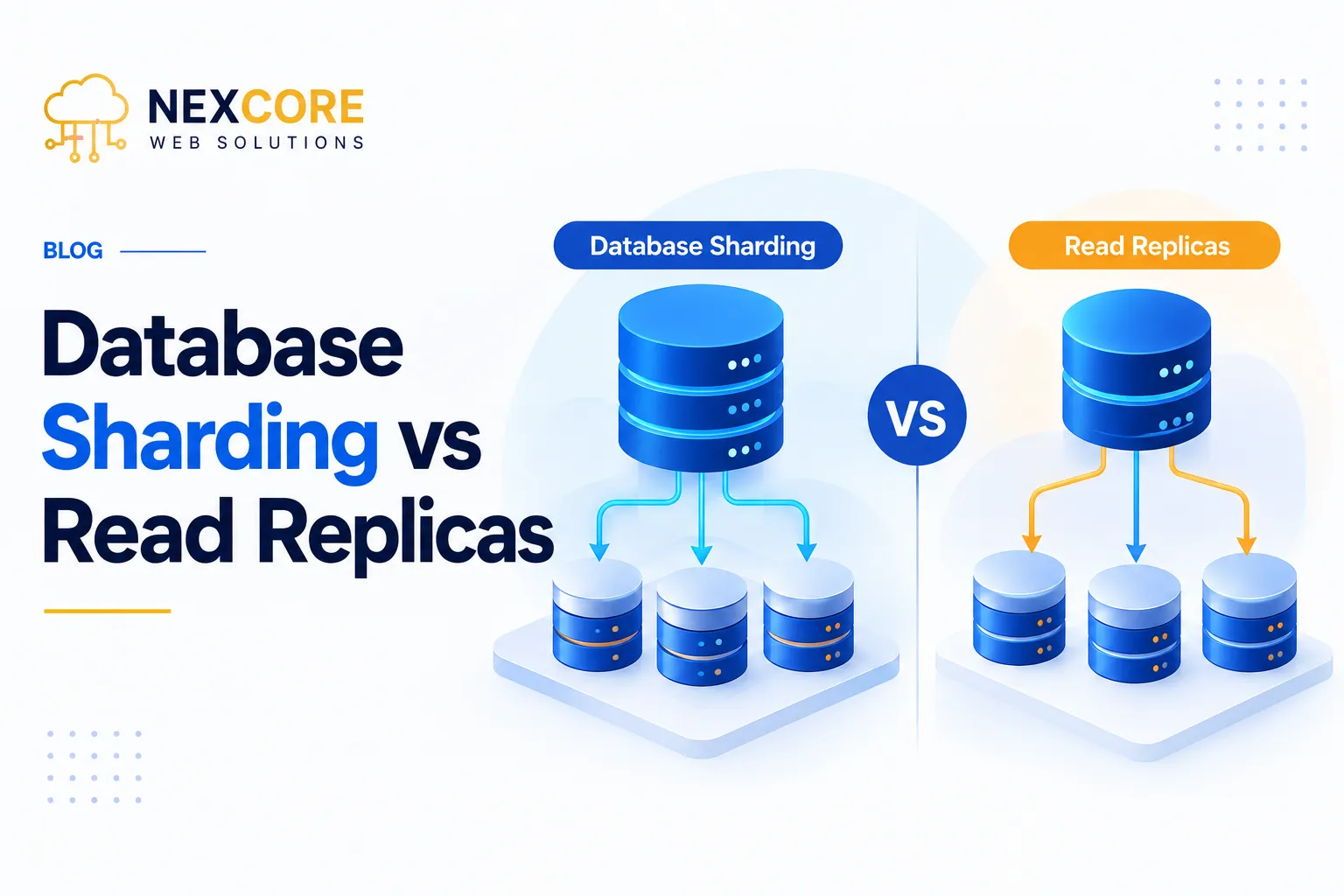
As applications grow, database performance can become a serious constraint on user experience, reliability, and operating costs. A system that handles thousands of requests comfortably may struggle when millions of users generate simultaneous reads, writes, and background jobs. Database sharding and read replicas are two common architectural strategies for addressing these demands, but they solve different problems. Read replicas distribute query traffic across additional database instances, while sharding divides data across multiple database partitions or servers. Choosing between them requires understanding the application’s read-to-write ratio, consistency requirements, data growth, and operational complexity. The wrong decision can add infrastructure costs without removing the actual bottleneck. This guide explains how both approaches work, when each makes sense, and how engineering teams can determine the right scaling strategy.
Understanding Read Replicas
Read replicas maintain copies of data from a primary database and serve eligible read queries. The primary usually handles writes, while replicas reduce the volume of read traffic reaching that primary. Depending on the database technology and configuration, replication may be asynchronous or synchronous, with different implications for latency and consistency. This architecture is especially useful for applications where users frequently retrieve information but update it less often.
Consider an online marketplace where customers browse product descriptions, category pages, and public reviews far more frequently than sellers update listings. Read replicas can serve many of those queries without forcing every request through the primary database. Additional replicas can increase read capacity when traffic grows, provided the workload and infrastructure support the distribution. However, replicas still need to receive updates from the primary, so replication consumes network, storage, and processing resources.
Read Replica Limitations
The main limitation is that replicas do not automatically increase the primary database’s write capacity. If transactions, updates, or index maintenance already overload the primary, adding replicas may provide little relief. Asynchronous replication can also introduce replication lag, meaning a recently committed change may not immediately appear on every replica. Applications that read newly updated information must account for this delay, perhaps by reading from the primary when fresh data is essential.
Understanding Database Sharding
Database sharding divides a dataset into smaller partitions distributed across multiple database instances. Each shard stores a subset of the overall data, allowing storage and query workloads to be spread across several servers. A shard key determines where a particular record belongs, using a strategy such as a customer identifier, geographic region, or tenant identifier. When the key distributes traffic effectively, sharding can increase both data capacity and write throughput beyond what a single database instance can comfortably handle.
For example, a business software platform may store millions of customer records and frequent transactions across multiple tenants. Assigning tenants to different shards can distribute storage requirements and transaction volume across database servers. Each shard can process writes for its own records, reducing competition for resources on a single instance. The benefit depends heavily on the shard key, because uneven distribution can leave one shard overloaded while others remain underused.
Sharding Challenges
Sharding introduces additional application and operational responsibilities. Queries that require data from multiple shards may need coordination, and cross-shard transactions can become more difficult to implement efficiently. Changing the shard key or redistributing records later may require substantial migration work. Teams must also monitor shard health, manage backups, plan capacity, and prevent uneven data distribution from creating hotspots.
Sharding vs Read Replicas: Key Differences
The central distinction is the bottleneck each approach addresses. Read replicas are primarily intended to distribute read traffic, whereas sharding partitions data and can distribute both storage and write workloads. Replicas preserve copies of the same dataset, while shards hold different portions of the dataset. Although both can be combined in one architecture, neither eliminates the need for careful query design and monitoring.
Read replicas are often simpler to introduce when the primary database has spare write capacity but struggles with frequent read queries. Sharding becomes more relevant when the primary approaches its limits for writes, storage, or the processing of a large dataset. Neither strategy is automatically faster for every workload, because network latency, indexing, connection management, and query patterns remain important. Teams should identify the limiting resource before choosing an architectural change.
How to Choose the Right Strategy
Evaluate Your Workload
Start by measuring query volume, transaction rates, read-to-write ratios, database CPU usage, disk latency, connection counts, and slow queries. If reads dominate and the primary spends significant resources answering reporting or browsing queries, read replicas may provide a practical improvement. If writes, storage growth, or single-instance capacity are the primary constraints, investigate sharding and database-level optimizations. Benchmarking with representative production traffic helps confirm whether the proposed design addresses the actual problem.
Consider Consistency and Query Patterns
Applications that require users to see their latest changes immediately need a clear read-routing strategy when replicas are involved. Reading from the primary after a write can help preserve read-after-write behavior, while replica reads may be appropriate for less time-sensitive information. Sharding decisions depend on access patterns as well, because queries that consistently include the shard key are easier to route efficiently. If common requests must scan many shards, the expected performance benefits may be reduced.
Plan for Operational Complexity
Read replicas require monitoring for lag, availability, and query distribution, but sharded systems usually introduce more complex data placement and recovery decisions. Teams should consider engineering expertise, failover procedures, backup restoration, schema changes, and future data migrations. Managed database services can simplify some responsibilities, although they do not remove architectural trade-offs. The best design is one the team can operate reliably as traffic and data volume increase.
Can You Combine Sharding and Read Replicas?
Yes, larger systems often combine both strategies when their workloads justify the additional complexity. A database can divide its dataset across several shards and maintain read replicas for each shard. This allows each shard to handle writes for its own data while replicas serve eligible reads for that partition. The architecture can improve read capacity and distribute write load, but it also requires coordinated monitoring, routing, failover, and recovery planning.
Combining the approaches should follow measured demand rather than assumptions about future scale. Teams may first optimize indexes and queries, then add replicas when read traffic becomes the limiting factor. Sharding can follow when storage or write capacity requires distributing the dataset itself. Introducing one change at a time makes performance results easier to interpret and reduces unnecessary operational risk.
Conclusion
Database sharding and read replicas are complementary scaling strategies, not interchangeable solutions. Read replicas are a practical choice when read-heavy workloads overwhelm a primary database, while sharding can distribute storage and write processing across multiple database instances. The right decision depends on measured bottlenecks, consistency expectations, query patterns, and the team’s ability to operate a distributed database architecture. Before redesigning the system, examine slow queries, optimize indexes, and benchmark realistic traffic. If replicas address the read bottleneck, start there and monitor replication lag. If write throughput or data size exceeds the practical limits of a single instance, evaluate sharding carefully. A measured, incremental approach supports sustainable performance without adding complexity prematurely.
Frequently Asked Questions
1. What is the main difference between database sharding and read replicas?
Read replicas maintain copies of the same dataset to distribute read queries across multiple database instances. Sharding divides the dataset into separate partitions, with each shard storing a portion of the overall data. Replicas primarily help address read-load bottlenecks, while sharding can distribute storage and write workloads. The appropriate choice depends on the resource limits and query patterns affecting the application.
2. Do read replicas improve database write performance?
Read replicas generally do not increase the primary database’s write capacity because writes still go through the primary in a conventional replication setup. They can improve overall application performance by moving eligible reads away from that primary. If write transactions are the bottleneck, teams may need query optimization, better indexing, workload changes, or a sharding strategy that distributes writes across multiple database instances.
3. When should a company consider database sharding?
A company should evaluate sharding when a database approaches practical limits for write throughput, storage capacity, or single-instance processing. Before introducing it, engineers should review query plans, indexing, hardware capacity, and workload patterns to confirm that simpler improvements are insufficient. Sharding works best when records can be distributed predictably and common queries can target individual shards without frequent cross-shard coordination.
4. What is replication lag, and why does it matter?
Replication lag is the delay between a change being committed on a primary database and that change becoming available on a replica. During this period, a replica may return older data than the primary. This matters for applications such as banking dashboards or order tracking, where users expect recent changes to appear immediately. Appropriate read routing and consistency controls can reduce the impact.
5. Can a database use sharding and read replicas together?
Yes, a sharded database can maintain replicas for individual shards to improve read capacity and availability. Each shard stores a different portion of the dataset, while its replicas maintain copies of that shard’s data. This combination can support substantial workloads, but it increases routing, monitoring, backup, and failover complexity. Teams should introduce it when measured requirements justify the additional operational effort.




