
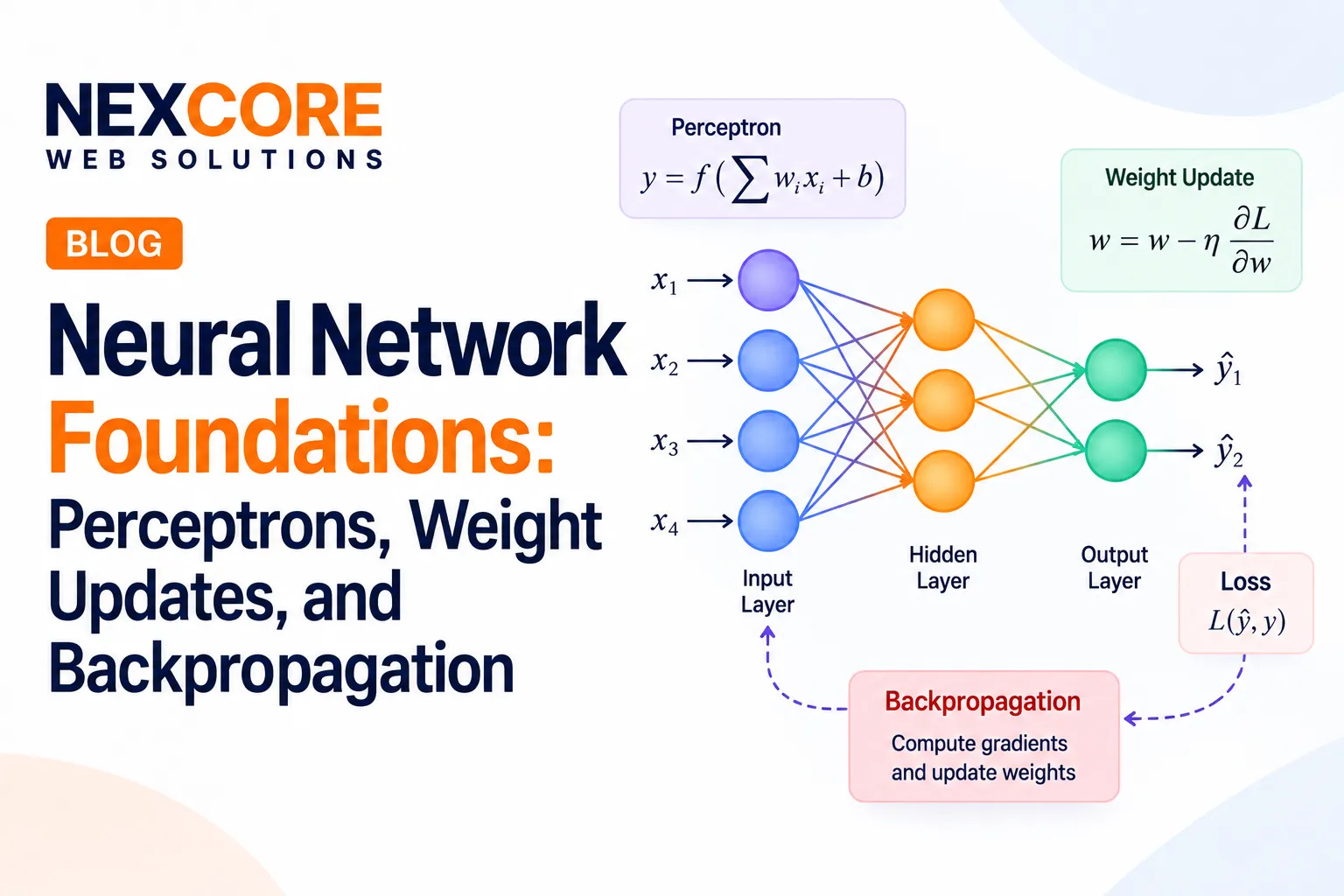
Neural networks are a core part of modern machine learning, powering applications such as image recognition, recommendation systems, language processing, and fraud detection. Although advanced architectures can look complicated, their fundamental ideas can be understood through a few building blocks: neurons, weights, activation functions, and learning algorithms. The perceptron provides one of the simplest ways to understand how a neural network makes a prediction from input values. Weight updates explain how a model learns from mistakes, while backpropagation extends this learning process across multiple layers. Understanding these foundations is valuable for students, developers, and anyone studying machine learning because many advanced neural network concepts build directly on them. A strong foundation also makes it easier to understand why training works and where models can struggle.
Understanding the Perceptron
A perceptron is a simple computational model that takes one or more input values, assigns each input a weight, and combines them to produce an output. Conceptually, it calculates a weighted sum and then applies an activation rule to decide the result. For example, a model predicting whether an email should be classified as spam could use features such as the number of suspicious words, links, or unusual patterns. Each feature contributes differently depending on its associated weight. The perceptron therefore provides a straightforward introduction to how machine learning models transform input information into predictions.
Weights, Bias, and Activation
Weights determine how strongly individual inputs influence a neuron’s output. A positive weight can increase the result, while a negative weight can reduce its influence, depending on the input value. The bias provides an additional adjustable value that allows the model to shift its decision boundary instead of forcing that boundary through the origin. After calculating the weighted sum plus bias, an activation function determines the neuron’s output. Traditional perceptrons commonly use a threshold-based activation, while modern neural networks often use functions such as ReLU, sigmoid, or tanh.
How Weight Updates Enable Learning
A neural network does not normally begin with useful weights. During training, it produces predictions, compares them with expected outputs, and adjusts its parameters to reduce the error. In a simple perceptron, the update process changes weights according to the input values and the difference between the predicted and expected result. If an input contributes to an incorrect prediction, its weight can be adjusted in a direction that helps the model make better decisions. Repeating this process across training examples gradually improves the model’s ability to separate patterns.
A Simple Learning Example
Imagine a perceptron designed to determine whether a student is likely to pass based on study hours and attendance. The model starts with arbitrary weights and produces an initial prediction that may be wrong. When the expected result is compared with the prediction, the learning rule updates the weights so that relevant inputs have a more appropriate influence. After many examples, the model can learn a decision boundary that separates passing and failing cases. This example illustrates an important principle: learning comes from repeatedly using errors to adjust model parameters.
Why Activation Functions Matter
Activation functions introduce nonlinear behavior into neural networks, allowing them to learn relationships that cannot be represented effectively by simple linear calculations. Without nonlinear activation functions, stacking multiple linear layers would still produce an overall linear transformation. ReLU is widely used in hidden layers because it is simple and generally efficient to compute. Sigmoid can be useful when an output needs to represent a value between zero and one, particularly in certain binary classification settings. Choosing an activation function depends on the architecture, task, and behavior required from the model.
Understanding Backpropagation
Backpropagation is the method used to calculate how much each parameter in a multilayer neural network contributed to the final error. After a forward pass produces an output, the model calculates a loss that measures the difference between its prediction and the target. Backpropagation then works backward through the network using the chain rule of calculus to determine gradients for weights and biases. These gradients indicate how parameter changes would affect the loss. An optimization algorithm such as gradient descent can then use those gradients to update the parameters.
Forward Pass and Backward Pass
The forward pass moves information from the input layer through hidden layers to the output layer. Each neuron combines inputs, applies weights and bias, and passes its activated result to the next layer. During the backward pass, the network starts with the output error and calculates gradients layer by layer toward the input. The optimizer uses these gradients to modify the parameters, usually with a learning rate controlling the size of each update. Training repeatedly alternates between these forward and backward processes until the model reaches an acceptable level of performance.
Common Training Challenges
Neural network training involves more than simply running backpropagation for a large number of iterations. A learning rate that is too high can cause unstable updates, while one that is too low can make training unnecessarily slow. Models can also overfit when they learn training examples too closely and perform poorly on unseen data. Techniques such as appropriate validation, regularization, data preprocessing, and careful architecture selection can help address these problems. Monitoring training and validation performance is important because a decreasing training loss alone does not guarantee useful generalization.
Conclusion
Perceptrons, weight updates, and backpropagation provide the foundation for understanding how neural networks learn. A perceptron shows how weighted inputs and activation rules can produce a prediction, while weight updates demonstrate how errors can guide learning. Backpropagation extends this idea to multilayer networks by calculating gradients that reveal how individual parameters affect the final loss. Once these concepts are clear, topics such as deep learning architectures, optimization methods, and advanced neural network training become easier to understand. The best way to strengthen these concepts is to combine mathematical intuition with small practical implementations. Building a simple network from scratch can reveal exactly how predictions, errors, gradients, and parameter updates work together.
FAQs
1. What is a perceptron in a neural network?
A perceptron is a basic artificial neuron that receives input values, multiplies them by corresponding weights, adds a bias, and applies an activation rule to produce an output. It is commonly used to introduce the fundamentals of neural network learning. Although simple perceptrons have limitations, particularly with nonlinearly separable problems, their structure helps explain how more advanced neural networks process information.
2. How does a neural network update its weights?
A neural network updates its weights by calculating how changes to those weights would affect the model’s error. During training, the network produces a prediction and calculates a loss compared with the expected result. Backpropagation calculates gradients for the parameters, and an optimizer uses those gradients with a learning rate to adjust the weights. Repeating this process helps the network reduce its training error.
3. What is the purpose of backpropagation?
Backpropagation determines how individual weights and biases contribute to the error produced by a neural network. It begins with the loss at the output and uses the chain rule to calculate gradients backward through each layer. These gradients provide the information needed by optimization algorithms to update model parameters. Without an efficient way to calculate these gradients, training multilayer neural networks would be considerably more difficult.
4. What is the difference between a perceptron and a multilayer neural network?
A basic perceptron generally represents a single computational unit and can learn only relatively simple decision boundaries. A multilayer neural network contains multiple connected layers of neurons and uses nonlinear activation functions to model more complex relationships. Because hidden layers can transform representations before producing the final output, multilayer networks can solve problems that a single perceptron cannot represent effectively.
5. Why are activation functions important in neural networks?
Activation functions determine how a neuron’s weighted input is transformed before being passed to another layer. Their most important role is introducing nonlinearity, which allows a network with multiple layers to learn complex patterns. Common choices include ReLU, sigmoid, and tanh, with each having different characteristics. The appropriate function depends on where the neuron is used and what behavior the model needs.




