
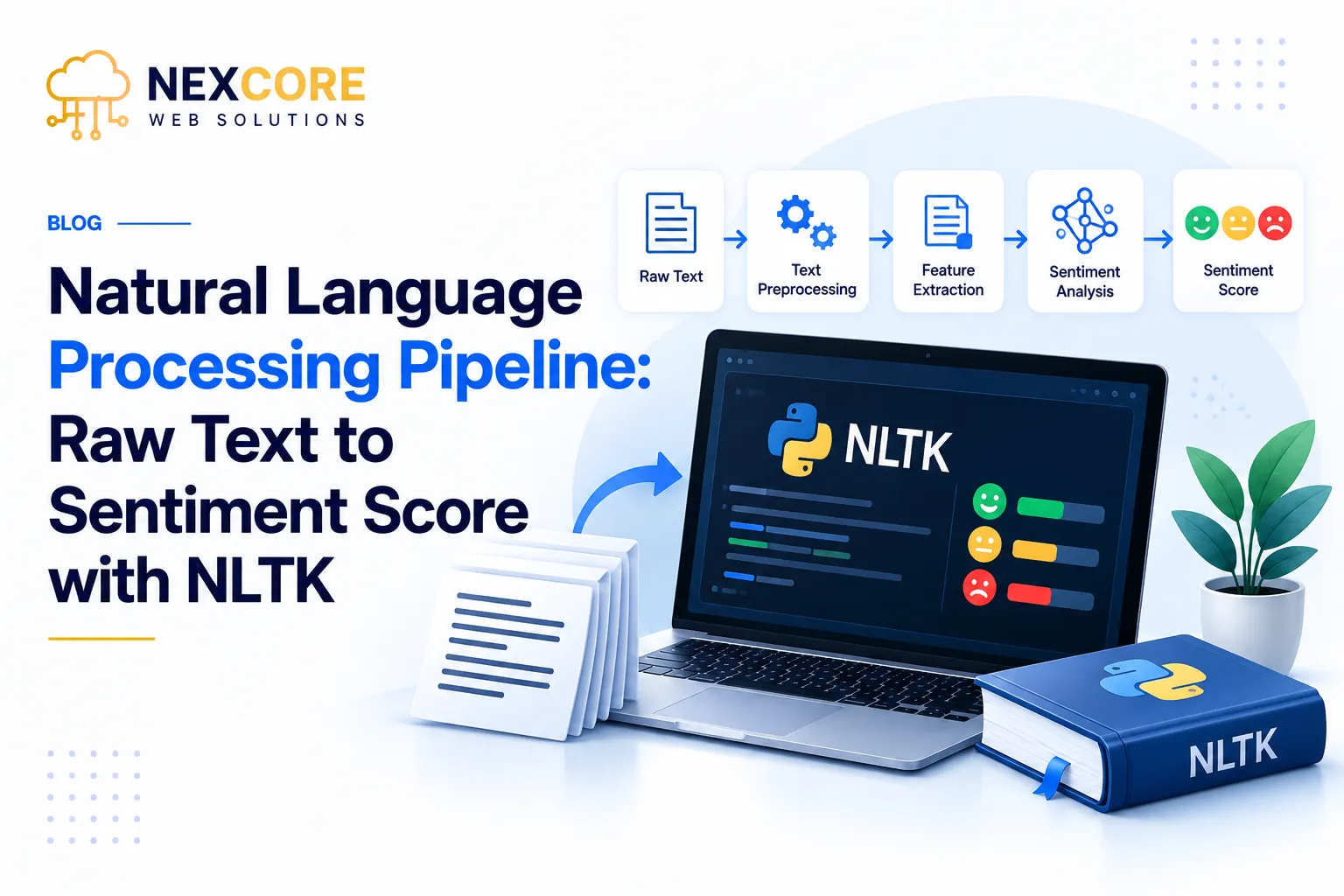
Natural Language Processing (NLP) allows computers to work with human language, but raw text is rarely ready for direct analysis. Customer reviews, social media posts, survey responses, and support messages often contain punctuation, inconsistent capitalization, filler words, and other noise. A sentiment analysis pipeline transforms this unstructured text into a numerical or categorical representation that indicates whether the content is positive, negative, or neutral. NLTK, or Natural Language Toolkit, provides practical Python tools for learning and implementing these NLP workflows. Understanding the complete process is valuable for students because it connects text preprocessing, linguistic analysis, feature engineering, and machine learning into one practical project. A well-designed pipeline also makes it easier to understand where errors originate and how model results should be interpreted.
Understanding the NLP Pipeline
A sentiment analysis system usually follows a sequence of connected stages rather than a single function. The process begins with collecting raw text and continues through cleaning, tokenization, normalization, feature extraction, classification, and evaluation. Each stage changes the representation of the original sentence while attempting to preserve information relevant to sentiment. For example, the sentence “The product is excellent, but delivery was slow” contains both positive and negative signals that a simplistic cleaning process might accidentally weaken. Building the pipeline step by step helps developers understand why preprocessing decisions directly influence sentiment scores.
Collecting and Inspecting Raw Text
The first stage is gathering representative text from a suitable dataset. A student project might use product reviews, movie reviews, restaurant feedback, or manually created sentences containing different sentiment categories. Before cleaning the data, inspect examples for missing values, duplicate records, unusual symbols, emojis, spelling variations, and inconsistent labels. This initial inspection prevents assumptions about the dataset from becoming hidden sources of errors. It is also useful to maintain a clear separation between training, validation, and testing data.
Text Cleaning with NLTK
Text cleaning prepares language for later processing without removing meaningful information unnecessarily. NLTK provides utilities for tokenization, stopword handling, stemming, and other linguistic operations. Common preprocessing steps include converting text to lowercase, removing unnecessary punctuation, splitting sentences into tokens, and filtering selected stopwords. However, every operation should have a purpose because aggressive preprocessing can remove sentiment-bearing words such as “not,” “never,” or “very.” For sentiment analysis, preserving context is often more important than making the text as small as possible.
Tokenization and Normalization
Tokenization converts a sentence into smaller units such as words or punctuation tokens. NLTK offers tokenization tools that can separate text into meaningful components while handling common language patterns. After tokenization, normalization may include lowercase conversion and reducing different word forms to a common representation. Stemming can reduce words to rough root forms, while lemmatization attempts to produce linguistically meaningful base forms. The appropriate technique depends on the dataset and the model being used.
Removing Noise Carefully
Not every character in a sentence is useful for classification, but not every unusual character is noise either. URLs, excessive punctuation, HTML fragments, and irrelevant formatting can often be removed when they do not contribute to the prediction task. Emojis and repeated punctuation, however, may contain useful emotional information and should not automatically be discarded. Similarly, negation words can completely change the meaning of an expression. A reliable pipeline therefore applies cleaning rules based on the intended task instead of blindly deleting everything that looks unusual.
Converting Text into Features
Machine learning algorithms cannot directly process ordinary sentences, so cleaned text must be converted into numerical features. One common approach is the Bag-of-Words representation, where vocabulary terms become features and their occurrences are counted. Another widely used technique is TF-IDF, which gives greater importance to terms that are frequent in a particular document but less common across the entire dataset. NLTK can support preprocessing and feature preparation, while libraries such as scikit-learn are often used for numerical vectorization and model training. The resulting feature matrix becomes the input for a sentiment classifier.
Example Sentiment Workflow
A practical student workflow can be organized into these stages:
- Load a labeled review dataset.
- Inspect and clean the raw text.
- Tokenize sentences using NLTK.
- Normalize words and handle selected stopwords.
- Convert processed text into numerical features.
- Train a sentiment classification model.
- Test predictions on unseen reviews.
- Convert predictions into positive, negative, or neutral results.
This structure makes the project easier to debug because every transformation can be inspected independently. It also provides a clear explanation for a project report or portfolio demonstration.
Training a Sentiment Classifier
Once text has been converted into numerical features, a classification algorithm can learn patterns associated with different sentiment labels. Naive Bayes is a popular educational choice because it is relatively simple and works effectively with many text classification problems. Logistic regression and linear support vector machines are also common options for sparse text features. The training data should contain examples representing the sentiment categories the system is expected to recognize. After training, predictions should be evaluated on data that the model has never seen during training.
Measuring Model Performance
Accuracy provides a quick overview of how many predictions were correct, but it should not be the only metric considered. Precision, recall, and F1-score can provide more useful information when classes are imbalanced or when one type of error matters more than another. A confusion matrix can show whether the model frequently confuses positive and negative examples or struggles with neutral text. For example, a dataset containing mostly positive reviews could produce misleadingly high accuracy even if the classifier performs poorly on negative reviews. Proper evaluation therefore requires examining multiple measurements alongside representative prediction examples.
Improving the Pipeline
A basic NLTK sentiment pipeline can be improved through better preprocessing, richer features, larger datasets, and systematic experimentation. Students can compare stemming with lemmatization, evaluate different stopword strategies, and test several classifiers using the same train-test split. Handling negation, emojis, spelling variations, and domain-specific vocabulary can also improve real-world performance. Cross-validation can provide a more reliable estimate when the dataset is limited. Keeping experiments reproducible through fixed random seeds, documented preprocessing rules, and versioned datasets makes results easier to compare.
Conclusion
An NLP sentiment pipeline demonstrates how raw human language can be transformed into useful computational information through a sequence of carefully designed steps. NLTK provides an accessible foundation for tokenization, normalization, linguistic preprocessing, and experimentation, while machine learning libraries can handle feature representation and classification. The most important lesson is that sentiment analysis is not simply about choosing a model; data quality and preprocessing decisions strongly influence the final result. Students who document each stage, evaluate multiple metrics, and test their system on realistic examples can build a project that demonstrates genuine understanding. With thoughtful improvements, the same pipeline can be adapted for reviews, surveys, customer feedback, and other text-based applications.
FAQs
1. What is an NLP sentiment analysis pipeline?
An NLP sentiment analysis pipeline is a sequence of processes that converts raw language into a sentiment prediction. It commonly includes text cleaning, tokenization, normalization, feature extraction, model training, and evaluation. The final classifier assigns a sentiment category or score based on patterns learned from labeled examples. Designing these stages separately makes the system easier to understand, test, debug, and improve.
2. Why is NLTK useful for sentiment analysis?
NLTK is useful because it provides many fundamental NLP tools in Python, including tokenizers, stopword resources, stemming utilities, and linguistic processing capabilities. It is particularly suitable for learning because each processing stage can be implemented and inspected independently. Students can therefore understand what happens to raw text before classification instead of relying entirely on a high-level automated pipeline.
3. Can NLTK calculate sentiment scores by itself?
NLTK can support sentiment analysis through its available tools and sentiment-related components, but sentiment scoring depends on the specific approach being used. A rule-based system may calculate scores from predefined linguistic patterns, while a machine learning pipeline learns from labeled examples. The important distinction is whether the score comes from fixed linguistic rules, a trained classifier, or another statistical model.
4. What preprocessing steps are important for sentiment analysis?
Important preprocessing steps can include lowercasing, tokenization, punctuation handling, stopword decisions, stemming or lemmatization, and removal of irrelevant data. However, preprocessing should not automatically remove every unusual element. Words such as “not” and “never” can change sentiment, while emojis and punctuation may provide emotional signals. The best preprocessing strategy depends on the dataset, language characteristics, and chosen model.
5. How can a student improve an NLTK sentiment analysis project?
A student can improve the project by testing multiple preprocessing strategies, comparing different classification algorithms, and reporting precision, recall, F1-score, and confusion-matrix results. Handling negation and domain-specific vocabulary can make predictions more meaningful. Students can also create a small interface that accepts new text and displays the predicted sentiment. Clear documentation of experiments is equally important because it demonstrates understanding beyond simply producing a final accuracy number.




