
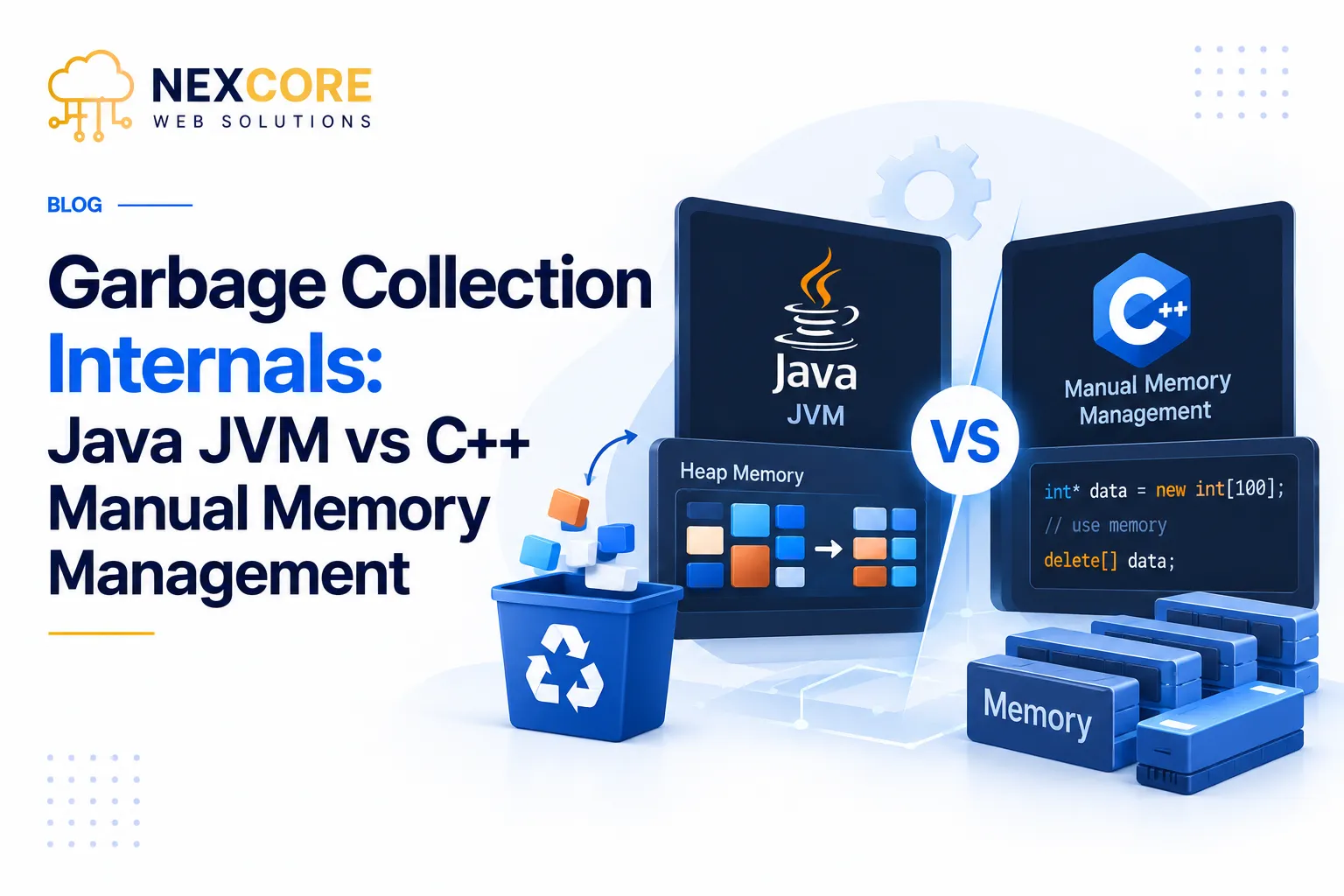
Memory management is one of the clearest differences between Java and C++. Both languages can build high-performance applications, but they approach object lifetime and memory reclamation in fundamentally different ways. Java relies on automatic garbage collection managed by the Java Virtual Machine (JVM), while C++ gives developers direct control over dynamic memory through allocation and deallocation mechanisms. These approaches affect application performance, debugging, resource ownership, and system design. Understanding what happens behind the source code helps developers explain memory leaks, pauses, fragmentation, and object lifetime more accurately. It also provides useful context for students preparing for programming interviews, systems courses, and performance-focused software projects.
How Java Memory Management Works
Java applications typically allocate objects on the heap, while local variables and method execution data are associated with thread-specific stack frames. When an object is no longer reachable through active references, it can eventually become eligible for garbage collection. The JVM’s garbage collector identifies unreachable objects and reclaims their memory without requiring application code to explicitly free each object. This reduces the risk of common errors such as double deletion and use-after-free. However, automatic memory management does not mean that developers can ignore object lifetimes or memory usage.
Generational Garbage Collection
Modern JVM garbage collectors commonly use generational concepts because many objects tend to have relatively short lifetimes. Newly allocated objects are generally placed in a young generation or equivalent allocation region, while objects that survive collection cycles may be promoted or treated as longer-lived objects. Collecting short-lived objects frequently can be more efficient than scanning the entire heap during every collection cycle. Different JVM collectors implement these concepts differently, with variations in concurrency, pause behavior, throughput, and heap organization. Developers should therefore consider the selected collector and JVM version when analyzing production memory behavior.
What Happens During Garbage Collection
A simplified garbage collection process involves identifying objects that are still reachable and reclaiming memory occupied by objects that are not. Some collectors use tracing techniques that begin from root references and follow reachable objects through the object graph. Depending on the collector, the JVM may also move objects to reduce fragmentation and improve allocation efficiency. Compaction can change object locations internally, but managed references are updated by the JVM so application code remains valid. These operations require runtime coordination and can consume CPU resources.
Garbage Collection Pauses
Garbage collection can introduce pauses when application threads must temporarily stop or coordinate with collector activity. Modern collectors are designed to reduce long pauses through concurrent processing and incremental work, but pause behavior depends on workload, heap size, allocation rates, and collector configuration. A system processing latency-sensitive requests may therefore require careful monitoring of garbage collection metrics. Developers should examine actual pause times and allocation patterns instead of assuming that garbage collection is either always slow or always invisible.
C++ Manual Memory Management
C++ provides much more direct control over object lifetime. Developers can allocate dynamic memory using mechanisms such as new, and traditionally release it using delete. Arrays allocated dynamically use corresponding array-management forms, while modern C++ also provides standard containers and smart pointers that reduce the need for explicit memory management. This control allows programmers to make deliberate decisions about ownership and lifetime. At the same time, incorrect ownership handling can produce memory leaks, dangling pointers, double deletion, and use-after-free bugs.
RAII and Smart Pointers
Modern C++ development generally favors Resource Acquisition Is Initialization, commonly known as RAII. Under RAII, an object’s destructor releases resources when the object’s lifetime ends, making cleanup part of normal scope-based object management. Smart pointers such as std::unique_ptr and std::shared_ptr can express ownership more safely than raw pointers. A unique_ptr represents exclusive ownership, while shared_ptr uses reference counting to manage shared ownership. These facilities do not provide Java-style garbage collection, but they automate many cleanup operations while preserving deterministic destruction.
Java JVM vs C++: Key Differences
The most important difference is who controls reclamation. Java’s garbage collector determines when unreachable heap objects can be reclaimed, while C++ object destruction is generally tied to explicit lifetime rules, scope, ownership structures, or manual operations. Java provides stronger protection against certain pointer-related memory errors because application code does not directly manipulate raw object addresses. C++ provides finer-grained control, which can be valuable when deterministic destruction and predictable resource management are important. Neither approach eliminates the need for developers to understand memory behavior.
Performance Considerations
Java garbage collection introduces runtime overhead associated with allocation, object tracking, and reclamation. C++ can avoid a tracing garbage collector, but dynamic allocation, deallocation, cache behavior, fragmentation, and ownership mechanisms can still affect performance. A poorly designed C++ program can perform significantly worse than a well-tuned Java application, just as an inefficient Java allocation pattern can create substantial garbage collection pressure. Performance should therefore be measured using realistic workloads rather than judged solely from the memory-management model.
Common Memory Problems
Java developers commonly encounter excessive object creation, unexpectedly retained references, large caches, and collections that prevent otherwise unused objects from becoming unreachable. These problems can increase heap usage and garbage collection activity even though explicit memory freeing is unnecessary. C++ developers face a broader set of ownership-related risks, including leaks, dangling references, invalid pointers, and incorrect destruction. Tools such as heap profilers, sanitizers, debuggers, and runtime monitoring can help identify these issues. The correct diagnostic method depends on the language and the specific failure.
Choosing the Right Approach
Java’s managed memory model is useful when developer productivity, safety, and automatic reclamation are important. C++ is particularly suited to systems where precise lifetime control, deterministic destruction, and low-level resource management are central requirements. However, modern C++ is not simply about manually calling delete; RAII, containers, and smart pointers are fundamental parts of responsible development. Likewise, Java developers must understand references, allocation rates, heap configuration, and garbage collector behavior. Learning both models gives programmers a stronger understanding of how high-level code interacts with machine resources.
Conclusion
Java and C++ demonstrate two distinct philosophies of memory management. Java delegates heap reclamation to the JVM’s garbage collector, which tracks object reachability and reclaims memory automatically, while C++ gives developers explicit control over lifetime through language rules, RAII, containers, and ownership mechanisms. Garbage collection can simplify memory safety but introduces runtime management overhead, whereas C++ offers deterministic control while requiring disciplined ownership practices. The practical difference is not simply automatic versus manual cleanup; it is how each ecosystem represents ownership, lifetime, and resource responsibility. Understanding these mechanisms helps developers diagnose performance problems, avoid memory-related bugs, and make better architectural decisions.
FAQs
1. What is garbage collection in Java?
Garbage collection is the JVM’s automatic process for reclaiming heap memory occupied by objects that are no longer reachable by active references. The application does not normally call a direct equivalent of C++ delete for ordinary Java objects. The JVM determines when collection work occurs according to its runtime algorithms and configuration. Developers still need to manage references carefully because retained objects can remain reachable and consume memory.
2. Does C++ have garbage collection?
Standard C++ does not require a built-in tracing garbage collector comparable to the JVM’s automatic memory-management system. Instead, C++ uses object lifetime rules, destructors, RAII, containers, and smart pointers to manage resources. Specialized libraries or external systems can provide garbage-collection techniques, but they are not the normal foundation of standard C++ memory management. Modern C++ development generally emphasizes explicit ownership rather than tracing collection.
3. Which is faster, Java garbage collection or C++ memory management?
There is no universal performance winner because application workload and implementation choices have a major effect. Java garbage collectors can efficiently manage large allocation workloads, while C++ can provide highly predictable lifetime behavior with carefully designed ownership and allocation strategies. Poor memory practices can hurt either language. Meaningful comparisons should measure allocation rate, latency, CPU consumption, cache behavior, and workload-specific performance.
4. What is RAII in C++?
RAII stands for Resource Acquisition Is Initialization and connects resource ownership to object lifetime. When an RAII object is created, it acquires or represents a resource, and its destructor releases that resource when the object leaves its lifetime. This approach works naturally with scopes and exceptions. Smart pointers, standard containers, file wrappers, and locking utilities commonly use RAII principles to make resource cleanup more reliable.
5. Can Java applications still have memory leaks?
Yes. Java prevents many traditional manual-memory errors, but applications can still retain objects unintentionally. For example, a long-lived collection, cache, listener registration, or static reference can keep objects reachable even when the application no longer needs them. Because the garbage collector only reclaims unreachable objects, these retained references can cause heap growth. Profiling tools can help developers identify which objects remain reachable and why.




