
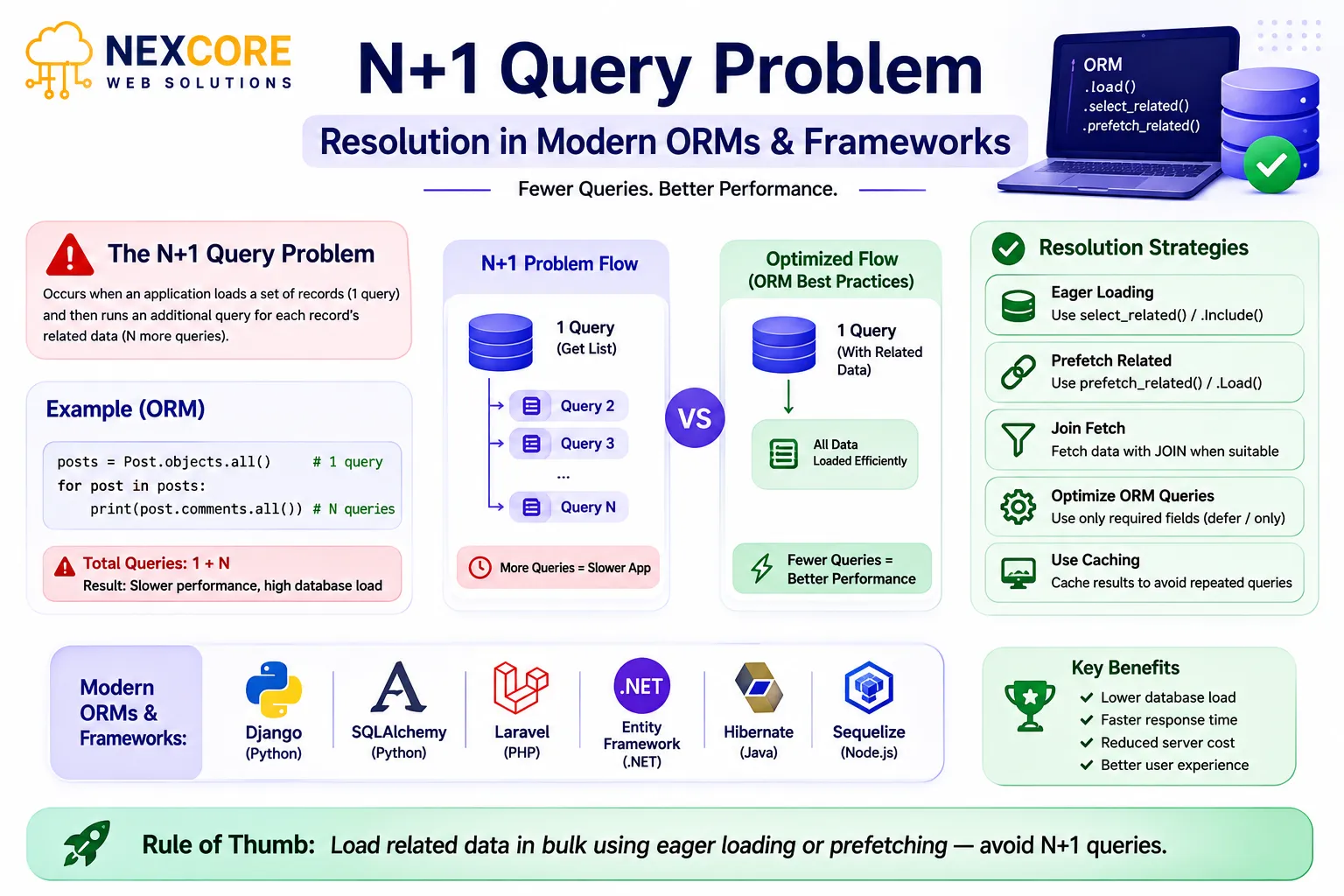
Modern web applications rely heavily on Object-Relational Mappers (ORMs) to simplify communication between application code and relational databases. ORMs make it convenient to work with relationships between users, orders, products, comments, invoices, and other records without writing SQL for every operation. However, this convenience can hide an important performance problem known as the N+1 query problem. An application may execute one query to retrieve a collection of records and then perform an additional query for each record to retrieve related information. With a small dataset, the issue may go unnoticed, but production workloads can quickly turn dozens of queries into hundreds or thousands. Understanding how to identify, prevent, and resolve N+1 queries is essential for building responsive and scalable applications.
What Is the N+1 Query Problem?
The N+1 problem occurs when an application performs one query to retrieve a list of parent records and then executes N additional queries to retrieve related child records. Imagine a dashboard displaying 100 customers and their latest orders. The application may execute one query for the customers and then 100 separate queries, one for each customer’s orders. Instead of one efficient database operation, the application performs 101 queries. This increases database workload, network round trips, connection usage, and response time.
Why It Happens
The problem frequently appears because ORMs make relationships feel like ordinary in-memory objects. A developer may loop through records and access a related property without realizing that each access triggers another database query. Lazy loading is convenient because related data is fetched only when requested, but that behavior can become expensive inside loops or API serializers. The code may therefore look simple while generating an inefficient query pattern.
Detecting N+1 Queries
Inspect Generated SQL
The first step is to determine what the ORM is actually sending to the database. Most modern frameworks provide query logs, debugging tools, database profilers, or development middleware that show executed SQL statements. A simple page-load test can reveal whether one logical operation creates dozens of repeated queries. Developers should examine both query count and query execution time because a small number of expensive queries can also cause performance problems.
Monitor Production Behavior
Development datasets are often too small to expose serious N+1 issues. A page that performs 21 queries for 20 records may feel acceptable during local testing, but the same endpoint could generate thousands of database calls when customer or order counts increase. Production monitoring should therefore track query duration, database load, request latency, and query counts for important endpoints. Performance testing with realistic datasets can reveal scaling problems before customers encounter them.
Eager Loading
The Most Common Solution
Eager loading retrieves related records in advance instead of querying them individually during iteration. Instead of fetching customers first and then querying orders one customer at a time, the ORM can load the required relationships using additional set-based queries. The application then works with data already retrieved from the database. Frameworks such as Laravel, Django, Entity Framework, and Rails provide eager-loading mechanisms suited to their respective ORM systems.
Avoid Loading Everything
Eager loading solves one problem but can create another if developers request relationships that the page does not actually use. Fetching large collections or deeply nested relationships can increase memory consumption and query complexity. The goal is not to load every possible relation, but to load exactly what the current operation requires. Selective eager loading can produce a better balance between database efficiency and application memory usage.
Batch Loading and DataLoader Patterns
Combining Related Queries
Batch loading groups multiple related requests into fewer database operations. Instead of retrieving a separate record for every parent object, the application collects the required identifiers and fetches the related records in one query using a suitable filtering condition. This approach is particularly useful in GraphQL APIs, where nested resolvers can easily create N+1 patterns. DataLoader-style utilities are commonly used to batch and cache requests during a single execution cycle.
Request-Level Caching
Batch loaders can also prevent the same entity from being fetched repeatedly during one request. If several parts of an application request the same user or product, the loader can reuse the already retrieved result. This reduces duplicate database calls while preserving the flexibility of the application layer. Request-level caching is especially useful when multiple components independently access overlapping relationships.
Query Optimization Beyond ORMs
Use Joins and Aggregations Carefully
Sometimes the most efficient solution is to use a carefully designed SQL query that retrieves the necessary information in a single operation. Joins, grouping, aggregation, and subqueries can be appropriate when a use case requires a tightly connected dataset. ORM query builders often provide ways to express these operations without abandoning the framework entirely. Developers should choose the approach based on query complexity, readability, and measured performance.
Select Only Required Columns
Performance issues are not limited to query count. Retrieving every column from multiple tables can increase database processing, network transfer, and memory usage. Selecting only the fields required by the current page or API response can reduce overhead significantly. This becomes especially important when related records contain large text fields, metadata, or other expensive data.
Framework-Specific Considerations
Laravel and Eloquent
Laravel developers can use eager-loading methods such as with() and load() to retrieve relationships before accessing them. Query inspection tools can help identify unexpected lazy-loading behavior during development. For larger datasets, developers should combine relationship loading with column selection, pagination, and appropriate indexes. Laravel can also be configured to discourage accidental lazy loading in development environments.
Django ORM
Django provides select_related() for relationships that can be retrieved through SQL joins and prefetch_related() for separate but optimized queries across relationships. Choosing between them depends on relationship type and query behavior. Django developers should inspect generated queries using the framework’s debugging facilities and test views with realistic datasets. These tools make N+1 detection much easier.
Entity Framework and Rails
Entity Framework supports eager loading through methods such as Include(), while Rails provides tools such as includes, preload, and eager_load. Each framework has different query-generation behavior, so developers should verify the resulting SQL rather than assuming a particular ORM method is always optimal. Understanding the database queries behind the abstraction is essential for reliable performance tuning.
Preventing N+1 Problems
N+1 prevention should become part of the development process rather than a late-stage optimization task. Code reviews should look for relationship access inside loops, nested serializers, and resolver methods that may trigger lazy loading repeatedly. Automated tests can assert expected query counts for important operations, while development environments can warn about unexpected lazy loads. Preventive practices reduce the chance of performance regressions as the codebase evolves.
Conclusion
The N+1 query problem is one of the most common hidden performance issues in ORM-based applications because elegant application code can conceal inefficient database behavior. The most effective solutions include eager loading, batching, request-level caching, selective column retrieval, optimized joins, and careful query design. Developers should also inspect generated SQL and monitor realistic workloads instead of relying solely on local testing. Modern ORMs provide powerful tools to avoid N+1 queries, but those tools work best when developers understand how relationships are translated into database operations. Treating query efficiency as part of everyday development helps applications remain fast, predictable, and scalable as datasets and user activity grow.
FAQs
1. What is the N+1 query problem?
The N+1 query problem occurs when an application performs one database query to retrieve a collection and then executes another query for each individual item to retrieve related data. For example, loading 100 users and then running one query for each user’s orders results in 101 queries. This unnecessary database activity can significantly increase response time and resource consumption.
2. How does eager loading solve N+1 queries?
Eager loading retrieves required relationships before the application accesses them inside loops or serializers. Instead of executing one query for every related record, the ORM can fetch the relationship using a smaller number of set-based queries. This reduces database round trips and usually improves endpoint performance substantially when related data is known in advance.
3. Is eager loading always the best solution?
No. Eager loading can become inefficient if an application retrieves large relationships that are not actually needed. It may also increase memory consumption when datasets are large. Developers should load only the relationships required for the current operation and combine eager loading with pagination, selective fields, indexing, and query analysis where appropriate.
4. How can developers detect N+1 queries?
Developers can detect N+1 behavior by inspecting generated SQL through framework debugging tools, database profilers, logs, or application monitoring platforms. Repeated queries with similar structures are a strong warning sign. Testing endpoints with realistic datasets and tracking query counts can reveal problems that remain invisible when development databases contain only a few records.
5. Does N+1 occur only with relational databases?
The classic N+1 problem is strongly associated with relational database access through ORMs, but the underlying pattern can appear in other systems whenever one request triggers many dependent data fetches. GraphQL resolvers, API integrations, and remote service calls can create similar performance problems. Batching, caching, and carefully designed data access patterns can reduce these repeated operations.




