
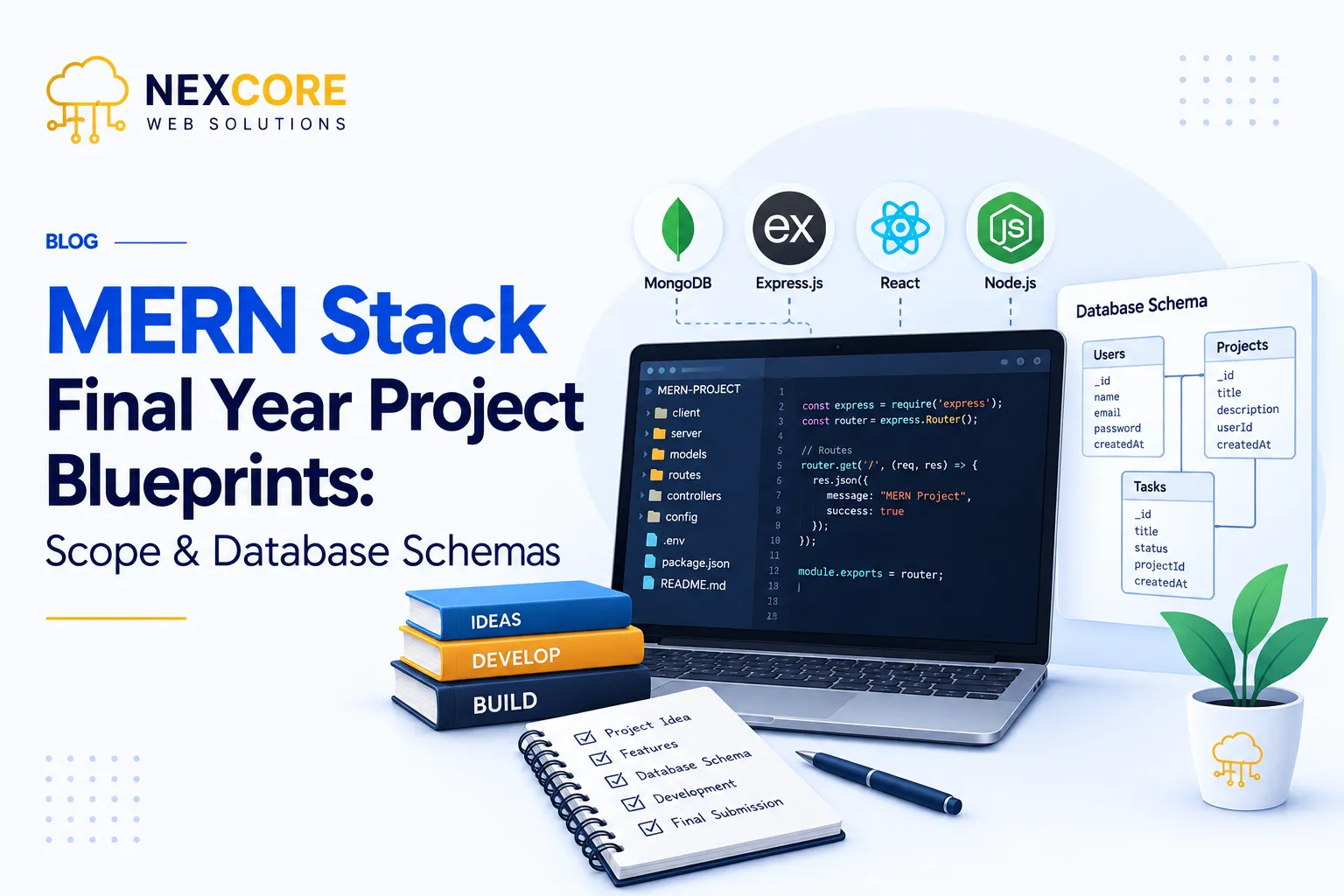
A final year project built with the MERN stack can demonstrate much more than basic website development. MongoDB, Express.js, React, and Node.js allow students to create complete applications with interactive interfaces, secure APIs, database operations, and real-world workflows. However, a successful project needs more than attractive screens and working login forms. It should have a clear scope, practical features, organized code, and a database structure that can support future growth. Planning these elements before development helps prevent technical confusion and unnecessary redesign. This guide presents practical MERN stack project blueprints, explains how to define project scope, and shows how to design database schemas that are simple, scalable, and suitable for academic evaluation.
Why Project Scope Matters in MERN Development
Project scope defines what the application will do, who will use it, and which features will be included in the final submission. Without a clear scope, students often add too many features and struggle to complete the main workflow before the deadline. A good project should solve one identifiable problem instead of trying to become a complete business platform. For example, a college event management system may include event creation, student registration, attendance tracking, and admin reports, while advanced payment integration can remain outside the first version.
A useful scope document should describe the target users, core modules, technology stack, expected outcomes, and project limitations. It should also separate essential features from optional improvements. Essential features are required for the application to work, while optional features can be added if time permits. This approach makes development measurable and gives students a clear explanation during project demonstrations and viva examinations.
MERN Stack Final Year Project Blueprints
1. College Event Management System
A college event management system allows administrators to publish events and students to register for workshops, seminars, competitions, and cultural programs. The application can include role-based dashboards for administrators, event organizers, and students. Students should be able to browse upcoming events, register, view schedules, and download participation certificates. Administrators can manage event details, approve registrations, monitor attendance, and generate reports.
The database should contain collections such as users, events, registrations, and certificates. A user document can store the name, email, password hash, role, and department. An event document may include its title, description, venue, start date, capacity, organizer ID, and registration status. The registration collection should connect students with events through userId and eventId, while a unique compound index can prevent duplicate registrations.
2. Online Learning Management Platform
An online learning platform is a strong choice for students interested in education technology. It can provide course listings, video lessons, assignments, quizzes, progress tracking, and instructor dashboards. Students can enroll in courses, complete lessons, submit assignments, and view their learning progress. Instructors can create courses, upload materials, review submissions, and publish quiz results.
A practical schema design may include users, courses, lessons, enrollments, assignments, and submissions. The course collection should store the instructor reference, title, category, description, price if applicable, and publication status. Lessons can reference a course and contain video URLs, notes, duration, and sequence numbers. Enrollment documents should connect learners to courses and store progress details such as completed lessons, percentage completed, and last accessed date.
3. Hospital Appointment Booking System
A hospital appointment system can demonstrate scheduling, user roles, validation, and sensitive data handling. Patients can search for doctors by department, view available slots, and request appointments. Doctors can manage schedules, review appointment requests, and update consultation status. An administrator can manage departments, doctor profiles, appointment records, and system users.
The main collections may include users, doctors, departments, appointments, and medicalRecords. An appointment document should contain patient ID, doctor ID, appointment date, time slot, reason for visit, and status. The system must validate that the same doctor cannot receive two confirmed appointments for the same time slot. Since healthcare information is sensitive, students should use sample data, apply access control, avoid exposing private records, and clearly state that the project is an academic prototype.
4. Expense Tracking and Budget Planner
An expense tracking application is manageable in scope but still demonstrates useful full-stack skills. Users can record income, add expenses, create categories, set monthly budgets, and view spending summaries. A dashboard can display charts for category-wise spending and monthly cash flow. Additional features may include recurring transactions, export options, and budget alerts.
The database can use users, transactions, categories, and budgets collections. Each transaction should include the user reference, transaction type, amount, category, date, payment method, and optional notes. Budget documents can store the user ID, category ID, monthly limit, and spending period. Proper validation is important because amounts must be positive, dates must be valid, and users should only access their own financial records.
Designing Effective MongoDB Schemas
MongoDB stores data in flexible documents, but flexibility does not mean that planning is unnecessary. Students should identify the main entities, their properties, and the relationships between them before creating collections. A schema diagram or entity relationship sketch can make the design easier to explain. Common entities include users, products, orders, posts, comments, courses, bookings, and payments.
Embedding is useful when related data is small and usually accessed together. For example, a user profile may contain an embedded address object with street, city, state, and postal code fields. Referencing is better when related data can grow independently or must be shared by multiple records. For example, an order should reference a user and products rather than duplicating complete user profiles in every order.
Indexes should be planned around frequent queries. Email fields used for login should normally be unique, while fields such as event dates, course categories, or transaction dates may need regular indexes. Students should also define required fields, suitable data types, default values, and validation rules. A well-designed schema improves performance, reduces duplication, and makes future maintenance easier.
Recommended MERN Project Architecture
A clean MERN application commonly separates the frontend, backend, database configuration, and reusable utilities. The React frontend should contain pages, components, hooks, services, and routing logic. The Express and Node.js backend can be organized into routes, controllers, models, middleware, and configuration files. This separation makes debugging easier and prevents business logic from becoming mixed with interface code.
Authentication should use secure password hashing, protected routes, and role-based authorization where necessary. Environment variables should store database connection strings, secret keys, and other configuration values instead of placing them directly in source files. Students should also implement error handling, loading states, form validation, and responsive layouts. These details often make the difference between a basic demo and a professional academic project.
How to Present the Project Successfully
A final year project should be presented as a complete solution rather than only a collection of source files. Include a problem statement, objectives, user roles, feature list, system architecture, database schema, screenshots, testing results, and future scope in the project report. Explain the reason behind important technical decisions, such as using MongoDB references, JWT authentication, or React state management.
During the demonstration, show the main workflow from beginning to end. For example, in an event system, create an event as an administrator, register as a student, confirm the registration, and display the updated dashboard. Prepare answers about security, validation, database relationships, limitations, and possible improvements. Honest explanations of unfinished features are more credible than claiming that every part is production-ready.
Conclusion
A strong MERN stack final year project combines a realistic problem, controlled scope, reliable functionality, and a well-planned database schema. Students should choose a project that matches their available time and technical ability instead of selecting an idea only because it sounds advanced. Clear collections, meaningful relationships, validation rules, authentication, and organized code will improve both development quality and project presentation. Start by defining the users and core workflow, then design the database before building the interface. After completing the essential features, add optional improvements such as analytics, notifications, exports, or deployment. A focused and well-explained MERN application can demonstrate practical full-stack development skills effectively.
FAQs
1. Which MERN stack project is best for a final year submission?
The best project is one that solves a clear problem and can be completed within the academic deadline. Event management, learning platforms, appointment booking, and expense tracking systems are practical choices because they include authentication, CRUD operations, dashboards, and database relationships. Select an idea that matches your skills, then focus on completing the main workflow rather than adding too many advanced features.
2. How should I design a MongoDB schema for my MERN project?
Start by listing the main entities and the information each entity must store. Decide which data should be embedded and which data should use references. For example, a user address can be embedded, while orders should reference users and products. Add validation rules, unique indexes, timestamps, and suitable field types. Draw the schema before coding so relationships remain clear.
3. Should a final year MERN project include authentication?
Yes, authentication adds practical value and demonstrates an understanding of application security. A project can include registration, login, password hashing, protected routes, logout, and role-based access. Administrators, instructors, doctors, and students may need different permissions. Never store plain-text passwords, and use environment variables for secret keys and database credentials.
4. What features make a MERN project look professional?
Professional projects usually include responsive design, clear navigation, form validation, loading indicators, useful error messages, secure authentication, and organized code. A dashboard with meaningful statistics can improve usability, but it should support the main purpose of the application. Good documentation, screenshots, API details, database diagrams, testing records, and deployment instructions also make the project easier to evaluate.
5. Can I add advanced features after completing the basic project?
Yes, advanced features should be added after the essential workflow is stable. Possible improvements include email notifications, analytics, payment integration, file uploads, search filters, real-time updates, recommendation systems, or cloud deployment. Build these features in separate stages and test each one carefully. A smaller project that works reliably is usually stronger than a larger project filled with incomplete modules.




