
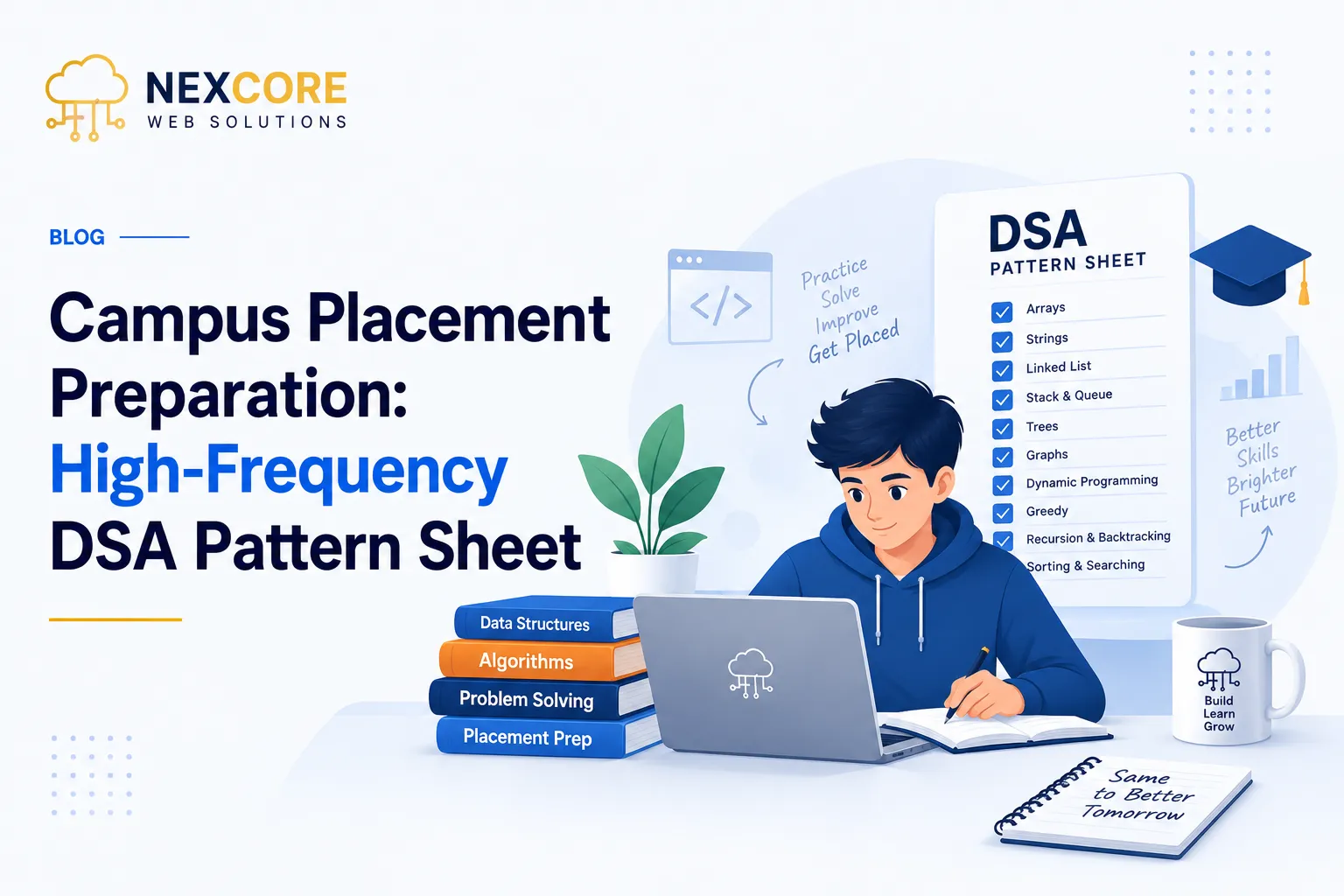
Campus placement preparation becomes easier when you stop treating Data Structures and Algorithms as a collection of random coding questions. Most companies test a repeated set of problem-solving patterns, including arrays, strings, hashing, two pointers, sliding windows, stacks, binary search, linked lists, trees, graphs, and dynamic programming. Learning these patterns helps you recognize the right approach instead of starting from zero every time. A focused DSA pattern sheet also improves speed, accuracy, and confidence during online assessments and technical interviews. Whether you are preparing for service-based companies or product-based organizations, mastering common patterns gives your practice a clear direction. The goal is not to memorize solutions, but to understand how and when each technique works.
Why DSA Patterns Matter in Campus Placements
Interviewers often change the story of a problem while keeping the underlying logic similar. For example, a question about finding two products within a budget may use the same approach as finding two numbers with a target sum. If you understand hashing or two pointers, you can solve both problems with minor adjustments. Pattern-based preparation also reduces revision time because one concept can help you solve several variations. Start with easy questions, understand the brute-force method, and then improve the solution using time and space complexity analysis.
High-Frequency Array Patterns
Hashing and Frequency Counting
Hashing is one of the most common techniques in placement coding rounds. Use a hash map or hash set when you need quick lookups, duplicate detection, frequency counting, or pair matching. Typical questions include Two Sum, finding duplicate elements, counting character frequencies, and checking whether two arrays contain the same values. The usual approach is to store useful information while traversing the input instead of repeatedly searching the entire array. This can often reduce the time complexity from O(n²) to O(n).
Two Pointers
The two-pointer pattern is useful when working with sorted arrays, strings, or problems that require comparison from both ends. One pointer may start at the beginning while another starts at the end, and both move according to a condition. Common examples include reversing an array, checking a palindrome, removing duplicates from a sorted array, and solving the Two Sum problem on sorted data. Before applying this technique, check whether the input is sorted or whether the problem has a clear left-right structure.
Sliding Window
Sliding window is designed for continuous subarrays or substrings. Instead of calculating every possible range separately, maintain a window and move its boundaries as the condition changes. Practice problems such as maximum sum subarray of size K, longest substring without repeating characters, and minimum-size subarray with a target sum. Fixed-size windows move at a constant length, while variable-size windows expand and shrink based on requirements. This pattern is especially important because many string and array questions use it indirectly.
Prefix Sum
Prefix sums help answer range-sum questions efficiently. Build an additional array where each position stores the sum of all previous elements, then calculate a range using subtraction. This method is useful for subarray sum problems, equilibrium index questions, and repeated range queries. When combined with hashing, prefix sums can solve problems such as counting subarrays with a target sum. Always check whether the array contains negative numbers because that affects which sliding-window techniques are valid.
String Patterns to Practice
String questions frequently appear in aptitude-linked coding tests and technical interviews. Focus on character frequency, palindrome checking, anagram detection, string reversal, and longest substring problems. Learn how to handle uppercase and lowercase letters, spaces, punctuation, and repeated characters carefully. Many errors occur because candidates ignore edge cases such as empty strings, one-character strings, or strings containing only repeated characters. Practice using arrays for fixed alphabets and hash maps when the character set is flexible.
Stack and Queue Patterns
Stacks are useful when the latest element must be processed first. Important problems include balanced parentheses, next greater element, stock span, removing adjacent duplicates, and evaluating postfix expressions. A monotonic stack is particularly valuable for questions involving next greater or smaller values. Queues are commonly used for level-order traversal, scheduling simulations, and breadth-first search. Understand the difference between normal queues, circular queues, deques, and priority queues because interviewers may test both implementation and application.
Linked List Patterns
Linked list questions mainly test pointer handling and careful case management. Prepare problems such as reversing a linked list, finding the middle node, detecting a cycle, merging two sorted lists, and removing the Nth node from the end. The slow-and-fast pointer technique is essential for cycle detection and locating the middle element. Draw the nodes on paper before changing links because one incorrect pointer assignment can lose part of the list. Always test your code with an empty list, a single node, and a list containing two nodes.
Searching and Sorting Patterns
Binary search is not limited to finding an element in a sorted array. It can also search for an answer when the possible solutions form a monotonic range. Practice first and last occurrence, search in a rotated sorted array, square root calculation, minimum capacity problems, and allocation-based questions. For sorting, understand merge sort, quicksort, counting sort, and the built-in sorting function available in your language. More importantly, learn when sorting can simplify a problem by enabling two pointers, greedy decisions, or duplicate grouping.
Tree and Graph Patterns
For trees, prepare recursive traversals, iterative traversals, height calculation, level-order traversal, diameter, lowest common ancestor, and binary search tree operations. Recursion becomes easier when you clearly define what the function returns for one node and how the result is combined. For graphs, learn adjacency lists, breadth-first search, depth-first search, connected components, cycle detection, and shortest paths. Grid problems involving islands, surrounded regions, or flood fill are also graph problems in disguise. Practice marking visited nodes correctly to avoid infinite loops and repeated work.
Dynamic Programming and Greedy Basics
Dynamic programming is often considered difficult because it requires identifying repeated subproblems and storing their results. Begin with climbing stairs, house robber, maximum subarray, coin change, knapsack, and longest common subsequence. First write a recursive solution, identify overlapping work, and then convert it into memoization or tabulation. Greedy problems require choosing the best immediate option while proving that the choice leads to an optimal result. Practice activity selection, minimum platforms, jump game, and interval merging before moving to advanced problems.
A Practical DSA Revision Plan
Use a structured routine instead of solving random questions every day. A useful weekly cycle can include:
- Learn one pattern and its template.
- Solve three easy problems without looking at solutions.
- Attempt two medium-level variations.
- Review mistakes and write down the key observation.
- Re-solve selected questions after two or three days.
Maintain a notebook containing patterns, common edge cases, complexity, and mistakes. During mock tests, practice explaining your approach before writing code. This habit improves both online assessment performance and interview communication.
Conclusion
A high-frequency DSA pattern sheet gives campus placement preparation a practical structure. Arrays, hashing, two pointers, sliding windows, stacks, linked lists, binary search, trees, graphs, and dynamic programming cover a large portion of common coding-round concepts. However, simply reading patterns is not enough; you must solve problems, compare approaches, and review mistakes regularly. Begin with foundational techniques, build confidence through easy questions, and gradually attempt medium-level variations. Always analyze time and space complexity, test edge cases, and explain your logic clearly. Consistent practice for even 60–90 minutes daily can produce strong improvement when your preparation follows a clear pattern-based strategy.
FAQs
1. How many DSA questions should I solve before campus placements?
There is no fixed number that guarantees success, but solving 100–150 carefully selected questions can create a strong foundation. Focus on covering major patterns rather than repeating similar problems without understanding them. Include easy, medium, and a few challenging questions. Review incorrect solutions and re-solve important problems after a gap so that the concepts become easier to recall during assessments.
2. Which DSA topics should beginners study first?
Beginners should start with arrays, strings, basic sorting, hashing, two pointers, and sliding windows. These topics build problem-solving skills and appear frequently in coding rounds. After becoming comfortable, move to stacks, queues, linked lists, binary search, trees, graphs, and dynamic programming. Learn one topic at a time and practice enough variations to understand the underlying pattern.
3. Is it necessary to learn dynamic programming for campus placements?
Dynamic programming is not required for every company or every role, but it is valuable for stronger technical assessments. Many basic placement tests focus more on arrays, strings, searching, sorting, and hashing. Still, learning introductory DP problems such as climbing stairs, house robber, and coin change improves your ability to identify repeated subproblems. Study DP after building a solid foundation in recursion and arrays.
4. Should I memorize DSA code templates?
You can remember common structures, but avoid memorizing complete solutions without understanding them. Templates for binary search, BFS, DFS, sliding windows, and linked list reversal are useful starting points. However, every problem may change the conditions, data structure, or stopping rule. Learn what each line does, understand the invariant, and practice writing the approach independently before relying on a template.
5. How can I improve speed during coding assessments?
Improve speed by practicing timed sessions and learning to identify patterns quickly. First read the complete problem, clarify constraints, and estimate the expected complexity. Write a short plan before coding, then test normal cases and edge cases. Avoid spending too long on one difficult question; solve easier problems first and return later. Regular mock tests will improve accuracy, confidence, and time management.




