
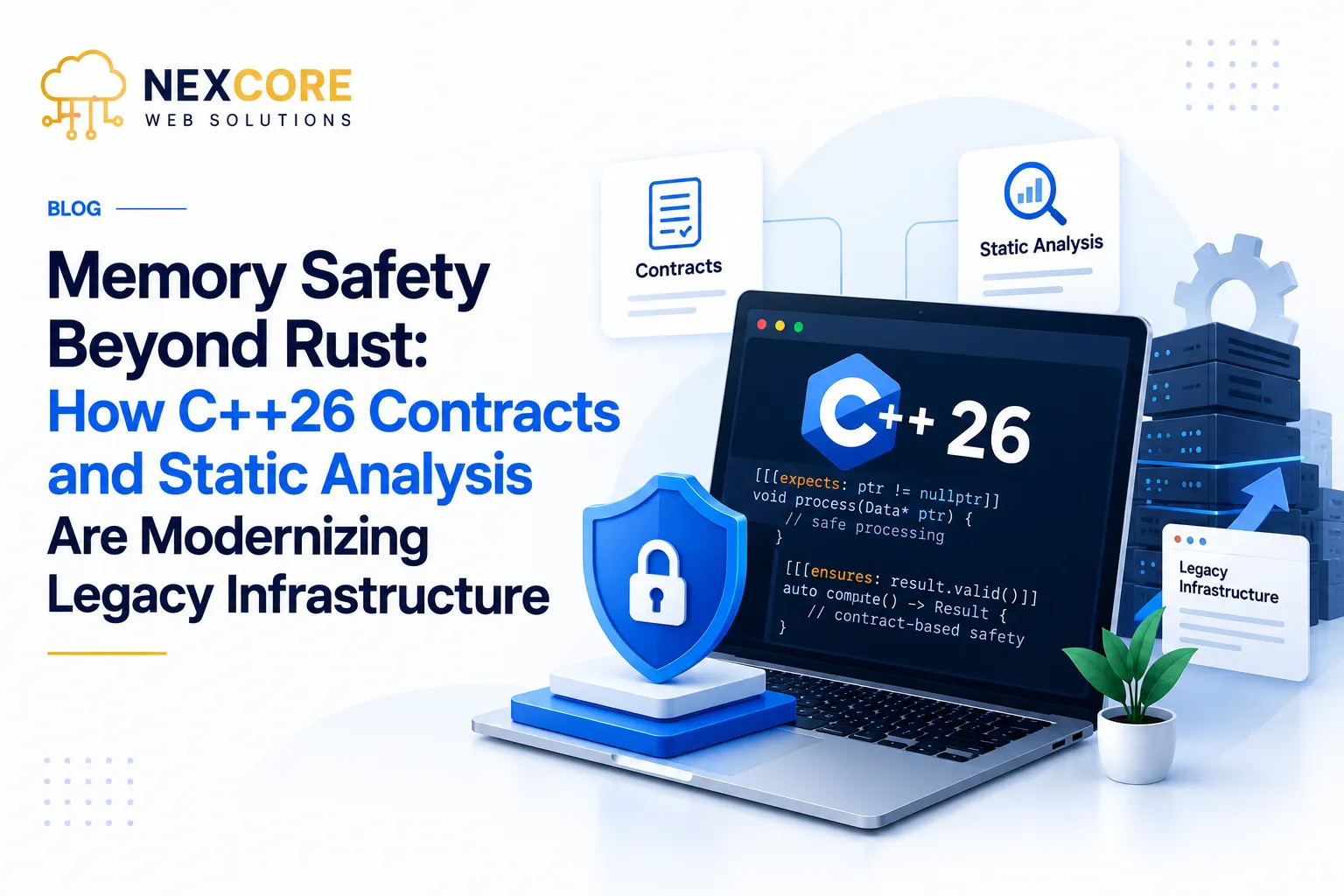
Memory safety has become a major concern for teams maintaining operating systems, databases, browsers, networking software, and other infrastructure built with C++. Languages such as Rust offer strong compile-time guarantees against many memory errors, but replacing established C++ systems can require years of engineering work and introduce migration risks. Organizations therefore need practical ways to improve existing code without rebuilding everything from scratch. C++26 contracts, modern static analysis, sanitizers, and safer programming patterns can help address this challenge. These techniques do not make C++ automatically memory-safe, but they give developers better tools to express assumptions, detect defects, and enforce important boundaries. For teams responsible for large legacy codebases, the goal is to reduce vulnerabilities incrementally while preserving performance, compatibility, and operational stability.
Why Memory Safety Matters in Legacy Infrastructure
C++ provides direct control over memory allocation, object lifetimes, pointers, and resource management. That flexibility supports high-performance software, but mistakes can lead to use-after-free errors, buffer overflows, dangling pointers, and double deletion. In infrastructure software, these defects may cause crashes, data corruption, privilege escalation, or remotely exploitable vulnerabilities. A small mistake in a shared library can affect multiple applications that depend on it.
Legacy systems make these problems harder to eliminate because their behavior may depend on undocumented assumptions and complicated ownership relationships. A database engine, for example, might share objects across threads while managing custom memory pools. Changing one ownership rule could introduce performance regressions or unexpected failures elsewhere. A gradual improvement strategy is often more realistic than a complete rewrite, particularly when the software supports critical business operations.
What C++26 Contracts Can Contribute
Expressing Preconditions and Postconditions
Contracts provide a way to describe conditions that should hold when a function is called or when it finishes executing. A precondition can state that a pointer must refer to a valid object, while a postcondition can describe a property the function must establish. These declarations make assumptions more visible to maintainers and reviewers. They can also help identify incorrect calls and clarify the intended behavior of complex APIs.
However, a contract is not a universal memory-safety mechanism. A condition that checks whether a pointer is non-null does not prove that the pointer refers to a live object or that the referenced memory is large enough. Contract behavior also depends on the language specification, implementation support, and configured evaluation semantics. Teams should verify the exact C++26 features supported by their compiler and avoid treating contracts as a substitute for sound ownership design.
Improving API Reliability
Contracts can be especially useful at boundaries between older modules and newer components. Consider a function that processes a network packet and expects a valid buffer length. Documenting and checking that expectation can expose invalid callers earlier in testing. Combined with clear parameter types and consistent error handling, contracts help turn hidden assumptions into reviewable interface rules. This improves maintainability even when a codebase cannot immediately adopt a different programming language.
Static Analysis as an Everyday Defense
Static analysis examines source code without requiring the program to execute every possible path. Modern tools can detect suspicious pointer usage, unsafe conversions, uninitialized variables, resource leaks, and violations of coding standards. Depending on the tool and configuration, analysis may also identify possible null dereferences or lifetime problems. Running these checks during development helps teams discover defects before they reach production.
The main challenge is managing findings in a large repository. Legacy projects may generate thousands of warnings, including false positives and issues that are difficult to prioritize. Teams can begin with critical modules, enable focused rules, and prevent new high-risk findings from entering the codebase. Existing warnings can then be addressed gradually according to exploitability, severity, and maintenance cost.
Integrating Analysis into CI
Static analysis is most useful when it becomes part of the normal development workflow. Pull requests can run selected checks automatically, while scheduled jobs perform deeper analysis across larger portions of the repository. Developers should receive actionable reports that identify the affected code and explain the potential problem. A baseline for existing findings helps teams measure progress without blocking every change on unrelated historical warnings.
Sanitizers and Testing Complement Static Analysis
Static analysis cannot identify every defect, especially when correctness depends on runtime inputs or complicated execution paths. Dynamic tools provide another layer of protection by observing program behavior during testing. AddressSanitizer can detect many out-of-bounds memory accesses and use-after-free errors, while UndefinedBehaviorSanitizer identifies several forms of undefined behavior. ThreadSanitizer can help find data races in supported environments, although it targets concurrency problems rather than memory safety alone.
These tools work best with realistic tests, fuzzing, and representative workloads. A network parser, for instance, can be fuzzed with malformed packets while sanitizer-enabled builds monitor memory access. Teams should run such builds in development and continuous integration environments, then investigate failures before release. Because instrumentation introduces overhead and cannot cover every execution path, clean test results reduce risk but do not prove that the program is defect-free.
Safer C++ Design Patterns for Existing Code
Tools are more effective when supported by safer design choices. The C++ Core Guidelines encourage practices such as preferring standard containers, using RAII for resource management, and expressing ownership clearly. Smart pointers can represent ownership relationships, while references and carefully designed interfaces can reduce unnecessary raw-pointer handling. Bounds-aware access methods and explicit size information also make buffer operations easier to review.
Modernization should focus on high-risk areas rather than replacing every pointer mechanically. Teams can first improve parsers, file-processing routines, authentication components, and externally exposed interfaces. Each change should include regression tests and performance measurements. This approach reduces the chance that safety improvements will disrupt established behavior or create new operational problems.
Building a Practical Modernization Roadmap
An effective program starts by inventorying the codebase and identifying components with the greatest security impact. Teams can establish compiler warnings, introduce static analysis, and enable sanitizers in suitable test environments. Next, they can define coding standards for ownership, buffer handling, error management, and contract usage. New code should follow these standards immediately, while existing modules are improved according to risk and available engineering capacity.
Progress should be measured through meaningful indicators, including high-severity findings resolved, recurring defect categories reduced, sanitizer failures fixed, and coverage of critical modules. Security reviews should confirm that changes address the underlying cause rather than merely suppressing warnings. For especially sensitive components, an independent review or targeted penetration testing can provide additional confidence. The roadmap should remain adaptable as compilers, analysis tools, and project requirements evolve.
Conclusion
C++26 contracts and modern static analysis offer useful ways to strengthen legacy infrastructure without requiring an immediate migration to Rust or another language. Contracts make function expectations more explicit, while static analysis identifies suspicious code patterns before execution. Sanitizers, fuzzing, safer ownership models, and disciplined testing provide additional defenses against memory-related defects. None of these techniques independently guarantees memory safety, and their effectiveness depends on implementation quality and consistent adoption. Infrastructure teams should begin with high-risk components, establish automated checks, and improve existing code incrementally. By combining clearer interfaces with measurable engineering practices, organizations can reduce vulnerabilities while preserving the performance and reliability their systems require.
Frequently Asked Questions
1. Do C++26 contracts make C++ memory-safe?
No. Contracts can express preconditions, postconditions, and other program expectations, but they do not automatically prevent dangling pointers, buffer overflows, or use-after-free errors. Their effectiveness depends on what conditions developers specify and how implementations evaluate them. Memory safety still requires sound ownership practices, careful API design, testing, and appropriate analysis tools. Contracts are one part of a broader defense strategy.
2. Can static analysis find every memory safety vulnerability?
No. Static analysis can identify many suspicious patterns without running the program, but complex control flow, external inputs, concurrency, and tool limitations can leave defects undetected. Some reports may also be false positives that require human review. Combining multiple analysis tools with sanitizers, fuzzing, code reviews, and realistic tests provides stronger coverage than relying on any single technique.
3. Is migrating legacy C++ code to Rust necessary?
Not always. Rust can provide strong compile-time guarantees for many memory-safety properties, but migrating a large C++ system may involve substantial cost, compatibility concerns, and integration work. Some organizations may benefit from rewriting selected high-risk components, while others can make meaningful progress through safer C++ patterns and automated analysis. The right choice depends on the system’s threat model, architecture, and long-term maintenance needs.
4. What is the difference between static analysis and sanitizers?
Static analysis examines source code without executing the program, helping identify potential defects across code paths that tests may not reach. Sanitizers instrument running programs to detect certain problems when they occur during execution. Static analysis may find suspicious patterns before testing, while sanitizers provide evidence about actual runtime behavior. Using both approaches improves defect detection, although neither guarantees that all vulnerabilities will be found.
5. How should teams start improving memory safety in a large C++ project?
Begin by identifying security-critical components and establishing a baseline of compiler warnings and static-analysis findings. Enable suitable sanitizers in test builds, add regression tests for known defects, and prioritize high-severity issues. Introduce clear ownership rules and safer interfaces for new code before expanding those practices to older modules. Track resolved findings and review results regularly to ensure that improvements are sustained.




