
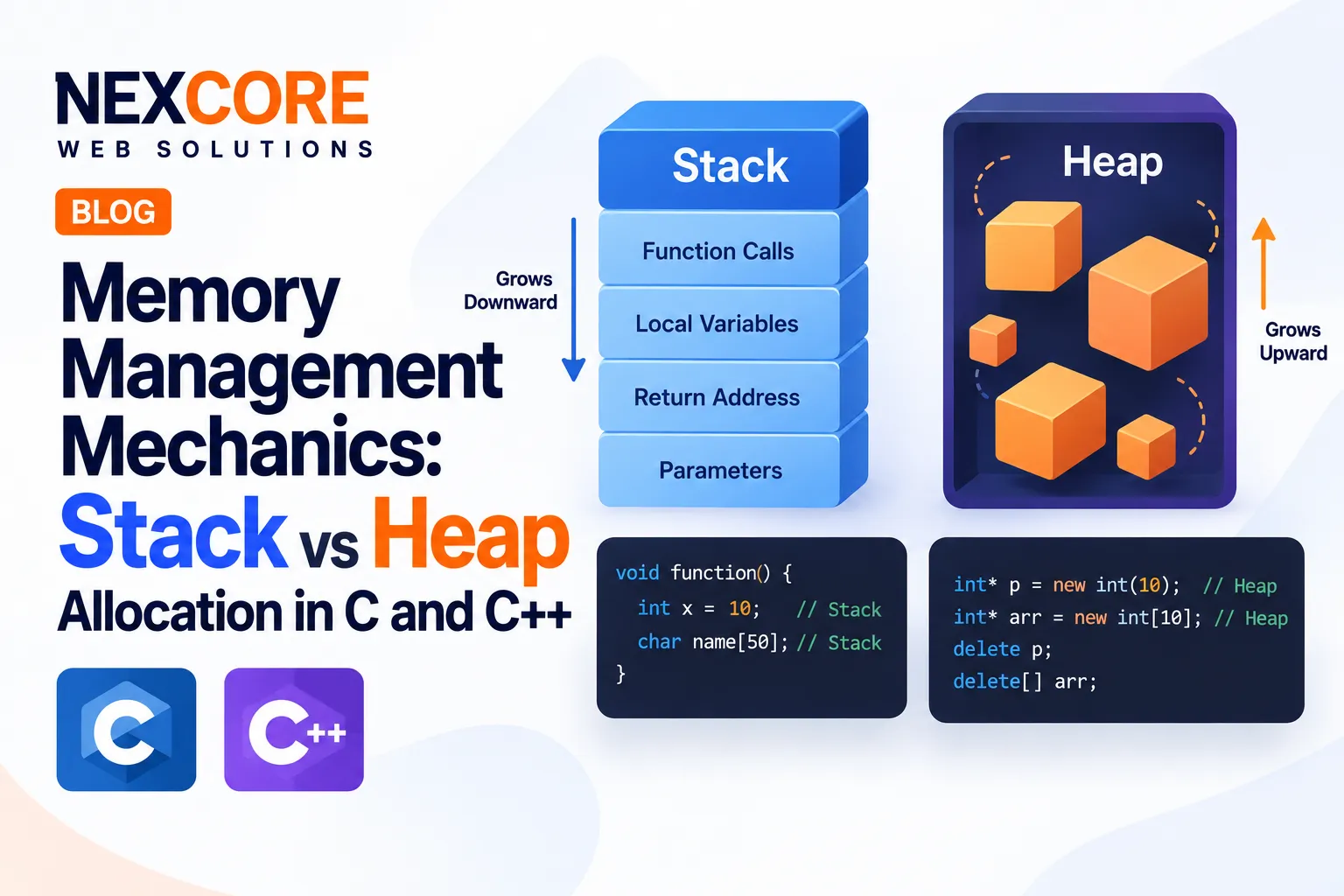
Memory management is one of the most important concepts for understanding how C and C++ programs actually work. Unlike languages with automatic garbage collection, these languages give developers significant control over how memory is created, used, and released. Two important areas programmers encounter are stack and heap memory, each serving different purposes during program execution. Understanding their behavior helps developers write efficient programs and avoid problems such as memory leaks, dangling pointers, invalid accesses, and stack overflow. The distinction also becomes important when working with functions, arrays, objects, dynamic data structures, and performance-sensitive applications. A clear understanding of allocation mechanics gives students and developers a stronger foundation for debugging and designing reliable C and C++ software.
Understanding Stack Memory
Stack memory is generally used for function calls and local variables whose lifetimes are tied to a particular scope or function execution. When a function is called, the program typically creates a stack frame containing information needed for that invocation, such as local variables and control data. When the function returns, that stack frame is automatically reclaimed. This automatic lifetime management makes stack allocation convenient and usually fast. For example, a local integer declared inside a function normally exists only while that function is executing.
Stack Allocation Example
Consider a function that declares int count = 10;. The variable has automatic storage duration and is normally associated with the function’s stack frame. You do not need to explicitly release this memory using free() or delete. However, returning a pointer or reference to such a local variable can create a dangling reference because the variable’s lifetime ends when the function returns. Stack memory is therefore convenient, but developers still need to understand object lifetime and scope.
Understanding Heap Memory
Heap memory is used for dynamic allocation when a program needs objects or storage whose lifetime is controlled explicitly or managed through C++ abstractions. In C, functions such as malloc() and calloc() can request memory from the heap, while free() releases it. In C++, traditional allocation uses new and delete, although modern C++ generally favors containers and smart pointers where appropriate. Heap allocation provides flexibility for data whose size or lifetime cannot conveniently be determined at compile time. That flexibility comes with additional management considerations.
Heap Allocation Example
Suppose a program needs an array whose size is entered by the user at runtime. In C, the program can dynamically allocate storage using malloc(), while C++ can use a dynamic allocation mechanism or, preferably, a container such as std::vector. The important distinction is that the allocated storage can remain available beyond the function that created it until it is released or its owning object is destroyed. Incorrect ownership decisions can result in leaks or invalid memory access.
Stack vs Heap: Key Differences
Stack and heap allocation differ mainly in lifetime, management, and typical usage. Stack storage is automatically managed according to scope and function execution, while dynamically allocated heap storage generally requires explicit ownership management or an abstraction that handles it. Stack allocation also tends to have lower management overhead, whereas heap allocation provides greater flexibility for dynamic-sized or long-lived objects. The actual performance characteristics depend on the compiler, runtime environment, allocation patterns, and hardware. Therefore, developers should avoid treating simple stack-versus-heap speed comparisons as universal rules.
Common Memory Management Problems
Memory errors can cause crashes, corrupted data, security vulnerabilities, and unpredictable program behavior. A memory leak occurs when dynamically allocated memory remains unreachable and cannot be properly released. A dangling pointer occurs when a pointer refers to memory whose lifetime has already ended, such as a local variable that has gone out of scope. Double-free errors happen when the same dynamically allocated memory is released more than once. Buffer overflows can also occur when code accesses memory beyond an object’s valid boundaries.
Preventing Memory Errors
Good ownership practices are essential for safe memory management. In C, developers should pair successful allocations with appropriate free() operations and carefully track ownership. In modern C++, RAII allows resources to be tied to object lifetimes, while smart pointers such as std::unique_ptr and std::shared_ptr can automate important ownership responsibilities. Standard containers such as std::vector and std::string can also eliminate many manual allocation tasks. Developers should use tools such as compiler warnings, sanitizers, and debugging tools to detect memory-related problems during development.
When Should You Use Stack or Heap?
The choice should be based on lifetime, size, ownership, and program requirements rather than a simple preference. Small local values with straightforward lifetimes are commonly suitable for automatic storage. Dynamic allocation becomes useful when storage must survive beyond a local scope, when runtime-sized data is required, or when a data structure naturally grows and shrinks. In modern C++, standard containers should usually be considered before manually managing raw memory. Understanding the underlying heap mechanics remains important even when higher-level abstractions handle allocation internally.
Conclusion
Stack and heap memory represent two fundamental approaches to managing storage in C and C++. Stack allocation is convenient for local objects with predictable lifetimes, while heap allocation provides flexibility for dynamically sized or longer-lived data. The biggest practical difference is not simply where memory resides, but how its lifetime and ownership are managed. C programmers need to carefully coordinate allocation and release, while modern C++ developers can rely heavily on RAII, containers, and smart pointers to reduce manual memory management. Learning these mechanics helps explain common crashes, leaks, and pointer errors. For students, the best approach is to practice small programs that demonstrate scope, allocation, ownership, and object lifetime before working with complex systems.
FAQs
1. What is the difference between stack and heap memory in C and C++?
Stack memory is typically associated with automatic variables and function execution, while heap memory is used for dynamically allocated storage. Stack objects are generally reclaimed automatically when their scope or function lifetime ends. Heap objects can remain alive until they are explicitly released or managed by an ownership abstraction. The exact implementation details are language and platform dependent, but this distinction is fundamental to understanding memory management.
2. Is stack memory faster than heap memory?
Stack allocation often has lower overhead than general-purpose heap allocation because stack storage follows a structured lifetime model. However, it is inaccurate to say that every stack access is always faster than every heap access. Performance depends on factors such as allocation patterns, caching, compiler optimization, and the allocator implementation. Developers should prioritize correct lifetimes and ownership before making performance decisions based solely on allocation location.
3. What causes a memory leak in C and C++?
A memory leak occurs when dynamically allocated memory is no longer needed but remains allocated because the program has lost the ability to release it. In C, this commonly happens when a pointer to allocated memory is overwritten or lost before free() is called. In C++, RAII, containers, and smart pointers can greatly reduce this risk. Careful ownership design is the most effective prevention strategy.
4. Why are smart pointers useful in modern C++?
Smart pointers provide automatic ownership management for dynamically allocated objects. std::unique_ptr represents exclusive ownership and automatically releases its object when the owner is destroyed, while std::shared_ptr supports shared ownership through reference counting. They work with RAII and help reduce manual delete operations. Developers should still understand ownership semantics because choosing the wrong smart pointer can create unnecessary complexity or lifetime problems.
5. Can stack memory cause a program to crash?
Yes, excessive stack usage can cause stack overflow and terminate a program. This can happen with extremely large local arrays, deeply nested function calls, or uncontrolled recursion. Stack size is limited and depends on the execution environment. Moving suitable large or dynamically sized data to managed dynamic storage can help, but developers should first understand why the stack usage is growing and address the underlying design problem.




