
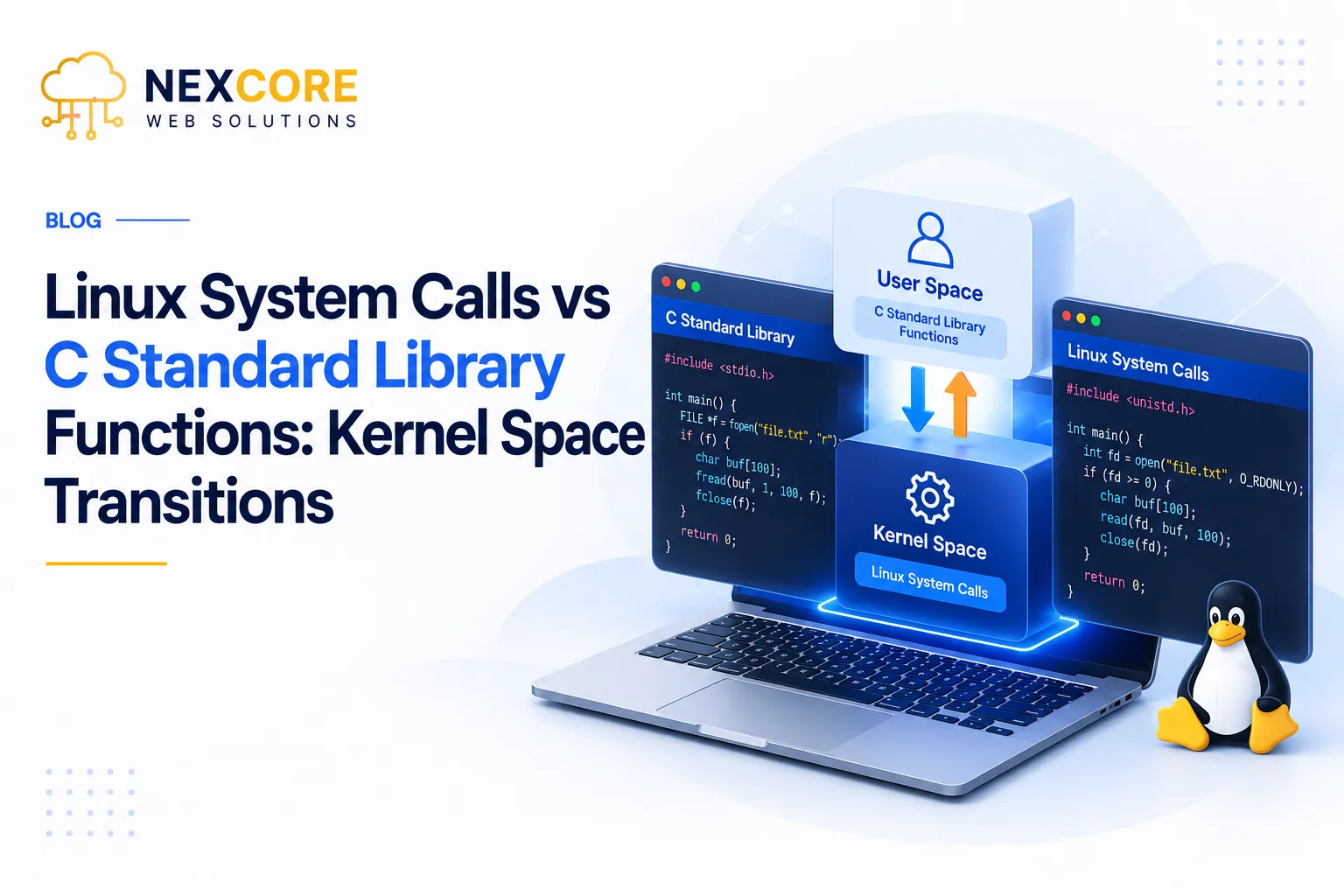
Linux applications rely on several layers of software to perform tasks such as reading files, allocating memory, creating processes, and communicating with devices. Two concepts that often appear together are Linux system calls and C standard library functions, but they are not the same thing. A system call provides a controlled interface through which a user-space program requests a service from the Linux kernel. A C library function may use a system call internally, implement functionality entirely in user space, or combine several operations. Understanding this distinction helps developers write more efficient programs and makes operating system concepts easier to understand. It also explains why a simple function such as printf() can involve significantly more work than its source code appears to show.
Understanding User Space and Kernel Space
Modern Linux systems separate applications from the kernel using privilege boundaries. User-space programs normally cannot directly access protected hardware, kernel memory, or privileged processor operations. Instead, they request operating system services through controlled interfaces. This separation improves system stability and security because an application cannot freely modify resources belonging to the entire operating system.
What Happens During a System Call?
When a program makes a system call, execution transitions from user mode into kernel mode through a processor-supported mechanism. The application supplies arguments and identifies the requested operation, after which the kernel validates the request and performs the required work. Once the operation finishes, control returns to user space with a result or error indication. This transition has overhead because the processor must change execution context and the kernel must perform security and argument checks.
What Are Linux System Calls?
Linux system calls are low-level interfaces exposed by the kernel for essential operating system services. Examples include read(), write(), openat(), close(), fork(), execve(), and mmap(). A program can invoke these interfaces directly, although most applications use higher-level libraries instead. System calls are particularly important when an application needs direct access to kernel-managed resources.
Consider reading data from a file. A program may eventually need the kernel’s file-reading functionality, but the application does not directly access the storage device. Instead, a system call communicates the request to the kernel, which handles permissions, filesystem operations, buffering, and device interaction. The kernel then returns the requested data or an error.
What Are C Standard Library Functions?
The C standard library provides reusable functions designed to make common programming tasks easier. Functions such as printf(), fopen(), fread(), malloc(), and memcpy() provide interfaces that are generally more convenient than directly working with operating system primitives. Some library functions are purely user-space implementations, while others eventually rely on operating system facilities. Therefore, calling a C library function does not automatically mean that a kernel transition occurs.
Library Functions Can Add Abstraction
For example, fopen() provides a convenient stream-based interface for opening files, while lower-level operations eventually interact with operating system file descriptors. Similarly, fread() can work with buffering maintained by the C library, potentially reducing the number of kernel calls required for repeated reads. This abstraction can improve programming simplicity and sometimes performance. Developers should understand that the library may perform additional work before or after a system call.
System Calls vs Library Functions
The main difference is their position in the software stack. A system call crosses the user-kernel boundary and requests a service directly from the operating system. A C library function operates at a higher abstraction level and may never enter the kernel. When a library function does require operating system support, it can invoke one or more system calls on behalf of the application.
A Simple Example
Suppose a program needs to write text to a terminal. Calling printf() first involves C library processing, including formatting the supplied arguments. Depending on buffering behavior, the resulting data may later be passed toward a lower-level output operation. A direct write() system call, by contrast, asks the kernel to write a specified number of bytes to a file descriptor. The two interfaces can therefore produce similar visible output while involving different layers of processing.
Why Kernel Transitions Have a Cost
A system call is more expensive than an ordinary function call because it crosses a protection boundary. The processor changes privilege level, the kernel establishes the required execution context, and arguments must be checked before privileged operations occur. Modern processors and operating systems optimize these transitions heavily, so an individual call is usually fast. However, applications that perform extremely large numbers of small system calls can experience noticeable overhead.
Reducing Unnecessary System Calls
Buffering is one common technique for reducing kernel transitions. Instead of writing every character separately, a library can accumulate data in user-space memory and issue fewer larger writes. Network applications can use batching techniques, while file-processing applications can read meaningful blocks rather than repeatedly requesting tiny amounts of data. The correct strategy depends on workload characteristics, because excessive buffering can increase memory usage or latency.
Choosing the Right Interface
Most application developers should prefer appropriate C library abstractions unless there is a specific reason to work at the system-call level. Library functions generally provide simpler interfaces, portability benefits, buffering, formatting, and error-handling conveniences. Direct system calls can be useful for operating-system programming, performance-sensitive workloads, specialized Linux features, and educational experiments. Developers should also verify the actual implementation and behavior rather than assuming that every library function maps directly to one system call.
Debugging Kernel Interactions
Tools such as strace can help developers observe system calls made by a Linux process. Running an application under tracing can reveal operations such as file access, process creation, memory mapping, and network communication. This is valuable when diagnosing unexpected filesystem activity or understanding why an application performs many kernel transitions. Profiling should be combined with application-level measurements because system-call counts alone do not explain total performance.
Conclusion
Linux system calls and C standard library functions operate at different levels of the software stack. System calls provide controlled entry points into kernel services, while library functions provide higher-level interfaces that may implement functionality in user space or invoke one or more system calls. Understanding the distinction makes it easier to reason about file I/O, process management, memory operations, buffering, and performance. Kernel transitions are necessary for many privileged operations, but unnecessary or overly frequent calls can create measurable overhead in demanding workloads. By choosing suitable abstractions, using buffering where appropriate, and tracing actual behavior when debugging, developers can build Linux applications that are easier to understand and optimize.
FAQs
1. What is a Linux system call?
A Linux system call is an interface that allows a user-space program to request a service from the kernel. Examples include operations for reading files, writing data, creating processes, and mapping memory. The processor switches into a privileged execution mode during the transition, allowing the kernel to perform operations that ordinary applications cannot access directly.
2. Is every C library function a system call?
No. Many C library functions execute entirely in user space and do not require a kernel transition. Others may call one or more operating system interfaces internally. For example, formatting functions can perform substantial processing without entering the kernel, while file-related functions may eventually use system calls to access kernel-managed resources.
3. Why use C library functions instead of direct system calls?
C library functions usually provide more convenient and portable interfaces. They can offer buffering, formatting, memory management, error handling, and other abstractions that reduce application complexity. Direct system calls can be appropriate when Linux-specific behavior or low-level control is required, but using them unnecessarily can make programs harder to maintain and less portable.
4. Why are system calls more expensive than normal function calls?
System calls cross the boundary between user space and kernel space, requiring a controlled privilege transition and additional validation. The kernel must safely process arguments and perform operations on protected resources. Modern systems optimize this process, but repeated small system calls can still create noticeable overhead. Batching and buffering can reduce unnecessary transitions in suitable workloads.
5. How can developers see which system calls a program makes?
On Linux, developers can use tracing tools such as strace to observe system calls performed by a process. The output can show operations involving files, processes, memory, networking, and other kernel services. This information is useful for debugging and performance investigation because it reveals actual kernel interactions rather than relying only on assumptions about how library functions work.




